Ingrown Toenails — The Complete Clinical Masterclass
An illustrated procedural atlas with troubleshooting for complications and recurrence. Practise assessment, conservative care, partial nail avulsion and appropriate matrix treatment.
6 hours 36 minutes estimated learning time
$195.00 AUD
Purchase courseLearning outcomes
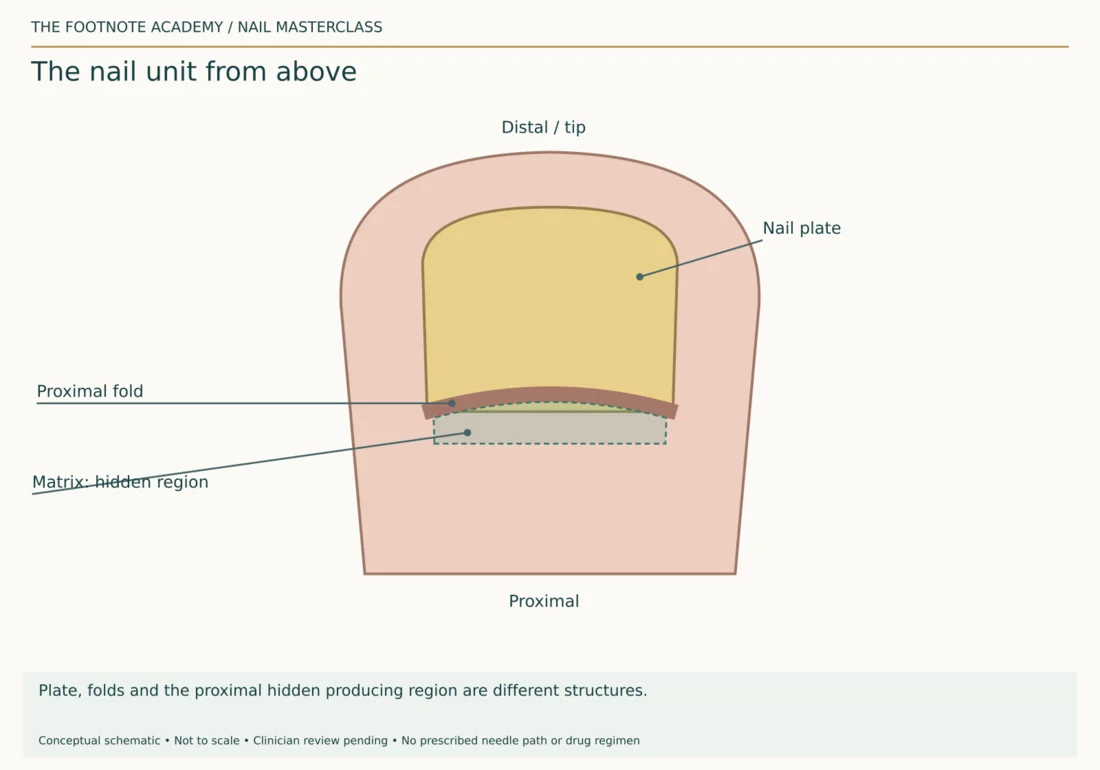
- Identify the nail-producing matrix and the structures endangered during intervention.
- Explain regrowth without confusing plate removal with matrix destruction.
- Describe the actual nail–fold relationship before choosing treatment.
- Distinguish an intact offending margin from a pointed spicule and a recurrent matrix fragment.
- Integrate pathology, infection, perfusion and patient goals.
- Distinguish immediate source control from recurrence prevention and specialist reconstruction.
- Distinguish local inflammation, local infection and spreading/systemic infection.
- Explain source control without denying antibiotic indications or high-risk exceptions.
- Relate proximal block placement to digital nerve anatomy.
- Confirm adequate anaesthesia and recognise incomplete block, toxicity and escalation requirements.
- Plan temporary source control with informed consent and preserved matrix.
- Inspect for retained fragments and explain regrowth and review.
- Match matrix treatment to the patient's recurrence-prevention objective.
- Compare tissue injury, healing and uncertainty across chemical and surgical approaches.
- Recognise recurrent matrix and soft-tissue causes of treatment failure.
- Explain wedge resection and alternative specialist procedures without implying universal superiority.
- Explain each procedural stage's anatomical objective, technical error and safety checkpoint.
- Recognise when the planned office procedure must stop or change.
- Distinguish expected recovery from infection, ischaemia and delayed healing.
- Provide procedure-specific patient instructions and a usable safety net.
- Investigate procedural difficulties rather than repeating the same intervention.
- Recognise emergencies and define assessment, management, escalation and prevention.
- Commit to a reasoned decision and revise management when findings change.
- Justify alternatives without turning every presentation into a surgical indication.
Course outline
- The nail unit: anatomy that actually matters
- Nail plate, folds, sulcus and matrix
- Blood supply, innervation and growth
- Perfusion before elective tissue injury
- Not all ingrown toenails are the same
- Offending edge, true spicule and recurrent fragment
- Mild distal-edge pain: a small treatment done properly
- Severity, morphology and diagnostic alternatives
- Calling it a spicule does not make it one
- Pincer morphology without an automatic infection diagnosis
- A painful corner, not an automatic operation
- The complete treatment algorithm
- Assess the patient, not just the nail
- Footwear, taping, guttering and bracing: choose what fits
- Conservative, temporary, permanent or referral?
- A first episode that does not need an operation by default
- Infection, antibiotics and source control
- The glass in the arm
- When infection changes the plan
- The teenager, the antibiotics and the retained mechanical problem
- Local paronychia is not the same as spreading infection
- When the problem extends beyond the nail fold
- Digital anaesthesia: the ring block masterclass
- Proximal ring block: anatomy and preparation
- Test the block, troubleshoot and stop safely
- The block that has not reached the operative field
- The block is incomplete
- Anxious children and traumatised patients
- Honest preparation, consent, assent and a workable stopping plan
- The anxious eight-year-old
- The teenager after a traumatic injection
- When a parent amplifies the anxiety
- “Please don't describe each step”
- The child withdraws cooperation
- Partial nail avulsion without matricectomy
- Preparation, consent and controlled removal
- Inspect, dress, review and explain regrowth
- A true retained nail fragment
- Regrowth after temporary PNA
- Phenol and other matrix treatments
- What exactly are you trying to achieve?
- Phenol, alternatives and evidence limitations
- The narrow strip after phenol
- Definitive surgical management
- Recurrence is a diagnostic problem
- The patient returning twenty-five years after phenol
- Wedge resection, matrix excision and soft-tissue surgery
- When the soft tissue is the main anatomical problem
- When another repeat procedure is not the whole answer
- A painful strip twenty-five years after phenol
- The complete illustrated procedural atlas
- From preoperative assessment to anaesthesia confirmation
- From controlled separation to postoperative monitoring
- Postoperative care and healing
- Expected recovery is procedure-specific
- Pain, drainage, delayed healing and safety-netting
- Diabetes, neuropathy and an unreliable pain signal
- The troubleshooting masterclass
- Anaesthetic and procedural troubleshooting
- Infection, healing, recurrence and complex patients
- Persistent pain after nail removal
- Clinical decision laboratory
- Clinical consultations and searchable practical pearls
- Integrating uncertainty, preference and referral