Author attribution not recorded
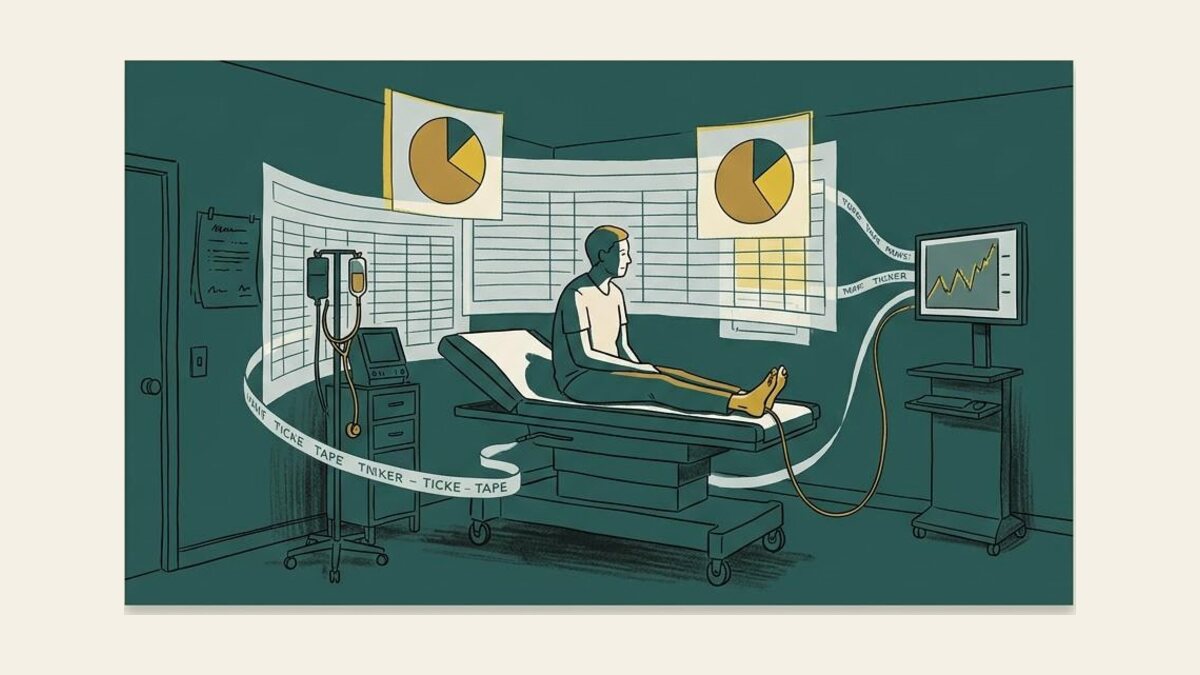
Or: why your podiatrist now needs a CFO, a KPI dashboard, and a bottle of antacid before touching your toes.
Scene-setting: the day the shareholders walked into the consultation room
Picture a typical Monday morning clinic. Once upon a time it was just you, a stethoscope (or doppler, or goniometer) and the sacred covenant of clinician–patient trust. Now there’s an invisible entourage: private-equity analysts demanding “throughput”, marketing teams A/B-testing your empathy, and a Chief Revenue Officer who thinks “SOAP” is something to wash churn off the balance sheet.
That uneasy feeling isn’t just nostalgia. It’s corporatisation in full swing, rearranging health care the way a bull rearranges crockery. In Australia more than one in six GPs now work in corporate-owned practices; ownership by doctors has fallen from 35 % in 2008 to 25 % in 2020. (1) By 2020 two multinationals controlled over 400 medical centres, their mission statements pledging “patient-centred excellence” while quarterly reports whispered “earnings before interest, tax and humanity”.
Meet the middlemen: brilliantly unproductive, magnificently expensive
If medicine were a jungle, the apex predators would no longer be disease but intermediaries: management companies, franchise chains, venture-backed roll-ups, “practice accelerators”, plan managers, support coordinators and assorted subscription platforms that bill 15 % for the privilege of sending you your own invoices.
Within Australia’s National Disability Insurance Scheme (NDIS) these players hoover up more than AUD 1 billion every year, (3) clipping fees that could buy thousands of hours of therapy, prosthetics or—heaven forbid—podiatry consults. Even the scheme’s Annual Pricing Review concedes the gravy train must slow: plan-management set-up fees are being axed and travel claims trimmed precisely because the system is haemorrhaging cash to bureaucratic ballast. (4)
GP land: when the waiting room became the boardroom
Corporate chains promised longer hours and convenience. What patients often got was “Uber-GP”: high volume, variable continuity and a revolving door of clinicians scored on productivity metrics. Bulk-billing evaporated the moment the Medicare rebate freeze threatened margins, proving that the first loyalty is to spreadsheets, not communities.
A UK study analysing just over 903,000 patient responses from 7,949 practices found that limited-company (corporatised) clinics scored lower on several key satisfaction domains, including continuity and doctor communication. (2) Australian surveys echo those findings.
Allied health: therapy by KPI (keep profits increasing)
Allied health should be the Switzerland of the health system—neutral, holistic, quietly competent. Enter private equity. Physiotherapy chains now cross-sell Pilates, dietetics and telehealth packages like they’re gym memberships. Psychology groups upsell six-session “resilience bootcamps” bundled with mindfulness apps (annual subscription auto-renews, of course). Podiatry sees conglomerates offering “free foot checks” that somehow culminate in orthotics, shockwave and a line of branded creams.
Clinical autonomy bends; the patient journey becomes a funnel; and new graduates learn that the real diagnosis code is $.
The French exception: liberté, égalité, no-fee-splitté
Think corporatisation is inevitable? Ooh-la-la, non! France has long treated medicine as a vocation, not a business line. Article R4127-19 of the Code de la santé publique states bluntly: La médecine ne doit pas être pratiquée comme un commerce—medicine must not be practised as commerce. Article R4127-22 adds: Tout partage d’honoraires entre médecins est interdit—fee-splitting is forbidden. (5,6)
Corporate structures can exist (Société d’Exercice Libéral), but doctors must hold the majority of shares and voting rights, and any non-physician investor is walled off from influencing clinical decisions or siphoning fees. You may profit with clinicians, but you may not profit off them. Try skimming 15 % for “practice management services” and you’ll meet l’Ordre des Médecins faster than you can say maladie.
The domino-effect of corporatisation, symptom by symptom
Consultation length collapses to hit volume targets, turning every appointment into a brisk “one problem per visit, love.”
Continuity of care splinters across a merry-go-round of locums, so patients re-tell their story half a dozen times and the risk of misdiagnosis doubles.
Out-of-pocket costs rise as bulk-billing dries up, pushing people to delay care—and complications inevitably surge.
Clinician wellbeing nosedives into burnout and moral injury, fuelling a workforce exodus that lengthens waiting lists.
System spending balloons with layers of administrative overhead, driving Medicare and NDIS budgets to breaking point.
Evidence includes rising practice fees after corporates adopted mixed billing, lower patient satisfaction scores, surging NDIS intermediary costs and a 2021 MJA narrative review warning that shareholder duty can trump patient duty. (1–4)
A day in the life of Dr Dividend
08 : 00 – Morning huddle. Regional manager reminds staff that “care minutes” must not exceed 12 min per patient.
10 : 15 – “Pods-per-visit” KPI slipping; reception instructed to double-book.
13 : 00 – Lunch-and-learn on latest “orthotic optimisation pathway”, sponsored by corporate partner.
15 : 40 – Support coordinator requests yet another case conference (billable, naturally) to discuss the case conference scheduled for next week.
16 : 55 – Finance ping: “Clinician utilisation down 3 %. Please review upsell scripts.”
18 : 10 – Doctor wonders if it’s too late to train as a barista.
Follow the money: how value is extracted, not created
Roll-ups & multiples – Buy small clinics at 4× EBITDA, bundle, flog to bigger fund at 8×. No new health outcomes created, but champagne all round.
Ancillary arbitrage – Own the pathology, imaging and pharmacy next door. Patient flow = captive revenue.
Franchising – Clinicians pay licence fees, marketing levies and IT subscriptions… for the privilege of doing their own job.
Vertical integration – Corporate buys insurer, clinic and software, then “optimises” claims (translation: denies them).
Meanwhile clinical outcomes flatline, clinician autonomy dissolves, and taxpayers foot the bill.
Burnout, brain-drain and the curious case of the vanishing GP
Ask any junior doctor why they’re eyeing dermatology, radiology or emigration to New Zealand: it’s not just money, it’s meaning. When every decision is second-guessed by an algorithm chasing incremental revenue, professionalism becomes performative. Federal modelling projects a shortfall of 5,560 full-time-equivalent GPs by 2033 and nearly 9000 by 2048. (7) Corporatisation pours kerosene on that bonfire of morale.
Solutions: reclaiming clinical sovereignty
a. Legislated safeguards – Australia could borrow from France: majority clinician ownership; explicit bans on fee-splitting beyond cost recovery; mandatory disclosure of investor interests.
b. Payment reform – Reward outcomes, not throughput. Bundled care or capitation makes volume-hunting less attractive.
c. Transparency – Publish clinic ownership, management fees and KPI structures so patients know who pulls the strings.
d. Professional backbone – Colleges and boards must treat predatory contracts as ethical breaches. Silence is complicity, not neutrality.
e. Patient power – Vote with your feet. Ask your provider, “Who actually owns this place?” and watch the receptionist’s eyebrows dance.
A standing ovation for the productive clinician
Every unnecessary intermediary siphons oxygen from the people who stitch wounds, fit orthotics, rehabilitate ankles and keep diabetics walking. Imagine rerouting even half of that billion dollars in NDIS plan-management fees into frontline therapy—pressure-ulcer rates would plummet faster than a corporate share price in a pandemic.
Closing prescription: less Wall Street, more Well Street
Health care flourishes when clinicians call the shots and the only bottom line is patient well-being. Corporatisation will keep testing that principle, stretching it like Silly Putty until legislatures, professions and the public snap it back.
So here’s your take-home: medicine is not a commodity, clinicians are not cost centres, and the best ROI in health isn’t Return on Investment—it’s Return on Integrity.
References
Royal Australian College of General Practitioners. General Practice: Health of the Nation 2021 – Corporate versus doctor ownership. East Melbourne: RACGP; 2021.
Kontopantelis E, et al. Patients’ satisfaction and the organisational ownership of general practices in England. Pulse Today. 2017 Nov 3.
Fitzpatrick J. NDIS spends $1 bn-plus on fees for middlemen managers. The Australian. 2025 Mar 24.
National Disability Insurance Agency. Annual Pricing Review 2024-25 – Outcomes Summary. Canberra: NDIA; 2025 Jul 1.
France. Code de la santé publique, art R4127-19 (2019).
France. Code de la santé publique, art R4127-22 (2019).
Department of Health and Aged Care. Supply and Demand Study: General Practitioners in Australia, 2024 Summary. Canberra: DoHAC; 2024.
Footnote from The Footnote Feel the corporate squeeze? Share your story, add your voice, and—if you’re an allied-health rebel with a spare 20 minutes—pen a guest column. Let’s send the middlemen a message: clinical practice is not their personal ATM.