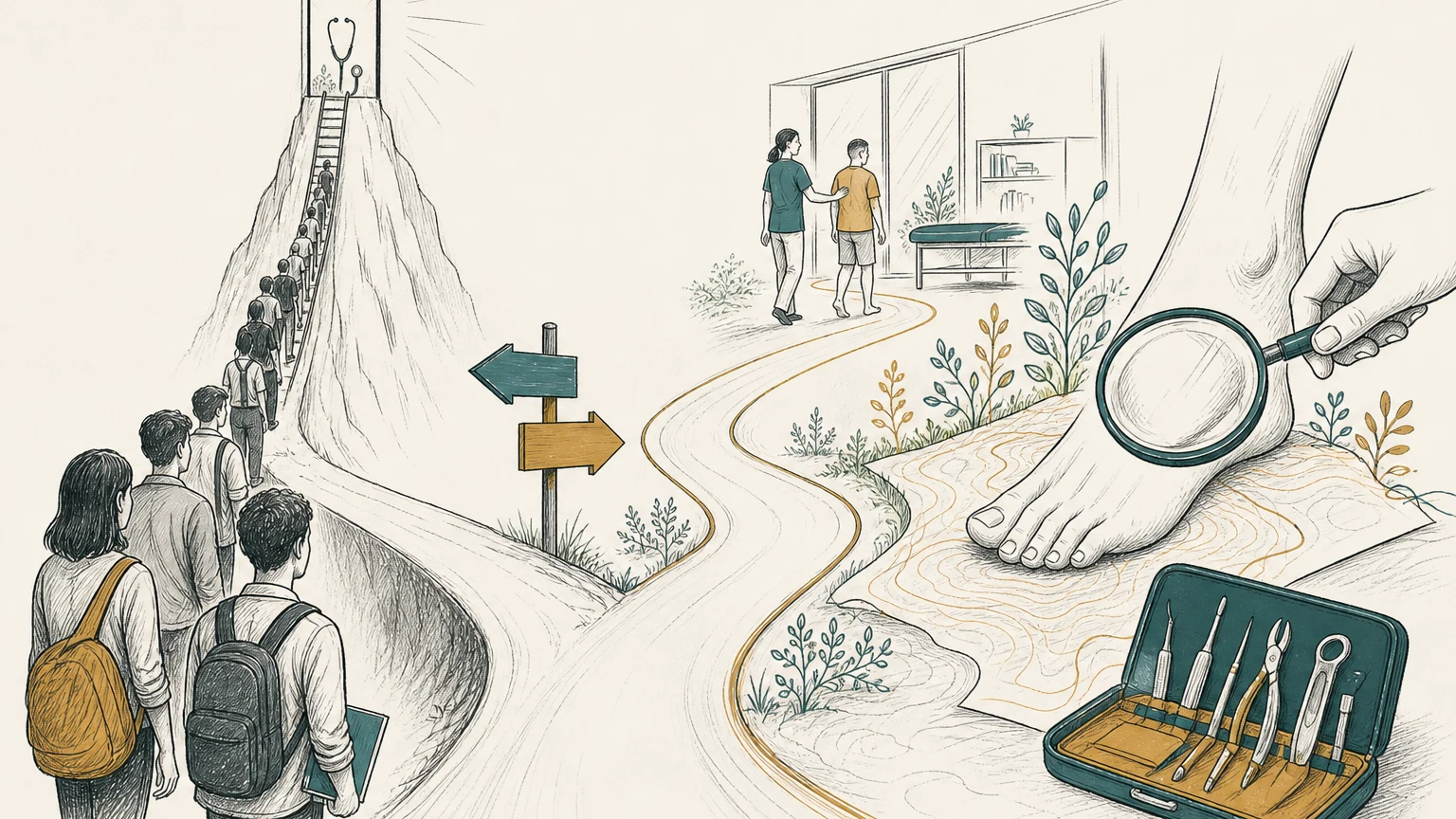
Every year, thousands of ambitious young Australians announce that they want to become doctors. Their parents are delighted. Their grandparents are practically organising the graduation photographs. Somewhere, a family friend is already introducing them as the future surgeon of the family.
And then the ATAR arrives.
Medicine is extraordinarily competitive. There are far more capable, intelligent and motivated applicants than there are places available. Plenty of students who would make excellent doctors will never get the opportunity. Not because they lack the intelligence, compassion or aptitude, but because the admissions process is designed to select a relatively small number of people from an enormous pool.
What happens to everyone else?
Some try again. Some spend years chasing postgraduate entry. Some reluctantly choose another profession while quietly carrying around the idea that they somehow fell short.
I'd like to suggest something that might save a few people an enormous amount of disappointment, not to mention several years of their lives.
Have you considered becoming a podiatrist?
I can already hear the response.
"A foot doctor?"
Yes. A foot doctor. Although, depending on your qualifications, jurisdiction and professional title requirements, the terminology needs a little care. We're registered healthcare practitioners specialising in the assessment, diagnosis and treatment of conditions affecting the foot and lower limb.
And before you dismiss the idea because you don't particularly fancy looking at toenails for the next forty years, allow me to explain what we actually do.
The human foot is an extraordinary piece of engineering. Twenty-six bones, thirty-three joints, a bewildering collection of muscles, tendons, ligaments, nerves and blood vessels, all somehow coordinating to keep an occasionally rather ungrateful human being upright.
It absorbs enormous forces, adapts to uneven terrain, propels us forward, maintains balance and generally gets on with the job despite being squeezed into footwear that appears to have been designed by someone with a personal grievance against anatomy.
When something goes wrong, the consequences can be devastating.
A painful joint can take away someone's ability to exercise. A tendon injury can end an athlete's season. Peripheral neuropathy can leave a person unaware that they've developed a serious wound. Poor circulation can threaten a limb. A seemingly insignificant skin lesion can make every step miserable.
And that's where we come in.
Podiatrists diagnose and manage musculoskeletal injuries, arthritis, tendon disorders, nerve entrapments, skin diseases, nail conditions, foot deformities, diabetic complications, vascular problems and a considerable number of other conditions.
We examine patients, formulate differential diagnoses, request and interpret medical imaging, perform procedures, manage wounds, prescribe orthotic devices, develop rehabilitation programs and coordinate care with other healthcare professionals.
Some podiatrists develop particular expertise in sports medicine. Others work in high-risk diabetic foot services, where preventing an amputation is a very real part of the job. Some focus on paediatrics, biomechanics, rheumatology or complex musculoskeletal pathology. Podiatrists with the appropriate endorsement can prescribe specified scheduled medicines, and those who complete extensive additional specialist training in podiatric surgery can undertake reconstructive foot and ankle operations.
It's a profession with considerable clinical breadth, even though our anatomical territory is relatively small.
And yes, we also treat toenails.
I have never understood why that particular aspect of the profession is considered so amusing. Nobody dismisses a dermatologist because they occasionally remove a wart. Nobody questions the intellectual credentials of a gastroenterologist because they've devoted their professional life to examining the digestive tract. Yet mention that you work with feet and people suddenly behave as though you've announced a peculiar personal fetish.
The reality is that podiatry offers many of the things that attract people to medicine in the first place.
You study anatomy, physiology, pathology, pharmacology, biomechanics and clinical medicine. You learn to recognise disease, interpret investigations, make diagnoses and develop treatment plans. You work directly with patients, apply scientific reasoning and make decisions that can substantially improve someone's life.
Most importantly, you get to do something useful.
And you get to do it without necessarily sacrificing the better part of your twenties and thirties to an extraordinarily demanding medical training system.
This is where I think podiatry deserves far more attention from students and, particularly, their parents.
Becoming a medical specialist in Australia can involve an undergraduate degree, a postgraduate medical degree, internship, residency and several further years of specialty training. Depending on the pathway, it can take well over a decade before someone completes their training. There are examinations, competitive applications, rotations, overnight shifts, weekends and years of professional uncertainty.
It's an enormous commitment, and one that deserves respect.
Podiatry offers a different proposition.
In Australia, there are undergraduate podiatry degrees, generally completed over four years, and graduate-entry Doctor of Podiatric Medicine programs for students who have already completed an appropriate bachelor's degree. Entry requirements vary between universities, and students should check the current prerequisites and admission criteria.
Universities offering podiatry pathways include Charles Sturt, Western Sydney, Newcastle, Queensland University of Technology, Central Queensland, La Trobe, Adelaide University, Monash and the University of Western Australia.
The degree isn't simply four years of learning how to cut toenails. Students undertake biomedical sciences, clinical assessment, lower-limb anatomy, pathology, pharmacology, biomechanics and supervised clinical training. They learn to examine patients, recognise disease, interpret clinical findings and develop evidence-based management plans.
Once you've completed an approved qualification and met the registration requirements of the Podiatry Board of Australia, you can enter the workforce as a registered podiatrist.
You don't need to spend another six years competing for a specialist training position before you're allowed to have a meaningful clinical career.
And here's another important consideration.
Podiatry is generally more accessible academically than medicine. That doesn't make the profession intellectually inferior. It means the admissions threshold is different.9
We need to stop confusing the difficulty of gaining admission to a university course with the value of the profession that follows.
Medicine is highly competitive because demand for places substantially exceeds supply. That doesn't mean every medical student is inherently more capable than every podiatry student, physiotherapy student or nurse.
The admissions system measures suitability against a particular set of selection criteria. It isn't a universal ranking of human intelligence or professional worth.
A student who misses out on medicine may be exceptionally well suited to podiatry. Indeed, someone who enjoys anatomy, problem-solving, practical procedures and direct patient care might discover that podiatry is a considerably better fit.
Now, we should probably discuss the elephant in the room.
Money.
Medical doctors, particularly established specialists, can earn substantially more than podiatrists. I'm not going to pretend otherwise. If your principal ambition in life is to accumulate the largest possible income, there are medical specialties that will comfortably outperform podiatry.
But I'd encourage young people to consider a rather important distinction.
Earning more money and having a better life are not necessarily the same thing.
A medical specialist might earn several hundred thousand dollars a year, sometimes considerably more. But reaching that position may require many years of training, substantial professional sacrifices and a working life that includes long hours, overnight calls, weekends and considerable responsibility.
Not every doctor works those hours, of course. There are medical careers with excellent work-life balance. But many doctors work extraordinarily hard for their income, particularly during training.
Podiatry, by comparison, is predominantly a daytime profession.
Most private-practice podiatrists work something resembling ordinary business hours, Monday to Friday. There are exceptions, particularly in hospitals, high-risk services and practice ownership, but overnight emergencies and weekend rosters are not generally part of routine private podiatry.
Imagine that for a moment.
You can work in clinical healthcare, diagnose and treat patients, earn a professional income, build a career, and still have a reasonable expectation of being home for dinner.
What an outrageous concept.
And the income itself shouldn't be dismissed.
Podiatrists can earn a very respectable living. Salaries vary considerably depending on experience, location, employment arrangements and clinical workload. Public-sector positions offer structured remuneration, while private practice can provide opportunities for percentage-based earnings, professional autonomy and eventually business ownership.
An experienced podiatrist with a well-established patient base can earn a strong professional income. Practice owners may earn more, although they also take on the financial risks, administration and responsibilities of running a business.
There are no guarantees of a six-figure salary immediately after graduation, and not every employment arrangement is equally rewarding. Like any profession, there are poorly paid positions, demanding workplaces and employers who have rather creative interpretations of what constitutes a reasonable workload.
But the opportunity to build a financially comfortable life is very real.
And this brings me to something I think we do a particularly poor job of teaching young people.
Money has diminishing returns.
The first substantial increases in income can transform your life. They allow you to pay your bills without anxiety, buy a home, support a family, travel, pursue interests and establish financial security.
Those things matter enormously.
But once you've reached a level of financial comfort, additional income doesn't necessarily produce a corresponding improvement in your quality of life.
An extra hundred thousand dollars might sound wonderful. But what if earning it means working another twenty hours every week? What if it means missing family dinners, weekend activities, holidays and time with your children?
What exactly are you buying with that money?
And what are you selling to obtain it?
Time is a peculiar commodity. We spend the first half of our lives trying to accumulate enough money to enjoy it, then sometimes spend the second half discovering that we no longer have much of it left.
I would encourage any student considering a healthcare career to think carefully about the life they actually want to live, rather than simply the professional title they'd like printed on their business card.
Podiatry offers an unusually attractive balance between clinical responsibility, professional autonomy, income and personal time. Dentistry offers a comparable proposition in many respects, although its training, business costs and earning potential are different.
And there's another advantage that rarely gets mentioned.
You can build a career almost anywhere.
Podiatrists work in metropolitan clinics, regional communities, hospitals, community health services, multidisciplinary practices, aged-care settings and private businesses. Rural and regional Australia offers particularly interesting opportunities, where access to healthcare can be limited and the demand for skilled practitioners is significant.
You can become an employee, work as a contractor, develop a particular clinical interest, teach, undertake research or establish your own practice.
You can shape your professional life around your interests rather than spending decades waiting for permission to pursue them.
Of course, I don't want to create the impression that podiatry is some sort of professional holiday with occasional feet.
It's demanding work.
Patients are complex. Clinical uncertainty is unavoidable. Some conditions are difficult to treat, some outcomes are disappointing, and some days you'll encounter a succession of problems that refuse to behave as the textbooks promised.
You'll need to keep learning throughout your career. You'll encounter professional limitations, funding restrictions, regulatory frustrations and the occasional person who believes your entire education consisted of a weekend course in nail clipping.
You'll also spend a surprising amount of time explaining to people that no, you don't particularly like feet.
You like helping people.
There's a difference.
And perhaps that's the most important point of all.
If what attracts you to medicine is the prestige, the title or the possibility of an enormous income, podiatry may not satisfy those ambitions.
But if what attracts you is understanding the human body, solving clinical problems, working with patients, developing practical skills and making a genuine difference to people's lives, then podiatry deserves serious consideration.
Not as a fallback.
Not as a consolation prize.
As a profession worth choosing in its own right.
I would love to see more parents discussing podiatry with their children before the university applications go in, rather than after the medical school rejection arrives.
Take them to meet a podiatrist. Arrange some work experience if possible. Let them see a musculoskeletal assessment, a diabetic foot examination, an ingrown toenail procedure or the process of working through a difficult diagnosis.
Show them what the profession actually involves.
And encourage them to ask the questions that matter.
Will I enjoy the work? Will I find it intellectually stimulating? Can I make a meaningful contribution? Will it provide financial security? Will I have time for the people and experiences that make life worthwhile?
Those are far more useful questions than whether the admission ATAR will impress the relatives at Christmas.
I came to podiatry with a background in other areas of healthcare, and what continues to appeal to me is the combination of scientific reasoning, practical treatment and direct patient care. You can see a patient arrive with a problem that has substantially diminished their quality of life and, sometimes within a single consultation, make an immediate and meaningful difference.
There aren't many careers that offer that sort of satisfaction.
And you can still get home at a reasonable hour.
So, to the ambitious seventeen-year-old who wants to study medicine, and to the parents who want the very best for them, I'd offer one piece of advice.
Don't become so fixated on getting into medical school that you overlook a profession that might give you almost everything you actually wanted from a career in healthcare.
Podiatry won't make you a medical doctor. It will make you a podiatrist, with a distinct and valuable area of clinical expertise.
You might discover that's exactly what you wanted all along.
And if anyone asks why you chose to spend your professional life looking at feet, you can always tell them the truth.
Because spending your working life helping people get back on theirs is a pretty good way to make a living.