Author attribution not recorded
A man on LinkedIn posts that cancer was “solved in 1931.”
He explains that all disease is really a problem of “cellular oxygen,” that mitochondria are suffocating, and that modern oncology ignored the answer because the medical establishment is corrupted by profit and ego. Beneath the post are thousands of likes, affirmations, prayer emojis and comments thanking him for “speaking truth.”
He is not an oncologist.
Often he is not even medically trained.
And increasingly, it does not matter.
This is not an isolated problem. It is a cultural shift. A profound one. Across LinkedIn, Instagram, TikTok and podcast culture, we are watching the rise of what might be called performance medicine: the replacement of methodological rigor with the aesthetics of insight.
The formula is now painfully familiar.
Take a legitimate scientific concept. Mitochondria. Inflammation. Dopamine. Cortisol. The microbiome. Trauma. The Warburg effect. Then inflate it into a universal explanatory framework capable of explaining nearly every modern illness simultaneously. Add a villainous establishment suppressing the truth. Add a few scientific terms to create authority. Finish with lifestyle rituals framed not merely as healthy, but as revolutionary acts of awakening.
Sunlight becomes “mitochondrial activation.” Sleep becomes “cellular repair optimisation.” Cold exposure becomes “restoring oxygen signalling.” Nutrition becomes “detoxification.” Every ordinary wellness behaviour is elevated into quasi-spiritual warfare against a corrupted system.
And the public increasingly cannot distinguish this language from science.
The terrifying part is that much of it contains fragments of truth. This is what makes it so persuasive. The Warburg effect is real. Metabolism matters in cancer biology. Sleep matters. Exercise matters. Sunlight matters. But reality in science is not determined by whether isolated facts are technically true. It is determined by whether conclusions survive rigorous methodological scrutiny.
This distinction is collapsing online.
The result is an epidemic of epistemic overreach by people profoundly unequipped to recognise the limits of their competence.
A wellness influencer reads three papers on mitochondrial metabolism and suddenly speaks with greater certainty than an oncology department. A chiropractor starts explaining vaccine immunology. A fitness entrepreneur lectures cardiologists on statins. Lay people with no training in experimental design confidently dismiss entire scientific fields because they listened to a four-hour podcast while driving to work.
And social media platforms reward this behaviour because certainty performs better than expertise.
A scientist says: “Current evidence suggests a complex multifactorial interaction requiring further study.”
The influencer says: “They lied to you.”
One sounds cautious. The other sounds brave.
The algorithm has made bravery indistinguishable from correctness.
LinkedIn has become particularly fascinating in this regard because it cloaks pseudoscientific certainty in the language of professionalism. The platform’s visual aesthetics create an illusion of credibility: profile photos, job titles, wellness branding, speaking engagements, inspirational typography. A person can construct the appearance of expertise long before demonstrating any.
And rational discussion increasingly collapses underneath these posts.
Not disagreement. Collapse.
Because genuine scientific discussion requires shared standards: evidence hierarchy, mechanistic plausibility, statistical literacy, burden of proof, respect for expertise and willingness to change one’s position when contradicted by stronger evidence. Increasingly, these norms are absent. Instead, discussions devolve into identity performance and emotional allegiance.
Any attempt at nuance is framed as cowardice. Any appeal to evidence becomes “closed-mindedness.” Any defence of institutional science becomes “blind obedience.”
The internet has produced a generation that mistakes skepticism for intelligence.
But skepticism without methodological discipline is not critical thinking. It is simply contrarianism with good branding.
And health professionals themselves are not immune to this collapse. In some ways they are especially vulnerable because possessing expertise in one narrow domain often creates the illusion of competence in all others. A podiatrist suddenly becomes a geopolitical analyst. A physiotherapist becomes an endocrinologist. A surgeon becomes an epidemiologist. Credentials become aesthetic armour for opinions wildly outside one’s actual expertise.
Medicine has always contained ego. But social media has industrialised it.
The clinician is no longer merely incentivised to be correct. They are incentivised to be visible. Visibility rewards simplification. Simplification rewards certainty. Certainty rewards audience capture. Eventually the individual stops functioning as a clinician communicating evidence and becomes instead a performer trapped within an algorithmic identity.
And the audience often cannot tell the difference.
The consequences are no longer theoretical.
Cancer patients delay treatment after consuming “natural healing” content. Parents reject vaccination after exposure to charismatic anti-establishment influencers. Patients become convinced their fatigue is “mitochondrial dysfunction,” their anxiety is “nervous system dysregulation,” their obesity is “toxin overload,” their depression is “dopamine burnout,” and every complex human problem can be solved with sunlight, magnesium, cold plunges and beef liver capsules.
This culture feeds on a deep public hunger for coherence in a world that feels increasingly fragmented, technological and impersonal. Modern medicine can indeed feel cold. Bureaucratic. Reductionist. Patients often feel unheard. Institutions have made serious mistakes. Pharmaceutical greed is real. Public health messaging during COVID was at times inconsistent, moralised and politically tribalised.
People sensed the fractures.
But instead of demanding stronger standards of evidence and communication, society increasingly responded by abandoning epistemic discipline altogether.
This is the catastrophe.
Because the answer to flawed institutions is not the destruction of expertise itself.
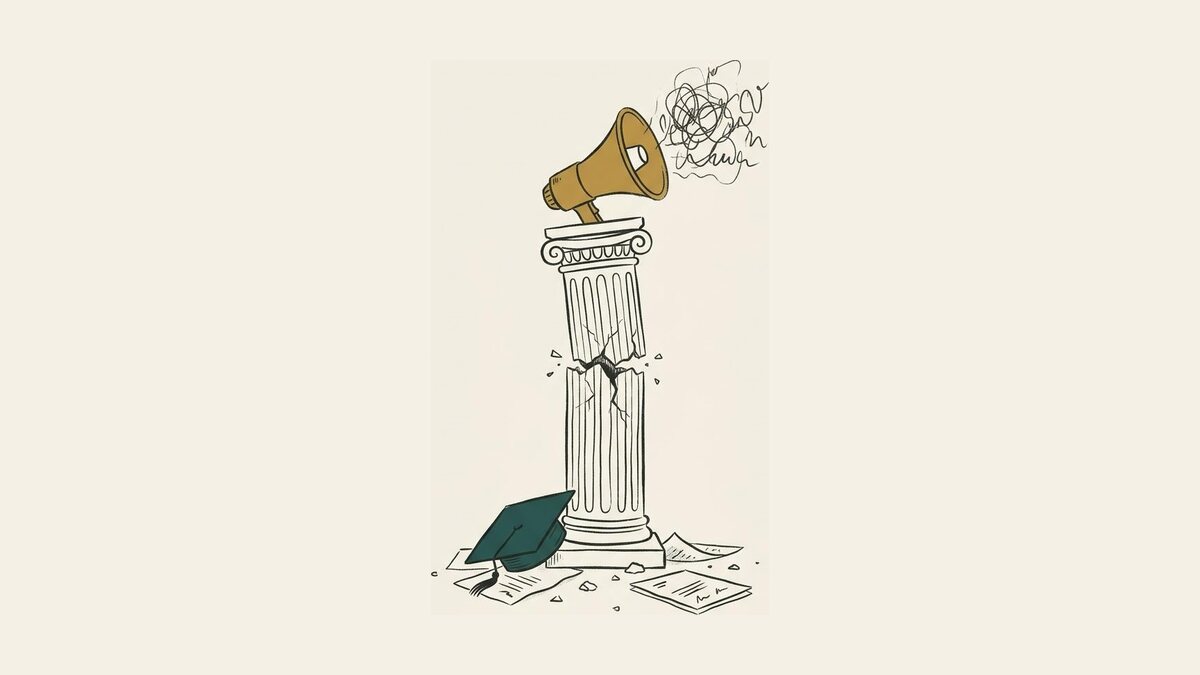
Civilisation depends upon epistemic infrastructure. Universities. Peer review. Scientific societies. Accreditation systems. Professional standards. Journalism. Regulatory bodies. These systems are imperfect and often frustrating, but they exist because human beings are extraordinarily vulnerable to self-deception, tribalism and charismatic nonsense.
Science was humanity’s attempt to build a cultural mechanism capable of restraining those tendencies.
Now we are dismantling that mechanism in real time.
And we should stop pretending this is harmless wellness culture or quirky internet behaviour. It is a direct assault on the institutions that sustain liberal democratic society itself. A civilisation cannot function if populations lose the ability to distinguish expertise from performance, evidence from narrative, or confidence from competence.
Once every institution is presumed corrupt and every expert presumed compromised, authority does not disappear.
It simply relocates.
Usually toward the loudest and most emotionally satisfying voice in the room.
History suggests this does not end well.
The irony is that the same people screaming “do your own research” are often the least equipped to critically evaluate scientific evidence. Reading abstracts is not expertise. Listening to podcasts is not expertise. Consuming scientific language is not expertise. True expertise is built through years of immersion within methodological cultures specifically designed to reduce error and bias.
That does not make experts infallible.
But it makes them vastly more reliable than influencer intuition masquerading as rebellion.
We are now raising entire online cultures that treat expertise itself as suspicious, complexity as weakness, and certainty as moral courage. This is not enlightenment. It is regression. A return to pre-scientific modes of thinking where charisma, tribal identity and narrative coherence matter more than systematic reality-testing.
And unlike previous eras of anti-intellectualism, this version spreads at algorithmic speed while wearing the costume of intelligence.
That is what makes it so dangerous.