Understanding toenail fungus, why it happens, how to prevent it and why the most important part of treatment might not come in a bottle.
There is an extraordinary industry built around the humble fungal toenail. Oils, creams, lasers, medicated nail polishes, electronic devices and an endless supply of suspiciously impressive before-and-after photographs. Apparently, everyone has discovered the secret to eliminating toenail fungus, usually for three easy payments.
Yet remarkably little attention is given to understanding what toenail fungus actually is, why it establishes itself in our nails and what we can do to make our feet a considerably less hospitable place for it to live.
Fungi are nature's great decomposers. They play an essential role in breaking down organic material and returning nutrients to the environment. Without them, the natural world would be buried beneath generations of dead organic matter.
Among the enormous diversity of fungi are organisms that have developed the ability to digest a particularly resilient protein called keratin. Some of these fungi naturally inhabit the soil, breaking down discarded animal hair, feathers and other keratin-containing material as part of nature's recycling process. Others have adapted to living on humans and animals.
You happen to have ten conveniently located plates of keratin at the ends of your feet.
Your toenails.
The visible portion of your toenail is essentially a plate of densely packed, dead, keratinised cells. It has no blood supply, no nerves and no capacity to repair itself. Its primary function is mechanical protection, but to certain fungi, particularly a group known as dermatophytes, it represents a readily available source of nutrients.
The fungus isn't particularly interested in you as a person. It has simply encountered something it is biologically equipped to digest.
Now, imagine you wanted to grow mushrooms. What sort of environment would you create?
Somewhere warm, moist, relatively dark and sheltered from direct sunlight, with a readily available source of organic material.
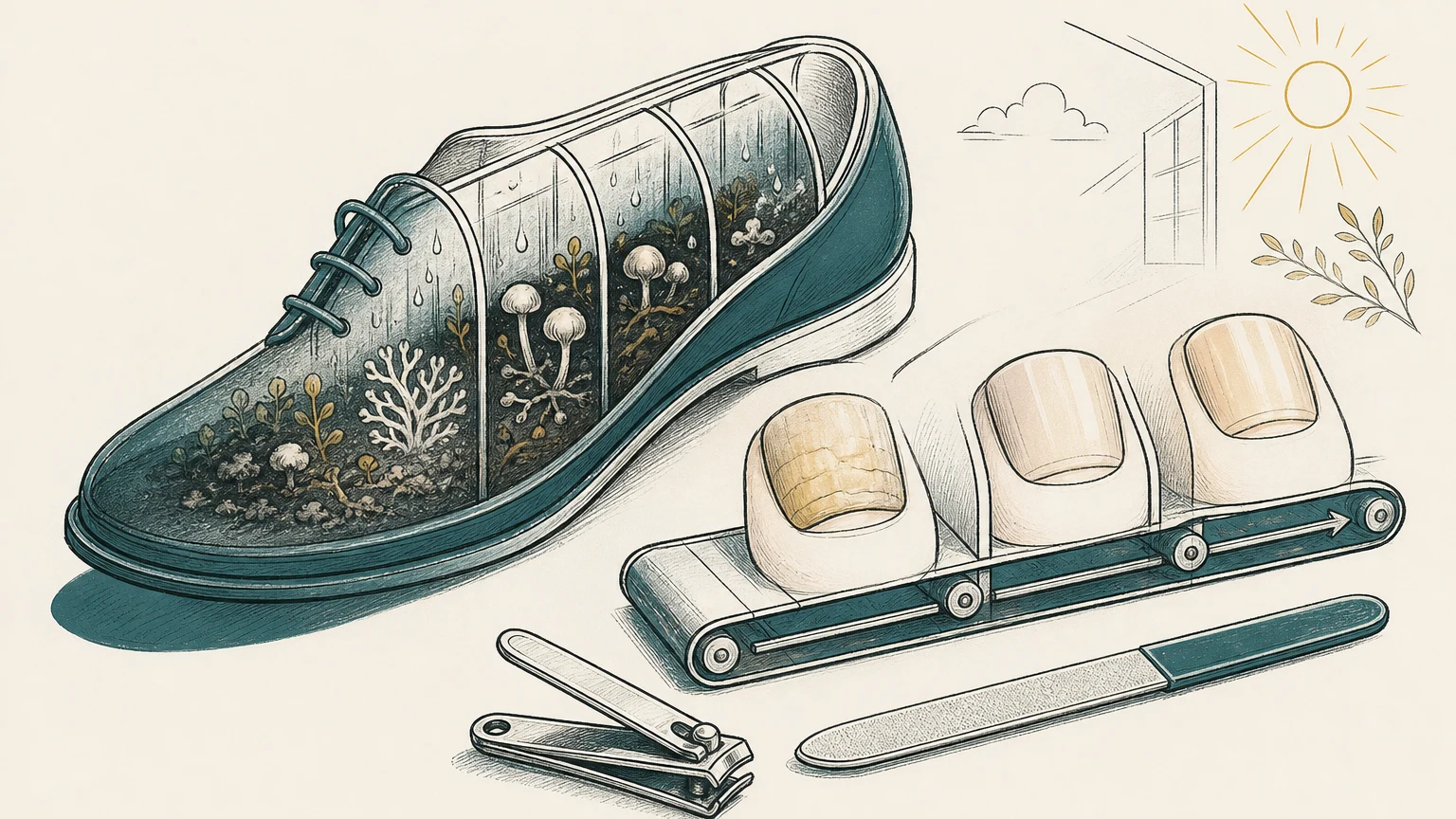
Congratulations. You've just designed a shoe.
Although the fungi responsible for toenail disease are not the same organisms as the mushrooms you buy at the supermarket, the ecological principle is similar.
We put our feet inside socks, encase them in relatively poorly ventilated shoes and leave them there for eight to twelve hours a day. Our feet perspire, moisture accumulates and the temperature increases. We then take those shoes off, leave them overnight and frequently put them back on the following morning before they have had an opportunity to dry completely.
And then we wonder why fungi are so much more commonly found in our toenails than our fingernails.
Our hands spend considerably more time exposed to the open air. They dry more readily, are less frequently confined within warm, moist environments and are regularly exposed to daylight. Fingernails also grow significantly faster than toenails.
Our feet, meanwhile, spend much of their existence inside something resembling a small fungal greenhouse.
But there is another enormously important component of fungal nail disease that receives surprisingly little attention: the physical integrity of the nail itself.
A healthy, intact toenail is a relatively effective protective barrier. When that nail becomes damaged, cracked, split or partially detached from the underlying nail bed, it provides opportunities for fungal spores to enter and establish themselves.
One of the most common sources of this damage is entirely preventable.
Your toenails repeatedly banging into the inside of your shoes.
Every time you walk downhill, run, abruptly stop or wear shoes with insufficient room for your toes, your toenails may be subjected to repetitive mechanical trauma. If your toenails are excessively long, they are particularly vulnerable to this.
Over time, this repetitive trauma can cause small structural defects in the nail and separation of the nail plate from the underlying nail bed, a process known as onycholysis.
Your nail doesn't necessarily need to turn black or fall off for damage to have occurred.
Often, the mechanical damage comes first. The fungus simply takes advantage of the opportunity.
This is why I place such considerable emphasis on maintaining good nail health, both in preventing fungal nail disease and in managing it once it has developed.
Keep your toenails reasonably short. Trim them relatively straight across, without cutting excessively short or digging down the sides. Use a nail file to smooth rough edges and prevent small defects from developing into larger splits. Ensure your shoes have sufficient length and depth to accommodate your toes without repeatedly contacting your nails.
If your nails are excessively thick, difficult to cut or beginning to deform, have them professionally maintained by a podiatrist.
Good nail health is one of the most important weapons you have against fungal invasion. Unfortunately, there isn't much money to be made from telling people to regularly trim and file their toenails.
There is also an important distinction to be made between colonisation and infection.
When most people hear the word infection, they immediately imagine something invading their body, damaging living tissue and provoking an immune response. They imagine redness, swelling, heat, pain and perhaps the need for urgent medical intervention.
Colonisation, on the other hand, describes the presence and establishment of an organism without necessarily causing tissue damage or provoking an inflammatory response.
A fungus can be present on a nail without causing disease. When it begins invading and degrading the nail structure, we medically classify this as a fungal nail infection, or onychomycosis. However, the behaviour of the organism in this situation is quite different from what most people ordinarily associate with an infection.
In many cases, the fungus is predominantly occupying and digesting a structure composed of dead cells. There may be no pain, no inflammation and no obvious immune response.
From a practical perspective, it is often useful to think about fungal nail disease as an organism establishing itself within an available biological material, rather than imagining something aggressively invading your body.
This distinction matters because it influences how urgently and aggressively we need to manage it.
In an otherwise healthy individual, a mildly affected fungal toenail may represent little more than a cosmetic concern. There is no obligation to pursue aggressive medical treatment simply because a fungus is present.
However, when nails become excessively thickened, painful, difficult to maintain or begin damaging the surrounding skin, they become a more significant clinical problem. This is particularly important in people with diabetes, impaired circulation, reduced sensation or compromised immune systems.
It is also worth pointing out that not every ugly toenail is a fungal toenail.
Repeated trauma, permanent damage to the nail-producing structures, psoriasis and age-related changes can all produce nails that look remarkably similar to fungal nails. Sometimes fungal involvement occurs alongside these conditions.
You can spend an extraordinary amount of money trying to kill a fungus that you don't actually have.
This is where an assessment by a podiatrist can be particularly valuable. Where necessary, a sample of the nail can be collected for laboratory testing to establish whether fungal organisms are responsible for the changes you are seeing.
So, what can we actually do about fungal toenails?
There are effective medical treatments available. Oral terbinafine is generally the most effective conventional treatment for the dermatophytes responsible for most fungal toenail disease. A typical course for toenails lasts approximately twelve weeks.
It works by interfering with the production of an essential component of the fungal cell membrane, disrupting the organism's ability to survive.
However, oral antifungal medications are not appropriate for everyone. Your prescribing doctor will need to consider your medical history, liver health, other medications and potential adverse effects. Confirming the presence of fungus before commencing oral treatment is particularly important.
There are also topical antifungal preparations, including medicated nail lacquers such as amorolfine, which may be appropriate for less extensive fungal involvement.
However, one of the greatest challenges in treating fungal toenails isn't necessarily finding something capable of killing the fungus. It is getting that substance to where the fungus actually resides, in sufficient concentrations and for a sufficient period of time.
Your toenail is specifically designed to be a tough, protective barrier. Its densely packed layers of keratin make it relatively difficult for many substances to penetrate.
Unfortunately, the very structure that the fungus is digesting also provides it with a degree of protection from the substances we are attempting to kill it with.
Much of the fungal activity may be occurring within the deeper layers of the nail plate, on its underside and within the accumulation of keratotic debris beneath it. Simply painting an antifungal preparation onto the surface of a thickened toenail does not guarantee that it will reach those organisms in therapeutically effective concentrations.
This is why a product that demonstrates exceptional antifungal activity in a laboratory may produce considerably less impressive results when applied to an actual toenail.
In a laboratory, the antifungal substance can be placed in direct contact with the organism. In a toenail, there may be several millimetres of densely packed keratin and accumulated debris separating the two.
Killing a fungus and successfully delivering an antifungal substance to a fungus are two entirely different challenges.
Unfortunately, much of the marketing surrounding fungal nail treatments concentrates on the former while conveniently overlooking the latter.
This is one of the advantages of oral antifungal medication. Rather than attempting to penetrate the nail from the outside, the medication reaches the nail-producing structures and nail bed through the bloodstream, becoming incorporated into the growing nail and reaching affected nail material.
It also explains why applying an ordinary antifungal skin cream to the surface of a toenail is unlikely to achieve the same results as applying it to a patch of athlete's foot. The organism may be similar, but the physical barriers separating the medication from the organism are entirely different.
It is also why professional nail debridement is such a valuable component of topical treatment. Reducing excessive nail thickness, removing detached nail and clearing accumulated keratotic debris can reduce some of the physical barriers between the topical preparation and the fungus.
But regardless of whether someone chooses oral medication, topical antifungals or a more conservative approach, there is a fundamental principle that I place considerable emphasis on in clinical practice.
Rather than concentrating exclusively on killing the organism, concentrate on making its environment increasingly inhospitable.
If you don't want fungi to grow, stop providing them with the conditions in which they thrive.
Take your shoes and socks off when you get home. Allow your feet to breathe. Dry your feet thoroughly after showering, particularly between your toes. Change your socks if they become damp throughout the day. Rotate your footwear and give your shoes an opportunity to dry completely before wearing them again.
If you remove your shoes at the end of the day and they are still damp the following morning, you are effectively maintaining the same favourable environment for fungal growth from one day to the next.
Spend some time with your feet exposed to the open air and ordinary daylight where it is safe to do so. Ultraviolet radiation can damage fungi under certain conditions, although sunlight itself should not be considered a proven treatment for fungal toenails. The more practical benefit is allowing your feet to dry and escape the enclosed environment of your shoes. There is certainly no need to risk sunburn.
If you have athlete's foot, treat it. Fungal organisms occupying the surrounding skin can provide a continuing source of reinfection for your nails.
Avoid walking barefoot in communal showers and changing rooms. Keep your nail clippers and files clean, and avoid sharing them with other people.
And, perhaps most importantly, pay attention to what is physically happening to the nail.
As fungi digest keratin, the nail can become increasingly discoloured, brittle, crumbly and structurally compromised. It may begin to separate from the underlying nail bed, and a considerable amount of keratotic debris can accumulate beneath it.
If you have ever looked underneath a fungal toenail, you may have noticed a white, yellow or brown material that resembles damp chalk or compacted dust.
This is predominantly an accumulation of keratinous material, which may contain fungal organisms.
Leaving large quantities of this material underneath the nail provides a reservoir for the fungus. It can also contribute to further lifting and distortion of the nail plate, creating additional spaces in which debris and moisture can accumulate.
The more the nail deteriorates, the more opportunities there are for fungal involvement. The fungus contributes to the deterioration of the nail, and the deteriorating nail provides further opportunities for the fungus.
This is why physically removing affected nail material and accumulated keratotic debris is such an important component of my conservative approach to fungal nail management.
A podiatrist can reduce the thickness of the nail, remove loose and detached portions, carefully clear accessible debris and smooth the remaining nail.
This reduces the amount of affected material, improves access for topical preparations and helps preserve the physical integrity of the remaining nail. It can also make an enormous difference to comfort, particularly when wearing enclosed footwear.
The objective is not to remove as much nail as humanly possible. It is to remove compromised material while preserving the healthy, attached nail.
Aggressively scraping underneath your toenails with sharp instruments can cause further separation and damage, which is precisely what we are trying to prevent.
One of the products I incorporate into conservative fungal nail management is Australian tea tree oil.
Much of the discussion surrounding tea tree oil concentrates on whether it can kill fungal organisms. It contains naturally occurring compounds, particularly terpinen-4-ol, that demonstrate antifungal activity under laboratory conditions.
However, that is not my primary reason for incorporating it into conservative nail care.
My approach is much more concerned with managing moisture, maintaining the physical condition of the nail and preserving the integrity of the remaining nail plate.
I use tea tree oil as an adjunct to regular nail cleaning, removal of accumulated keratotic debris and mechanical nail maintenance. The objective is to maintain a clean, dry and structurally sound nail rather than allowing it to become increasingly crumbly and compromised.
In my clinical experience, this combination of regular maintenance and topical care can help improve the condition and manageability of affected nails.
However, it is important to distinguish clinical observations from established scientific evidence. We do not have strong evidence that tea tree oil itself reliably dries the nail plate, restores nail integrity or eradicates an established fungal nail infection.
And, of course, tea tree oil faces precisely the same challenge as other topical antifungal substances. Demonstrating that it can kill a fungus in a laboratory tells us relatively little about its ability to penetrate a thickened toenail and reach the organisms residing beneath it.
This is another reason why I regard the regular removal of damaged nail and keratotic debris as being so important. Applying a topical preparation without addressing the accumulation of compromised material is overlooking a significant part of the problem.
Tea tree oil should be regarded as an optional adjunct to nail maintenance rather than a miraculous antifungal treatment or a substitute for proven medical therapies when those therapies are indicated.
Use a preparation intended for topical application, follow the manufacturer's instructions and discontinue it if irritation develops. Tea tree oil can cause allergic skin reactions, particularly in concentrated preparations. It should never be swallowed or applied to open wounds.
There is also a distinction between maintaining a dry environment around the nail and excessively drying the nail plate itself. We want to preserve its structural integrity, not make it increasingly brittle.
You may also encounter recommendations for vinegar and other acidic preparations. Environmental acidity can influence fungal growth, but dermatophytes are adaptable organisms, and there is limited clinical evidence that vinegar treatments reliably eradicate fungal nail disease.
Something doesn't automatically become an effective clinical treatment simply because there is an appealing scientific explanation for why it might work.
What we are ultimately trying to achieve through conservative management is to reduce the fungal burden, limit opportunities for further invasion and allow the new nail to progressively grow out under more favourable conditions.
And this brings us to the most frustrating aspect of fungal toenail management.
Waiting.
Toenails grow extraordinarily slowly. A large toenail can take twelve to eighteen months, sometimes longer, to completely replace itself.
The damaged portion of your toenail is not going to magically become healthy again. Remember, it is predominantly dead keratin. It has no capacity to repair itself.
What you are looking for is healthy new nail emerging from the base of the nail, gradually pushing the damaged portion towards the end of the toe, where it can eventually be trimmed away.
Think of it as an exceptionally slow conveyor belt.
Even if you successfully eliminate every fungal organism from your toenail today, the nail may continue to look abnormal for another twelve months.
And if the structures responsible for producing the nail have been permanently damaged, it may never return to its original appearance, irrespective of whether the fungus has been eliminated.
This is why judging the effectiveness of a fungal nail treatment after three or four weeks makes very little sense.
Take a photograph of your nail when you begin managing it. Take another photograph every month or two. Rather than concentrating on the damaged portion at the end of the nail, look at what is happening at its base.
Is the new nail growing through clearer? Is it remaining attached to the underlying nail bed? Is the amount of keratotic debris decreasing? Is the nail becoming easier to maintain? Are you preventing further mechanical damage?
These are useful indicators of progress, although appearance alone cannot confirm that the fungus has been eliminated.
Conservative management is not guaranteed to eradicate an established fungal nail infection, particularly when extensive portions of the nail are affected. Some people will require prescription antifungal treatment to achieve that outcome. Others may be perfectly satisfied with maintaining comfortable, manageable nails without pursuing complete fungal eradication.
The appropriate approach depends on the individual, the extent of the fungal involvement, their general health and what they actually want to achieve.
Even the most effective oral antifungal medication does not provide permanent protection against reinfection.
If you successfully eliminate the fungus but subsequently return your feet to precisely the same environment, with the same footwear problems, the same accumulation of debris and the same repetitive nail trauma, you may eventually find yourself back where you started.
You have removed the organism without addressing the circumstances that allowed it to establish itself.
This is why I regard fungal toenail management as an ongoing process of nail maintenance rather than simply a course of antifungal treatment.
Keep the nails short. Keep them smooth. Keep your feet clean and dry. Remove loose keratotic debris safely. Reduce excessive nail thickness. Protect the new nail from mechanical damage. Address the environment in which the fungus has established itself, and give the nail sufficient time to grow.
See a podiatrist periodically to maintain the nail, monitor its progress and determine whether additional treatment is warranted.
If you have diabetes, poor circulation, reduced sensation or difficulty safely reaching and maintaining your feet, professional nail care is particularly important. Do not attempt to aggressively remove thickened nail or debris yourself. If you develop redness, swelling, discharge, increasing pain or a wound around the nail, seek prompt medical attention.
There is no miraculous overnight cure for fungal toenails. There is no secret ingredient that overrides the biology of the organism, and there is certainly nothing that will accelerate twelve months of nail growth into twelve days.
There is, however, a considerable amount you can do to make your feet a less attractive place for fungi to live.
Sometimes the most useful thing we can do is stop thinking exclusively about how to kill the organism and start thinking about why it is there in the first place.
After all, if you don't want to grow mushrooms, stop maintaining the mushroom farm.
The Footnote
Helping you understand your feet, not just telling you what to buy.