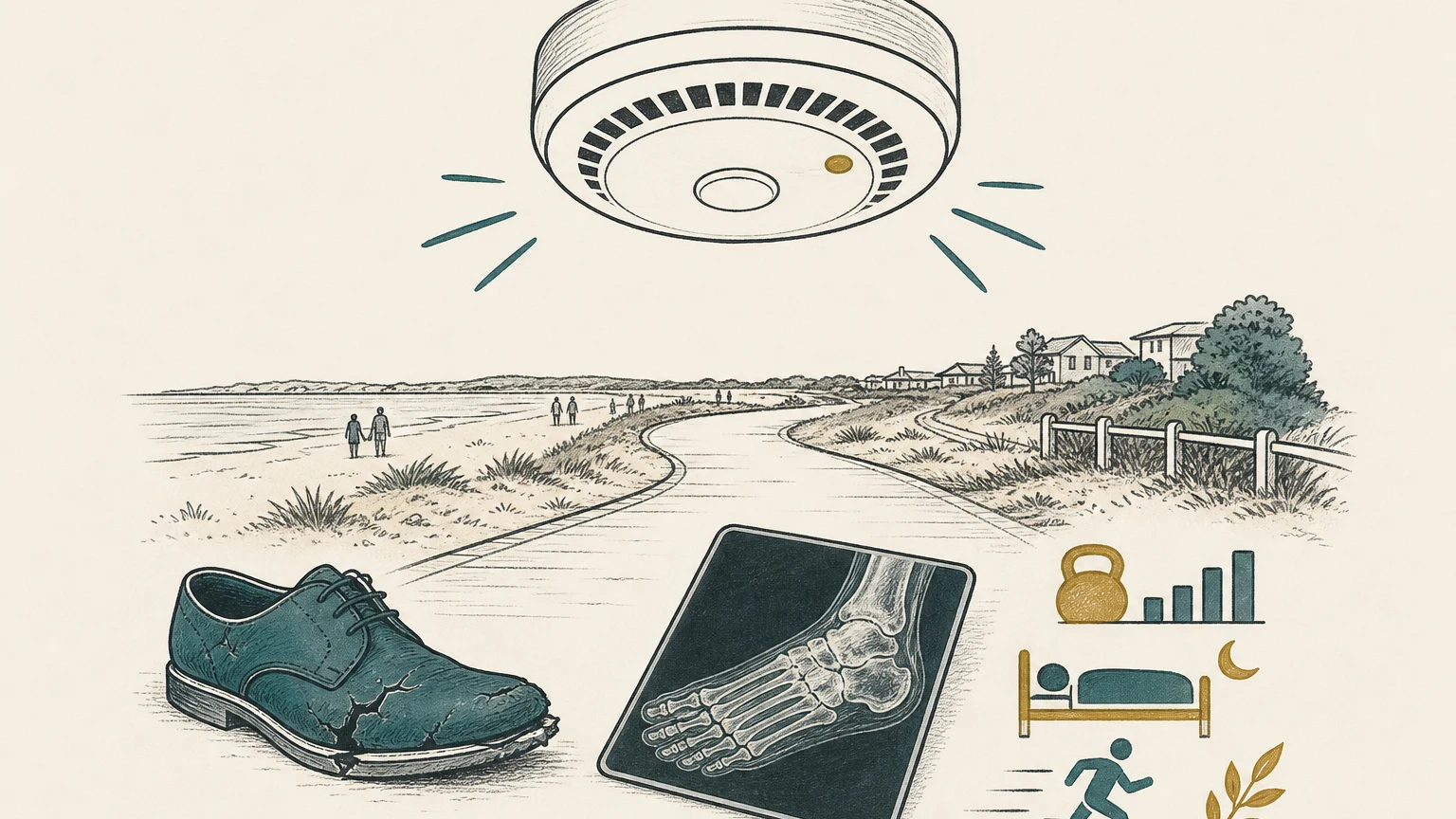
One of the more peculiar experiences of being a podiatrist is looking at an X-ray of a foot that appears to have been assembled during an earthquake, only to discover that its owner walks five kilometres every morning and has absolutely no pain.
Then, twenty minutes later, someone walks into my clinic barely able to put their foot on the ground, and their X-ray looks like something you might put in an anatomy textbook.
It's terribly inconvenient for those of us who would like the human body to make sense.
We tend to think of pain as a sort of internal damage report. Something hurts, therefore something must be damaged. The more it hurts, the more damaged it must be. It's a perfectly reasonable assumption, particularly if your previous experience of pain involved standing barefoot on a piece of Lego.
Unfortunately, human biology is considerably more complicated than Lego.
Pain is a protective experience produced by your nervous system. Its purpose is to encourage you to respond to a perceived threat. Tissue damage can certainly contribute to that threat, but so can inflammation, repetitive loading, previous injuries, fatigue, poor sleep and a nervous system that has become particularly sensitive.
This does not mean your pain is imaginary. All pain is real. The distinction is that pain is not necessarily an accurate measurement of how much physical damage has occurred.
Imagine having a smoke alarm in your kitchen. Sometimes it goes off because your house is on fire. Sometimes it goes off because you've demonstrated an ambitious but ultimately unsuccessful approach to making toast.
The alarm is real in both circumstances. The severity of the problem, however, is considerably different.
One of the challenges in healthcare is that we have become remarkably good at finding things wrong with people. Give me sufficiently sophisticated imaging equipment and enough time, and I can probably find something structurally imperfect in almost anyone.
Particularly anyone over forty.
We accumulate anatomical imperfections in much the same way that we accumulate scratches on our cars. Cartilage changes, tendons thicken, joints develop little bony projections, and tissues gradually lose some of their youthful properties. Much of this is simply evidence that we've been alive and using our bodies.
Yet people often arrive in my clinic carrying an imaging report that reads like an inventory of everything that has gone wrong with them. They have degeneration, osteophytes, tendinosis, joint space narrowing and, occasionally, a heel spur that has been unfairly blamed for absolutely everything.
Understandably, they're terrified.
Someone has effectively handed them a structural engineering report suggesting their foot should be condemned.
But an imaging finding is not necessarily an explanation for pain. Establishing whether something we can see is actually responsible for what someone feels is an important part of clinical practice. Otherwise, we're simply treating abnormalities because we've found them.
And there is no shortage of abnormalities to treat.
I often explain to patients that their feet have a certain capacity to tolerate the demands placed upon them. That capacity isn't fixed. It changes with age, health, activity, recovery and previous injury. If the demands placed upon a tissue exceed what it can comfortably tolerate, it may become painful.
Sometimes the solution is to temporarily reduce those demands. Sometimes it's to redistribute them through footwear, padding or orthotics. Sometimes it's to gradually increase the capacity of the tissue itself through exercise.
Often, it's a combination of all three.
What I don't necessarily need to do is restore your foot to some anatomically perfect condition that it probably hasn't occupied since the late 1980s.
Nor do I necessarily want you to stop doing the things you enjoy.
If walking along the beach every morning is the highlight of your day, telling you never to walk along the beach again might benefit your foot in the short term, but it may do considerably less for the person attached to it.
The purpose of healthcare, surely, is to improve the lives of people, not merely the condition of their individual body parts.
Of course, pain should not simply be ignored. Sometimes the smoke alarm is telling you that the house really is on fire. Fractures, infections, inflammatory conditions and problems with blood supply all require appropriate investigation and management. New, severe or unexplained pain, particularly when accompanied by swelling, redness, changes in colour or temperature, or difficulty bearing weight, deserves prompt assessment.
The point is not that pain is unimportant. It's that understanding why something hurts is considerably more useful than simply establishing that it does.
So, if you've been told that your feet are worn out, that your arches have collapsed, that your joints are degenerating or that your tendons are deteriorating, don't automatically assume that your days of walking, running, gardening or chasing your grandchildren are numbered.
You may need treatment. You may need to modify how you do certain things. You may even need to accept that some structural changes are permanent.
But permanent structural changes do not necessarily mean permanent pain.
I've never had a patient tell me that their ambition in life is to have a beautiful X-ray.
They want to walk their dog. They want to play golf. They want to travel. They want to get through a day at work without thinking about their feet. They want to walk around the supermarket without wondering whether they've parked too far away.
Those are the outcomes worth pursuing.
Your feet don't have to be perfect.
They just have to get you where you want to go.