Author attribution not recorded
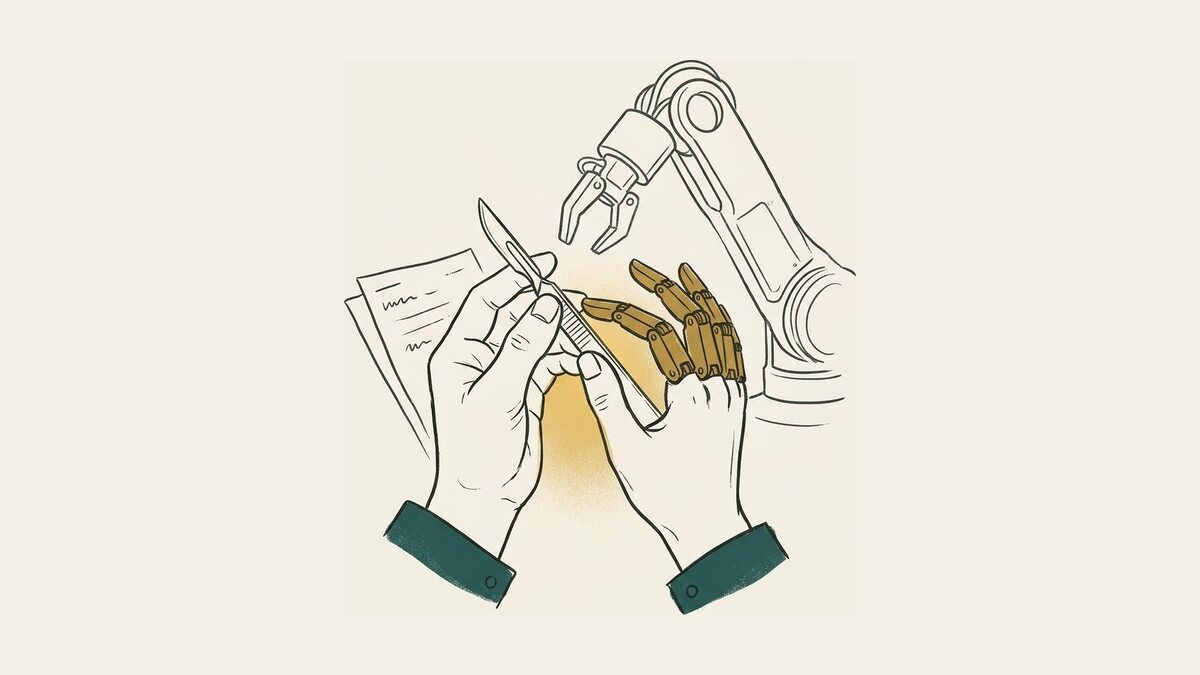
Last week, LinkedIn informed surgeons that their real problem isn’t long hours, litigation risk, or the emotional burden of cutting into another human being.
It’s that their income doesn’t scale.
Apparently, the tragedy of modern surgery is not mortality. It’s leverage.
The post was earnest. Surgery pays well, it conceded but there’s “no asset being built.” No ownership. No scalability. The solution? Rethink income. Monetise knowledge beyond the operating room. Escape the invisible ceiling.
Almost simultaneously, a tech billionaire announced that surgeons would soon be replaced by robots anyway.
And there it was. The perfect collision.
On one side: “Your income is capped.” On the other: “Your hands are obsolete.”
Somewhere in the middle stands the biological robot looking up, quietly realising the world has begun talking about him the same way it talks about a forklift.
Let’s be fair.
Large parts of surgery are technical. Incisions follow anatomy. Sutures follow physics. Protocols reduce variability. If you define the role narrowly as cut here, close there, then yes, it is engineerable. Robots don’t tremor. They don’t fatigue. They don’t rush because the list is running late.
If the job is purely mechanical, silicon will eventually outperform carbon.
But that is not what patients consent to.
Patients don’t hand over their body because they’ve reviewed your knot security metrics. They can’t assess your marginal reduction in operative time. They don’t know your complication rate in granular detail.
They assess something else entirely.
Whether you looked them in the eye. Whether you explained without condescension. Whether you sat down instead of hovering over them like a visiting consultant to their own life. Whether you treated their fear as rational rather than inconvenient.
Trust is built in the consult room long before it’s tested in theatre.
Here’s the part the LinkedIn post misses and the part surgeons sometimes forget too.
This “biological robot” thing isn’t only a personality flaw. It’s a system design.
Hospital administration has been trying to turn clinicians into throughput engines for years. Fifteen-minute consult slots. Productivity quotas. KPIs that measure speed, not meaning. Checkbox medicine. EHRs that turn the patient into a form and the clinician into a data entry unit with a stethoscope.
It is hard to practice humanity while sprinting.
It is hard to be present when the clock is louder than the person.
And it’s easy to see why the “monetise your knowledge” message finds purchase when you’re burnt out, your autonomy is being eroded, and the people running the place already talk about you as if you are interchangeable. The post isn’t seductive because it’s wise. It’s seductive because it offers a fantasy of escape.
But the escape route has a trap door.
If you start talking about yourself as an under-leveraged asset, a revenue engine constrained by hospital systems, you begin to describe yourself the way engineers do.
Optimisable. Replaceable. Upgradeable.
If you present as a biological robot, don’t be surprised when someone builds a synthetic one.
There are, undeniably, surgeons who have mistaken technical superiority for moral superiority. Status can do that. Years of training. High barriers to entry. Life-and-death authority. It can calcify into detachment. Into arrogance. Into the quiet belief that bedside manner is cosmetic.
But bedside manner isn’t cosmetic.
It is the human layer that makes the entire enterprise legitimate.
When someone signs a consent form, they are not purchasing a mechanical procedure. They are entering into a profoundly asymmetric relationship of trust. They are saying: I cannot do this. I need you to do it. And I need to believe you will treat me as more than a case.
This is why the robot argument always misses something.
A robot can execute tasks.
It cannot answer for them.
And “answering for” is not just an apology when things go wrong.
It starts before the incision.
It’s the pre-operative conversation where you calibrate hope with reality where your judgment translates statistics into human terms without hiding behind percentages. It’s the moment you say, “Here’s what can happen,” and mean, “I will be here with you if it does.”
It’s the post-op visit where a complication is explained not as a system error, but as a human event requiring a human response. Not defensive. Not bureaucratic. Not outsourced.
The scalpel is not the most important instrument in the room.
Responsibility is.
This isn’t a sentimental defence of inefficiency.
It’s strategic.
If surgery becomes framed as a scalable income problem, and surgeons behave like detached operators maximising output, then automation isn’t a threat. It’s an inevitability. Machines compete beautifully on precision, consistency, and fatigue resistance.
Humans compete on presence, judgment, and moral weight.
You do not beat robots at being robots.
You beat them by being irreducibly human.
The operating theatre is not a content platform. It is not a monetisation bottleneck. It is not an asset class waiting to be unlocked.
It is a place where another human being hands you their mortality and asks you not just to perform, but to care.
That privilege is not capped.
It is sacred.
So before worrying about synthetic robots replacing biological ones, surgeons might consider a simpler upgrade:
Version MD 2.0 — now with restored bedside manner. Enhanced humility. Reinstalled sense of service.
Not as a brand strategy.
As resistance.
Because if you insist on behaving like a machine, you will eventually be benchmarked against one.
And the machine will not need a day off.