Understanding what diabetes does to your feet, and why the damage often begins long before you notice anything wrong
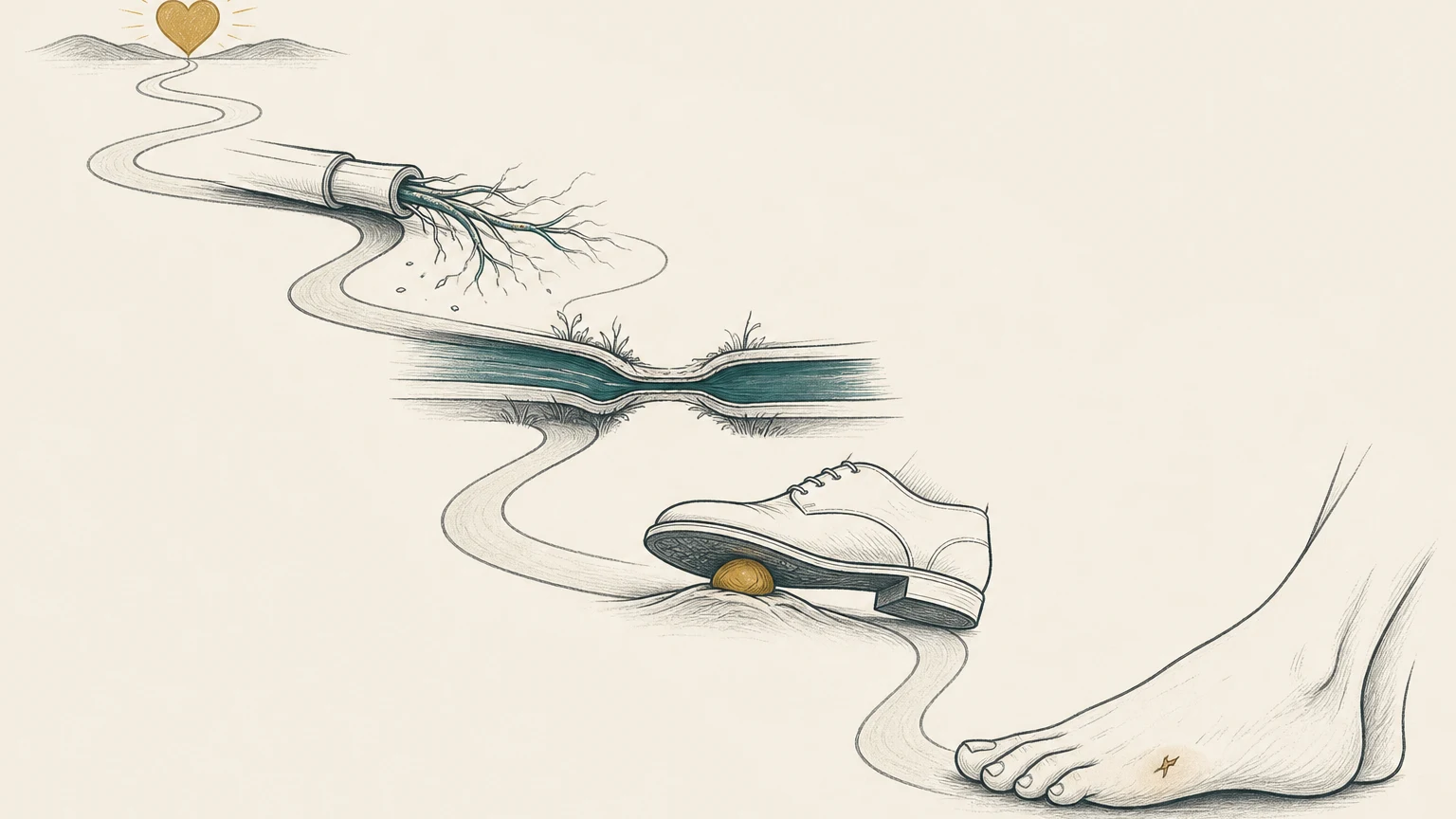
.Most people with diabetes have been told to look after their feet.
They've been told to check for cuts, wear sensible shoes, avoid walking barefoot and have their feet examined regularly.
It's good advice.
But there's something missing from the conversation.
Why?
Why does diabetes make a small blister potentially dangerous? Why can someone develop a serious infection without experiencing much pain? And why do some people with diabetes eventually require amputations when the original problem might have been nothing more than a little pressure beneath a toe?
To understand that, we need to look at what diabetes actually does to the body.
Because the problem doesn't begin with a foot ulcer.
It often begins years earlier.
Your Feet Are at the End of a Very Long Road
Your feet are remarkable pieces of engineering.
Each contains 26 bones, 33 joints and an intricate network of muscles, tendons, ligaments, nerves and blood vessels.
They carry your entire body weight, absorb the forces of walking and adapt to uneven ground thousands of times every day.
And they do all of this while sitting at the furthest point from your heart.
That last detail matters.
Your feet depend on a healthy blood supply to deliver oxygen and nutrients, functioning nerves to detect pressure and injury, and healthy skin to provide a protective barrier against the outside world.
Diabetes can interfere with all three.
Not necessarily at once. Not necessarily in everyone. And often so gradually that you don't notice anything changing.
Until something goes wrong.
First, Diabetes Can Damage the Nerves
One of the most important complications of diabetes is called peripheral neuropathy.
Put simply, it means damage to the nerves outside the brain and spinal cord.
Over time, persistently elevated blood glucose and associated metabolic changes can damage the tiny blood vessels and structures that keep nerves functioning.
The nerves in the feet are particularly vulnerable.
Initially, people might experience tingling, burning, pins and needles, or strange electrical sensations.
Some describe feeling as though they're wearing socks when they're barefoot.
Others experience uncomfortable sensitivity, particularly at night.
But here's the dangerous part.
Sometimes the nerves simply stop delivering the messages they're supposed to deliver.
And the most important message they deliver is pain.
Pain has a terrible reputation. We spend an enormous amount of time trying to get rid of it.
But pain is also one of the body's most sophisticated protective systems.
Step on something sharp and pain tells you to move.
Develop a blister and pain encourages you to change your shoes.
Put too much pressure beneath a joint and discomfort makes you shift your weight.
Now imagine losing that warning system.
A stone can sit inside your shoe for hours.
A blister can develop without you noticing.
A small wound can become progressively deeper while you continue walking on it.
And because walking involves repeated loading, an injury that would normally make you stop can become substantially worse.
The absence of pain does not mean the absence of injury.
In someone with diabetic neuropathy, it can mean exactly the opposite.
Then There's the Blood Supply
Your feet need blood.
Not simply to stay warm, but to maintain healthy tissues, fight infection and repair injuries.
Diabetes increases the risk of a condition called peripheral artery disease.
This occurs when arteries become narrowed or blocked, commonly through atherosclerosis.
The result is reduced blood flow to the legs and feet.
Think of it as trying to maintain a garden with a damaged irrigation system.
The plants might survive under ordinary conditions.
But when something goes wrong, there's little capacity to recover.
The same principle applies to your feet.
A small cut requires oxygen, nutrients and functioning immune cells to heal.
When circulation is significantly impaired, that healing process becomes much more difficult.
And when poor circulation occurs alongside nerve damage, the combination can be particularly dangerous.
You may not feel the injury.
And your body may struggle to repair it.
It's important to understand that diabetes doesn't automatically mean poor circulation. Some people have neuropathy with excellent blood flow, while others have significant arterial disease without losing sensation.
That's why a proper diabetic foot examination assesses both.
They are different problems requiring different approaches.
A Foot Ulcer Is Usually the End of a Process, Not the Beginning
People often imagine a diabetic foot ulcer appearing suddenly.
Sometimes an injury does occur unexpectedly.
But many ulcers develop through a sequence of changes.
Imagine someone with diabetes who has gradually lost protective sensation beneath the ball of their foot.
Perhaps they have a prominent metatarsal head, a hammertoe or a stiff big toe joint.
These structural changes concentrate pressure in particular areas when walking.
Normally, that pressure might become uncomfortable.
But with neuropathy, the warning signal is reduced or absent.
The skin responds to repeated pressure by becoming thicker.
We call this callus.
And while callus might appear harmless, in a person with significant neuropathy it can become part of the problem.
Thickened skin can increase pressure on the underlying tissues. Repeated loading may cause damage and bleeding beneath it.
Eventually, the skin can break down.
An ulcer develops.
The patient might still feel absolutely nothing.
This is why podiatrists pay particular attention to callus in people with diabetes.
We're not simply removing hard skin for cosmetic reasons.
Sometimes we're identifying and addressing the mechanical conditions that could eventually produce a wound.
And once a wound develops, continuing to walk on it can prevent healing.
That is why pressure relief, often called offloading, is such an important part of diabetic foot treatment.
A dressing alone cannot solve a problem caused by thousands of repeated steps.
Why Infection Can Become So Serious
Your skin is an extraordinary protective barrier.
Every day, it prevents countless microorganisms from entering your body.
But when that barrier breaks, bacteria have an opportunity to enter.
Diabetes, particularly when blood glucose is poorly controlled, can impair aspects of the immune response and make infections harder to manage.
Combine that with a wound, reduced sensation and potentially poor circulation, and the consequences can be significant.
An infection may spread through the soft tissues.
In more serious cases, it can reach the bone, causing a condition called osteomyelitis.
And because neuropathy can reduce pain, the person may not appreciate how serious the infection has become.
This is why redness, swelling, warmth, discharge or a new wound in someone with diabetes deserves attention.
Importantly, a foot infection does not always produce dramatic symptoms.
Some people with significant neuropathy have surprisingly little discomfort.
And in severe cases, the problem can progress to tissue death, gangrene and the need for amputation.
But here's what I want patients to understand.
Amputation is not an inevitable consequence of diabetes.
It is a possible outcome of serious complications, many of which can be prevented or treated before reaching that point.
The Shape of Your Foot Matters Too
There's another aspect of diabetic foot health that doesn't receive nearly enough attention.
Biomechanics.
The way your foot moves, the shape of your toes, the flexibility of your joints and the distribution of pressure beneath your feet all influence the risk of tissue damage.
Someone with a prominent metatarsal head may experience excessive pressure beneath the forefoot.
Someone with clawed toes may develop pressure over the tops or tips of those toes.
Someone with a restricted ankle joint may compensate by increasing pressure through the front of the foot.
None of these things automatically causes an ulcer.
But combine abnormal pressure with loss of protective sensation, and the risk changes.
This is why diabetic foot care should involve more than simply looking at the skin and checking circulation.
A thorough assessment considers the mechanical forces acting on the foot.
Sometimes the solution is relatively simple.
Different footwear.
An appropriate insole or orthotic.
Removing dangerous callus.
Reducing pressure over a vulnerable area.
Other situations require more substantial interventions.
The important point is that the way you walk matters, particularly when you can no longer rely on pain to protect you.
There's Also a Complication You've Probably Never Heard Of
One of the more unusual complications of diabetic neuropathy is called Charcot neuroarthropathy, often shortened to Charcot foot.
It occurs when bones and joints in the foot become damaged in the setting of significant neuropathy.
The foot may become red, hot and swollen, sometimes with remarkably little pain.
Because those symptoms can resemble an infection, gout or a simple sprain, the diagnosis may be missed.
If someone continues walking on an active Charcot foot without appropriate protection, the bones and joints can progressively collapse, producing significant deformity.
That deformity can then create new areas of excessive pressure and increase the risk of ulceration.
The important message is simple.
A suddenly hot, swollen foot in someone with diabetes and neuropathy requires urgent assessment, even if it doesn't hurt.
Early recognition and immobilisation can make an enormous difference.
So What Does a Podiatrist Actually Check?
A diabetic foot assessment isn't simply a matter of looking for cuts.
A proper examination considers several different systems.
Sensation: Can you detect light pressure? Have you lost protective sensation? Are there symptoms suggesting nerve damage?
Circulation: Are the foot pulses present? Are there signs of impaired arterial blood flow? Is further vascular testing required?
Skin and nails: Are there wounds, calluses, pressure lesions, infections or areas of breakdown?
Foot structure: Are there deformities, restricted joints or prominent bones creating excessive pressure?
Footwear: Are your shoes protecting your feet, or are they contributing to the problem?
Previous history: Have you had an ulcer, amputation, Charcot foot or vascular intervention before?
These findings help determine your level of risk and how frequently your feet should be reviewed.
Not everyone with diabetes needs the same level of care.
Someone with intact sensation, good circulation and no previous foot complications has a very different risk profile from someone with neuropathy, peripheral artery disease and a previous ulcer.
Good healthcare recognises that difference.
What You Can Do to Protect Your Feet
The good news is that there is a great deal you can do.
Check your feet every day. Look for cuts, blisters, redness, swelling or changes in skin colour. Use a mirror or ask someone to help if necessary.
Wear appropriate footwear. Shoes should fit properly, protect your feet and avoid concentrated pressure. Check inside them before putting them on.
Don't walk barefoot if you're at risk. Even around the house, unnoticed injuries can occur when protective sensation is reduced.
Don't cut away your own calluses or corns. Avoid medicated corn plasters and sharp instruments, particularly if you have neuropathy or poor circulation.
Look after your diabetes. Blood glucose management, blood pressure, cholesterol and smoking cessation all contribute to reducing complications.
Have your feet assessed regularly. The frequency should depend on your individual risk, not simply the fact that you have diabetes.
And perhaps most importantly, don't ignore a new wound.
If you have diabetes and develop a foot ulcer, arrange prompt professional assessment, ideally the same day or within 24 hours.
If your foot becomes suddenly red, hot and swollen, or you develop spreading redness, blackened tissue, fever or signs of serious infection, seek urgent medical attention.
Waiting to see whether it becomes painful is not a reliable strategy.
The Real Goal Is to Prevent the First Ulcer
Much of the public conversation about diabetic feet focuses on the worst possible outcomes.
Ulcers.
Infections.
Amputations.
And while these complications deserve serious attention, they shouldn't define the entire conversation.
The real opportunity lies much earlier.
Identifying neuropathy before an injury occurs.
Recognising poor circulation before a wound struggles to heal.
Understanding abnormal pressure before the skin breaks down.
Choosing footwear that protects vulnerable areas.
And helping patients understand what is happening inside their own bodies.
Because diabetes doesn't suddenly become a foot problem when an ulcer appears.
The processes that make that ulcer possible may have been developing for years.
The best diabetic foot care isn't about treating the wound you can see. It's about recognising the problems you can't see, before they become a wound.
And that begins with understanding your feet.
The Footnote — Independent health education, without the unnecessary jargon.
This article provides general health information and is not a substitute for individual medical assessment. People with diabetes should have their foot risk assessed by an appropriately qualified healthcare professional.