Author attribution not recorded
I don’t think people realise how little room for intellectual laziness there is in podiatry.
Not because the problems aren’t real. Not because they aren’t common. But because they often sit in that awkward part of medicine where the evidence is thinner than people imagine, the interventions are not especially glamorous, and the commercial incentives are weak. There is no blockbuster drug for plantar fasciopathy. No patentable intervention waiting to turn heel pain into a billion-dollar return.
It is an unsexy corner of healthcare. Mechanical. Chronic. Difficult to monetise.
That does not mean there is no research. There is. But it is often limited, commercially thin, mechanistically incomplete, and asked to carry more certainty than it can bear.
What fills that gap is not confidence.
It is the clinician.
That is the part that rarely gets said out loud.
To practise well in podiatry, you cannot just follow a pathway. There often is no clean one. Or if there is, it is thin, inconsistent, or built on shaky ground. You are left interpreting fragments: small trials, mixed outcomes, partial models, clinical habits dressed up as doctrine.
Which means the job becomes thinking.
Actual thinking. About tissue. About load. About failure. About what a structure is supposed to do, and what happens when it no longer does it.
It is a heavier burden than many people realise. And that is exactly why it is so frustrating when we refuse to carry it.
I see it with shockwave for plantar fasciopathy.
The default approach is almost automatic. Find the pain. Treat the pain. Focus everything on the medial calcaneal tubercle because that is where the patient points.
It feels logical. It feels precise. It feels targeted.
And to be fair, that location does matter. It is a common site of tenderness. It is where the plantar fascia originates. It is where the patient often feels the problem most acutely.
But that is not the same as saying it is the whole pathology.
That is where the reasoning often breaks down.
The heel hurts because it is an enthesis. A sensitive interface where tissue meets bone. It can be biologically reactive. Clinically irritable. Painful for very good reasons. Even if the condition overall is better understood as fasciopathy rather than a simple fasciitis, that local insertion can still be highly symptomatic.
But local symptom expression is not the same thing as complete causal understanding.
The plantar fascia is not just a point of pain. It is a structure. A system. A tissue that is meant to stretch, store energy, and help manage load.
And over time, in plantar fasciopathy, it appears to lose some of that capacity.
I explain it to patients with something simple.
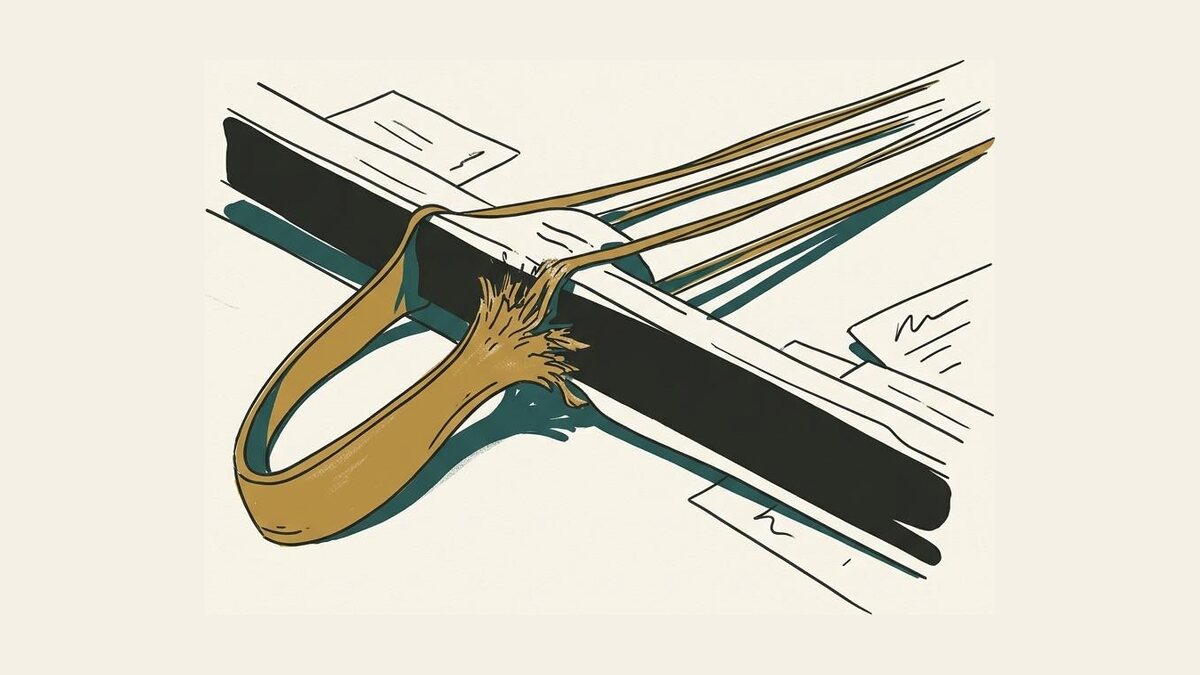
If I hold an elastic band and pull, nothing dramatic happens. The force is absorbed. The system stretches.
If I do the same thing with a rope, there is no give. The force transfers straight through to the endpoints.
You get yanked.
That, in crude terms, is what seems to happen at the heel.
As the fascia becomes less compliant, less capable of absorbing and redistributing force, the load is transmitted more harshly into the enthesis at the medial calcaneal tubercle. That is where the consequences may be expressed most clearly.
That is why it hurts there.
Not because that is the only place that matters, but because that is where the tissue has become easiest to hear.
And yet too often we treat the pain as though it is the whole disease model.
I have heard clinicians speak as though radial pressure wave behaves almost diagnostically, as though the fact that treatment hurts at the heel somehow proves that the pathology begins and ends there.
It sounds neat. Almost elegant.
But it does not survive much thought.
Of course it hurts at the heel. The insertion is already sensitised. Already reactive. Already under load it may not be tolerating well.
That does not mean the rest of the fascia is normal. It does not mean the broader mechanical picture is irrelevant. It does not mean the painful site tells the whole story.
We make a similar mistake with imaging. A thickness measurement at the medial calcaneal tubercle becomes the diagnosis. A number. A threshold. Something objective to cling to.
But it is still only a measurement. A useful one, sometimes. Not a declaration that the pathology begins and ends exactly where we chose to place the probe.
The tissue does not suddenly become conceptually normal a few centimetres away from the place we decided to measure.
This is the real problem.
Not that the medial calcaneal tubercle matters too little. In some cases it matters a great deal.
The problem is that clinicians can let it matter too much.
They let symptom location stand in for mechanism. They let tenderness masquerade as explanation. They let a local finding carry more theoretical weight than it should.
And in a field like podiatry, that is a dangerous habit.
Because the evidence will not always rescue you.
If the evidence is limited, reasoning has to expand to fill the gap. You have to understand what you are treating beyond where it hurts. You have to build a model of the problem that actually makes sense.
What is this tissue meant to do?
How has that changed?
Where is the load going now?
What am I actually trying to influence?
That is the work.
And that is why it is difficult to watch when practice becomes reflexive. When ideas harden into ritual. When treatments are repeated because they sound right, not because the reasoning underneath them has been properly examined.
Worse still is when those rituals are defended with certainty. When rationale is met not with curiosity, but contradiction.
That is the one thing a profession like this cannot afford.
Podiatry demands more of us, not less.
It asks for judgement where certainty is thin. It asks for mechanism where protocols are incomplete. It asks clinicians to think clearly in the space between evidence, anatomy, and lived patient reality.
That is not a weakness of the profession.
It is the profession.
Podiatry may never be a research-heavy field.
But it was never meant to be a thought-light one.