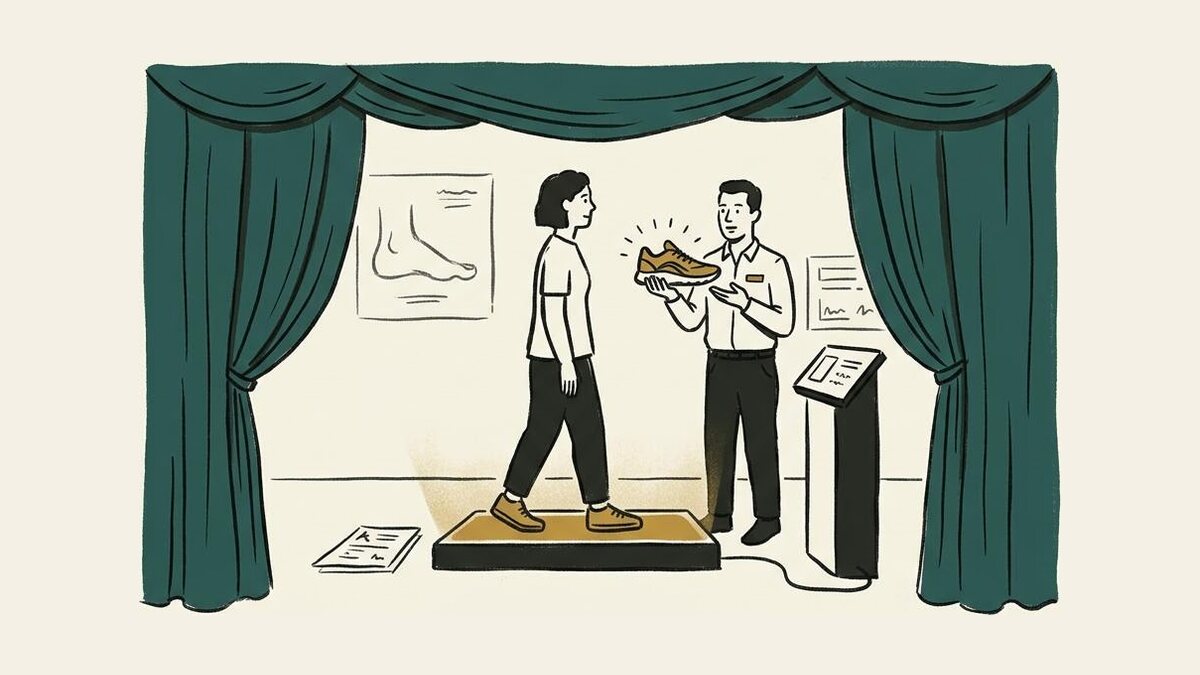
Walk into almost any “technical” shoe shop today and you’ll be greeted not by a humble Brannock device but by a glowing pressure mat, a whirring 3-D laser scanner and a teenager in branded polo assuring you that “your arches collapse more than most people’s—no wonder your podiatrist couldn’t fix you.” The scan flashes. Up pops a heat map. A cursor circles a red blob under your big toe. “See that?
Author attribution not recorded
The $300 Sneaker Diagnosis
Walk into almost any “technical” shoe shop today and you’ll be greeted not by a humble Brannock device but by a glowing pressure mat, a whirring 3-D laser scanner and a teenager in branded polo assuring you that “your arches collapse more than most people’s—no wonder your podiatrist couldn’t fix you.” The scan flashes. Up pops a heat map. A cursor circles a red blob under your big toe. “See that? Pronator’s hotspot. You need the Pro-Stabiliser Hyper-Control Max—only $299.”
The problem? That ten-second verdict is a medical diagnosis in everything but name—and it’s being delivered by someone who was stacking school shoes last week.
When a Gadget Becomes a Medical Device
Retail chains love the theatre of tech. The Athlete’s Foot markets its MyFit 3D system as “state-of-the-art technology” that captures a 3-D scan, films foot strike and records pressure via “4 000 individual sensors” to help “identify motion” and ensure “the PERFECT FIT.”¹
Yet a cursory check of the Australian Register of Therapeutic Goods (ARTG) shows only a handful of foot-pressure platforms are actually listed—Bilby Shoes’ Tekscan mat is one of the few, registered merely as a Class I device, the lowest risk category.² Most retail scanners, including the Volumental units powering many shoe-store fit-outs, do not appear on the ARTG at the time of writing, meaning they bypass the safety, performance and post-market surveillance obligations that bona-fide medical devices must meet.
Accuracy? Depends Which Mat You Step On
Independent research paints a messier picture than the glossy marketing suggests. A 2023 systematic review of commercially available pressure sensors concluded that reliability and validity “vary widely between systems,” warning clinicians to interpret retail data with caution.³ A 2025 laboratory study comparing three popular platforms (Tekscan, RSSCAN and an in-shoe unit) found significant cross-system discrepancies in both peak pressure and centre-of-pressure trajectory.⁴ Even the XSENSOR in-shoe system—better than most—showed test–retest error margins up to 15 %.⁵
Translation: the same foot can look “over-pronated,” “neutral,” or “supinated” depending on which store you visit. That instability might be tolerable for choosing a fun-run trainer, but it is nowhere near the diagnostic rigour required to manage plantar fasciopathy, diabetic ulcer risk or painful paediatric flat-foot.
Retail Gait Analysis: Old Myths, New Screens
Biomechanics specialists have critiqued in-store gait analysis for more than a decade, noting that the arch-type model (flat-medium-high = motion-control-neutral-cushion) lacks predictive power for injury and comfort. A 2024 review bluntly stated that “running-store gait analysis methods are simply deficient.”⁶
Despite this, sales associates often cloak the print-out in pseudo-clinical language: “You’re a severe over-pronator with tibial rotation; these $80 prefabricated orthotics will neutralise your Q-angle.” Such jargon convinces customers that they have received professional advice—undermining genuine podiatry prescriptions along the way.
Crossing the Legal Line
Under Australia’s Health Practitioner Regulation National Law, only registered podiatrists may use the protected title “podiatrist” or imply they are qualified to diagnose and treat foot pathologies. Offences include holding out as a registered practitioner, delivering unlawful advertising and performing restricted acts. Maximum penalties were beefed up in 2019 to fines and even three years’ imprisonment.⁷
Regulators do act. In May 2025 a Gold Coast man was fined $3 000 for practising as a podiatrist while unregistered—after treating patients for over a year.⁸ While that case involved a former practitioner, the precedent is clear: the National Law cares little whether the offender is a lapsed clinician or a shoe-store chain—if you diagnose or treat, you must be registered.
Real-World Fallout in the Clinic
Ask any podiatrist in private practice and you’ll hear war stories. One clinician told The Footnote of a 64-year-old with diabetic neuropathy who replaced his customised off-loading orthotic with a retail “anti-pronation insert” after a sales rep said “your podiatrist is stuck in the past.” Two weeks later he presented with a pre-ulcerative lesion. Another practitioner recounted a seventeen-year-old casual employee telling a patient that “shin splints are because your podiatrist put you in the wrong drop”—then upsold a maximalist shoe that aggravated the woman’s tibial stress syndrome.
While anecdotal, these cases illustrate a recurrent pattern: retail diagnosis → contradictory advice → abandonment of evidence-based care → preventable complications.
Why the Public Is Fooled
White-coat effect. A scanner, a heat map and a confident spiel feel clinical.
Instant gratification. A “problem” is identified and solved within ten minutes.
Healthcare access gaps. Long waits or cost barriers make retail advice tempting.
Marketing blitz. Brands conflate biomechanical buzzwords with medical legitimacy.
A Call to Action
For regulators: Audit retail pressure-mapping devices for ARTG compliance and advertising claims. For professional bodies: Launch public-awareness campaigns clarifying what constitutes legitimate podiatric care. For clinicians: Educate patients early—provide written shoe and orthotic prescriptions that explain why retail substitutions can be risky. For consumers: If someone without an AHPRA registration number is diagnosing your “collapsed arch,” pause, and seek a second opinion from a registered podiatrist.
The Bigger Picture
Health regulation exists to protect patients from harm—whether that harm comes from an unqualified backyard surgeon or a slick mall-front shoe boutique. Technology in footwear retail can be helpful when used as adjunct data, but it loses its shine when wielded as a diagnostic crystal ball to sell the priciest pair on the wall.
Until shoe stores either employ registered podiatrists or curb the medical theatre, remember: the smartest sensor in the room is still an evidence-trained clinician.
References
The Athlete’s Foot. School Shoe Fitting with MyFit3D. 2021. The Athlete's Foot
Therapeutic Goods Administration. Bilby Shoes – Pressure measurement/mapping system, anatomical (ARTG 232767). 2015. Therapeutic Goods Administration (TGA)
Imran F, et al. Commercially available pressure sensors for sport and health applications: a review. J Sports Eng Tech. 2023;237(2):98-112. ScienceDirect
Collins R, et al. Discrepancies between plantar pressure devices: evaluating cross-system validity. Gait Posture. 2025;102:172-9. ScienceDirect
Parker D, Andrews J, Price C. Validity and reliability of the XSENSOR in-shoe pressure measurement system. PLOS ONE. 2022;17(11):e0277971. PLOS
NYDNR Running Clinic. Why running-store gait analysis won’t find you the best shoe. 2024. NYDNRehab.com
Australian Health Practitioner Regulation Agency. What’s an offence under the National Law? 2024. AHPRA
Podiatry Board of Australia. Gold Coast man sentenced for working as a podiatrist without registration. 13 May 2025. Podiatry Board of Australia