A few months ago, I found myself asking ChatGPT (o3, if you’re keeping score) to draft a referral letter. It answered in twelve seconds flat and even threw in a courteous “Kind regards.” I hit copy a little too gleefully—until I noticed the creeping dread: my own prose was starting to sound like that. My punctuation was symmetrical; my jokes were gone; my sentences marched in formation like freshl
Author attribution not recorded
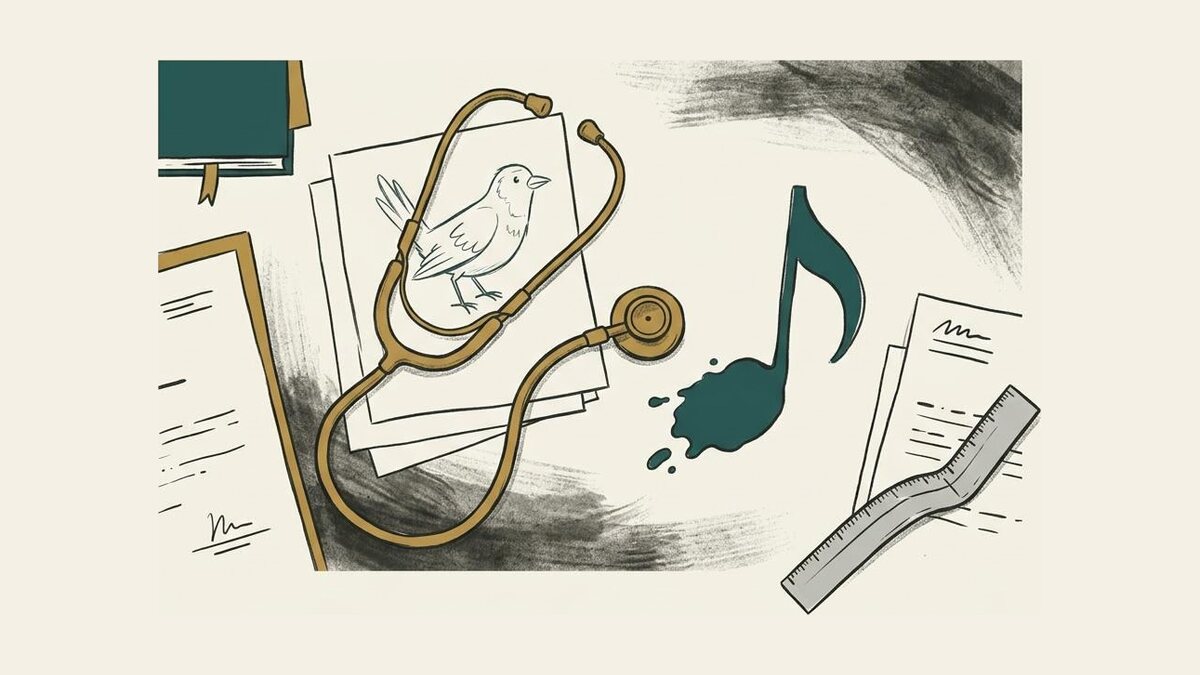
Prologue: The Day the Algorithm Waved Back
A few months ago, I found myself asking ChatGPT (o3, if you’re keeping score) to draft a referral letter. It answered in twelve seconds flat and even threw in a courteous “Kind regards.” I hit copy a little too gleefully—until I noticed the creeping dread: my own prose was starting to sound like that. My punctuation was symmetrical; my jokes were gone; my sentences marched in formation like freshly launched penguins off an assembly line.
At that moment I realised something uncomfortable: if we train ourselves to sound like machines, the machines will oblige by taking the job. They’ll do it cheaper, faster, and with better keyboard hygiene. The antidote isn’t more AI polish; it’s grit. It’s smell-of-coffee, mispronounce-the-Latin-phrase, highly-fallible, kaleidoscopic humanity.
The Cult of Consistency—and Its Hidden Cost
Medicine (and most professional life) rewards reliability. We standardise: pulse oximeters, guidelines, consent forms. Consistency reassures regulators, reduces litigation, and helps us sleep at night. But somewhere between “consistent” and “cookie-cutter” we surrendered the messy jazz solos that make us unmistakably human.
AI feeds on patterns. The more predictable your output, the easier it is to clone. Dictate identical referral letters for six months and you’ve gifted Silicon Valley a training set with your name on it.
Footnote 1: Yes, this entire article is being composed with my AI pal open in another tab. Contradictions contain multitudes.
Footnote 2: They’ll even name the model after you—“Stevo-Bot”—and charge a subscription. You’ll get a commemorative tote bag.
Why Bedside Scripts Are the New Fast-Food Kiosks
Picture the fast-food counter of 2010: a teenager staring through you while key-smashing your order. Now picture the same franchise today: you tap your burger on a touchscreen that never rolls its eyes. The teenager was replaced because they behaved like a button-press proxy.
Transplant that parable into healthcare:
“Hello Mrs Nguyen, on a scale of 0–10 how would you rate your pain? [pause] Anything else? Here’s a fact sheet.” Next patient please.
If your average consultation could be modelled as a checklist in C#, congratulations—you’ve self-checkout-ed your way onto the redundancy list.
The Original Killer App: Curiosity
Algorithms don’t get curious; they optimise. They don’t wake at 2 a.m. wondering why every third patient with chronic plantar fasciitis also owns a cockatoo. They don’t veer off-script to ask, “What’s the story behind that tattoo?” and then quietly discover that the patient’s trauma history is the real aetiology of their pain behaviour.
Curiosity is embarrassingly low-throughput. It slows the consult, leaves awkward silences, drags you into Googling obscure journal articles at midnight. Yet it births insights no transformer model will hallucinate without first ingesting your spark.
Footnote 3: Totally made-up statistic. Also, if you publish it first, meta-analysis fame awaits.
Creativity: The Messy, Cost-Inefficient Advantage
GPT systems can generate eight workout programs before your coffee cools. But they’ve never woken to the smell of antiseptic + fear, shuffled the clinic schedule to fit a patient’s panic attack, or fashioned an orthotic out of a cut-up thong because rural supply chains collapsed again.
Creativity in healthcare is situated improvisation. You re-wire protocols on the fly, repurpose a stethoscope as a child’s lightsaber, scribble diagrams on the exam table paper because the EHR won’t insert images. Each unscripted flourish is a wrinkle in the data fabric that AI can’t flatten without killing its soul (or yours).
The Empathy Differential
Large language models simulate bedside manner surprisingly well, but they don’t feel the 4 °C ward air or taste the metallic tinge of adrenaline when a dressing comes off and everyone inhales at once. They also don’t carry last night’s argument with their partner into the room—yet paradoxically, that human emotional layering is what lets us see another person’s chaos and say, “I get it.”
Patients notice micro-hesitations, eyebrow quirks, the half-second of swallowing when you choose honesty over comfort. These analogue blips tell them, “A real human is here; stay.” Remove them and you’re a Kindle with a stethoscope.
Charisma as Clinical Intervention (Yes, Really)
You might recall my earlier tale of the charismatic podiatrist whose patients swore miracles at his feet.⁴ Placebo? Possibly. Relational neurobiology? Probably. Either way, the “X-factor” still resists codification. While AI can mimic warmth, it lacks the unpredictable flair of a living, sweating, pun-dropping clinician whose cell-receptor-binding fragrance is equal parts coffee and latex.
Footnote 4: See The Footnote, May 2025: “When the Clinician Becomes the Therapy.” People still DM me about it. Mostly to ask the secret coffee brand.
How (Not) to Automate Your Personality
Let’s run a quick self-diagnostic. First, consider the temptation to copy-paste last week’s clinic notes, tweak the date, and call it documentation. Each time you do, you strip the record of narrative richness and nuance, handing a perfect 10-out-of-10 training sample to any algorithm learning your style. Next, think about the reflexive hallway greeting—“Busy?”—that never names a person, project, or feeling. It forfeits genuine connection and is about an eight on the “clone-me” scale. Then there’s the habit of defaulting to guidelines even when a patient’s lived reality contradicts them. That surrender of critical thinking clocks in at a nine. Finally, those reply-all emails packed with boilerplate platitudes erode your distinctive voice; they rate a solid seven for ease of replication. If you’re scoring double digits across these behaviours, it’s a sign your inner firmware could use a serious update.
Tools ≠ Identity: Befriending the Bots Without Becoming One
I’m not arguing for Luddism. AI can transcribe, triage, draft, even suggest differential diagnoses you forgot existed. The trick is to position AI as an exoskeleton, not a doppelganger. Exoskeletons extend reach; doppelgangers displace.
Ask the model to crunch your patient-reported outcome measures, but don’t let it deliver the news that surgery failed. Use it to summarise 57 pages of a reimbursement update, but compose the advocacy letter with your battle-scarred syntax.
Cultivating Your Anti-Robot Skill-Set
Storytelling – Practice narrative med-ed: tell the pathophysiology like a campfire ghost story.
Analogical Reasoning – Compare tendinosis to sourdough starter; patients will remember.
Meta-Cognition – Say out loud, “I’m thinking whether this swelling is infective or inflammatory.” Transparency beats oracular mystique.
Improvisation – Take an improv class. (Bonus: your telehealth banter will become legendary.)
Deep Listening – Embrace silence so long it scares you. Silence is CPU-intensive for bots.
Manual Dexterity – Robots suture better than humans—except when tissue planes go weird. Keep your calloused fingers in the game.
Ethical Judgment – Reflective practice > reinforcement learning. Your moral compass isn’t crowdsourced (and shouldn’t be).
The Leadership Imperative: Hire for Quirk
If you’re a practice owner, stop recruiting for “culture fit” that reads like a McPolicy manual. Hire the clinician who writes limericks in the margins or plays bassoon at open-mic night. Diversity of thought grows antifragile teams.
Put differently: the more homogenous your group, the easier it is for a single model to replace the lot of you in one upgrade cycle.
Measuring What Machines Can’t
KPIs today worship quantifiables: time-to-consult, readmission rates, Net Promoter Score. Important, yes—but the moment you chase only what can be graphed, you compress complexity into two decimals and invite algorithmi-fication.
What if we tracked:
Patient Narrative Complexity – Did the story change in the retelling?
Clinician Reflective Depth – How often did you document your own uncertainty?
Humour Index – Frequency of patient laughter (genuine, not polite).
Creative Deviations – Number of guideline departures with documented rationale.
No AI is optimised for those metrics—yet. And by the time one is, we’ll have invented stranger ones.
Counter-Arguments from Planet Efficiency
“But guidelines improve safety.” Absolutely. Follow them—until you shouldn’t. Your skill is knowing the boundary, not burying it.
“Patients expect digital slickness.” They expect seamless booking and short waits; they also crave messy human presence once in the room. The iPhone taught us impatience; it didn’t erase loneliness.
“AI will just augment us.” Augmentation is cool until the exoskeleton develops ideas about who’s really doing the heavy lifting. Maintain agency.
Practical Micro-Habits (Steal These Today)
A few everyday moments offer the chance to trade robotic efficiency for real human texture. Take the new-patient intake form: when the software auto-fills a line that simply states “occupation,” you could shrug and move on, or you could pause and ask, “Does that job light you up or drain you?”—instantly opening a window into motivation, fatigue, and lifestyle that no checkbox can capture.
When you create patient-education material, the easy path is a stock Canva infographic that looks like every other clinic’s. Instead, grab a marker and sketch a quick cartoon foot with speech bubbles; hand-drawn whimsy makes anatomy memorable and signals you cared enough to personalise the explanation.
In multidisciplinary meetings it’s common to nod along and trade jargon until everyone’s eyelids droop. Swap that for a brisk, sixty-second “patient hero” story—one vivid case that reminds the room why their collective expertise matters and sparks genuine cross-talk.
Even your email sign-off can rebel against automation. “Kind regards” is harmless but forgettable. “May your shoes be comfy and your coffee strong” keeps the tone professional yet unmistakably yours, leaving a smile that no template could.
The Footnote Manifesto (Literal and Metaphorical)
We named this blog “The Footnote” because great insights often hide in the margins. So here’s the meta-footnote to the article you’re reading:
AI is inevitable; algorithmic monoculture is optional.
Your weirdness is a strategic asset. Dust it daily.
If you ever feel replaceable, do the thing you’re scared might look unprofessional—kindness, vulnerability, playful ranting about cockatoos. That’s the moment no robot will replicate without also inheriting your messy childhood and half-finished novel.
Epilogue: The Jazz Trio Litmus Test
Imagine two clinics. In Clinic A, every practitioner charts identically, greets identically, jokes identically. It’s a marching band with perfect sync. Clinic B resembles a jazz trio: themes in common, wild solos tolerated—nay, celebrated. Which clinic fascinates AI researchers? The first. Which one patients rave about? The second.
Don’t be the marching band. Clutch that blue note, bend it till it squeaks, and let the audience know a living, breathing improviser is in the house. Because when the bots do finally steal the sheet music, they still won’t know how to make it swing.
Share your un-bot-like story in the comments: the moment you broke protocol and healed a human. We’ll compile the best into a future edition—hand-typed, coffee-stained, gloriously imperfect.
Stay quirky, Steven (occasionally Dr, always human)