On the curious business of teaching students to have all the answers
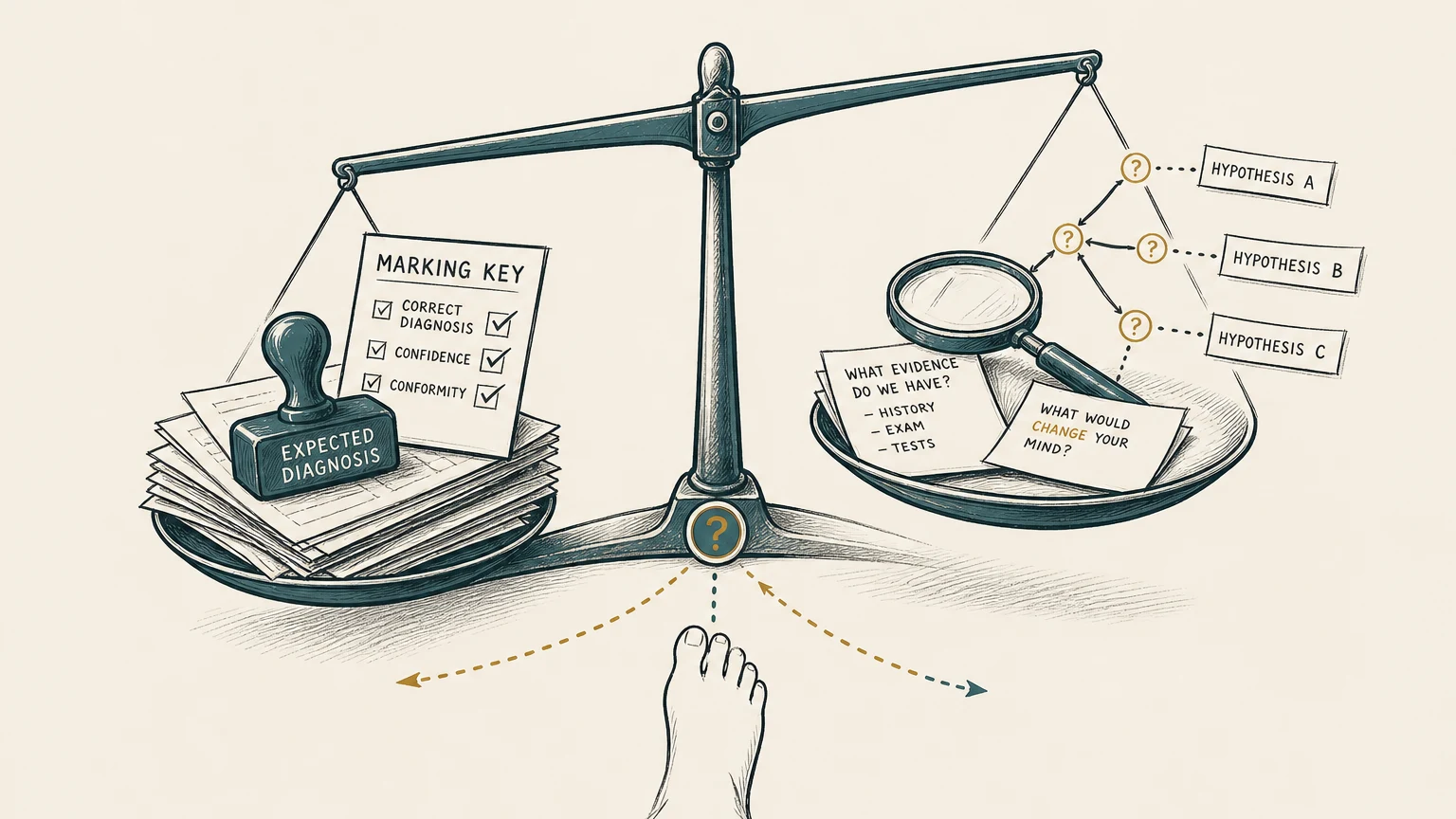
I've noticed something rather peculiar about students and newly graduated podiatrists. They seem to know an extraordinary amount. In fact, judging by the confidence with which some of them approach clinical problems, they occasionally appear to know considerably more than I do.
Which is interesting, because the more I've thought about the nature of knowledge, the less inclined I've become to be certain about things.
Perhaps I've been doing it wrong.
It's an observation that has become increasingly difficult to ignore, particularly having been through the university system myself. We spend years learning anatomy, pathology, biomechanics, pharmacology and all the other things that supposedly prepare us to become clinicians. We attend lectures, complete practical assessments, sit examinations and demonstrate our competence in carefully constructed clinical scenarios. Eventually, someone decides we've acquired sufficient knowledge to be released into the community, where we can begin applying it to unsuspecting members of the public.
And somewhere in this process, we appear to have confused knowing things with knowing how to think.
Consider the way students are assessed. They're presented with a clinical problem and expected to produce an answer. Preferably quickly. In an OSCE, the entire encounter is organised around this expectation. There's a patient, a clinical scenario, a limited amount of time and an examiner holding a marking sheet. The student is expected to gather the relevant information, perform the appropriate examination, identify the pathology and formulate a management plan. All within a few minutes.
There is little opportunity to contemplate the possibility that the information might be inadequate, that the clinical findings might be misleading, or that the most appropriate conclusion might be that no conclusion can yet be reached.
The examination has an answer. The examiner knows the answer. The student is there to find the answer.
And so they do.
Or at least they learn to produce something that resembles one.
Now, there are perfectly sensible reasons for assessing students this way. Universities have to establish minimum standards of competence. They need to know that graduates can recognise common pathology, perform examinations, identify dangerous conditions and make appropriate clinical decisions. They also need assessment systems that are reasonably consistent, practical and fair.
And, of course, students need to acquire knowledge before they can do very much with it.
I'm not suggesting we abandon examinations or replace clinical education with three years of philosophical contemplation. Although I suspect that would produce some fascinating conversations in the treatment rooms.
The problem isn't that we assess students' knowledge. It's that the way we assess that knowledge can encourage students to confuse producing an answer with understanding a problem.
This is not to suggest that universities don't teach clinical reasoning. They certainly claim to. It's written into learning outcomes, assessment rubrics and graduate competency statements. Students are taught differential diagnoses, diagnostic testing and the importance of evidence-based practice. Many educators make genuine efforts to encourage reflection and critical thinking.
But there's a difference between teaching someone the vocabulary of clinical reasoning and creating an environment in which they actually have to reason.
And there's an even greater difference between telling students to think critically and rewarding them for doing so.
Students are remarkably good at recognising what gets them marks.
An examination that rewards the rapid identification of a predetermined diagnosis is not necessarily assessing the ability to manage uncertainty. It may simply be assessing how efficiently a student can recognise the clues that the examiner has deliberately placed in front of them.
Real patients, unfortunately, are rarely so cooperative.
They don't arrive with three carefully selected symptoms, two positive clinical tests and a diagnosis conveniently concealed beneath the examination table. They arrive with complicated histories, contradictory findings, incidental imaging abnormalities and symptoms that sometimes bear only a passing resemblance to anything described in a textbook. They frequently have more than one thing wrong with them. Sometimes the thing that's wrong with them isn't the thing that's causing their symptoms. And occasionally, despite everyone's best efforts, nobody can establish precisely what's going on.
This is apparently rather inconvenient for an educational system that has spent three years teaching people that every clinical problem is supposed to have an answer.
I've encountered this disconnect firsthand when students and newly graduated clinicians have observed my consultations. Occasionally, I'll examine a patient and explain that I'm not entirely certain of the diagnosis. There may be several plausible explanations. The examination findings may not adequately distinguish between them. I might want further investigations, or perhaps simply to see how the condition develops before committing to a particular interpretation.
What I find fascinating is the response this sometimes produces.
Rather than recognising that uncertainty might be an entirely reasonable conclusion, some students seem to interpret it as evidence that I don't know what I'm doing. I've had students attempt to explain what I should be doing, and others seek out another podiatrist to clarify something they apparently believe I've failed to understand.
It's a peculiar experience. I'm considering the limitations of the evidence, while someone who has barely begun practising appears to have concluded that the problem is my lack of knowledge.
Of course, they might be right. A student can certainly recognise something another clinician has overlooked. And questioning the conclusions of someone more senior is not something I would discourage. Quite the opposite.
But that's not really the issue.
What's interesting is the apparent inability to distinguish between someone who doesn't know the answer and someone who recognises that the answer hasn't yet been established.
These are fundamentally different things.
And I don't particularly blame the students. They're behaving in a way that makes sense within the educational environment they've experienced. If you've spent years being rewarded for identifying diagnoses quickly and confidently, it isn't entirely surprising that you might interpret a clinician's hesitation as a lack of competence.
The problem isn't necessarily the student.
It's what we've taught them competence is supposed to look like.
I suspect part of the difficulty is that students are conditioned to regard uncertainty as a temporary inconvenience that must be eliminated as quickly as possible. Throughout their education, not knowing is something to be corrected. A blank examination answer receives no marks. Hesitation suggests inadequate preparation. Silence is uncomfortable, particularly when someone is standing over you waiting for a response.
And so students learn to fill the silence.
They learn to identify a diagnosis early, organise the available information around it and communicate their conclusion with confidence. The process becomes almost automatic. A patient mentions first-step heel pain, and plantar fasciopathy immediately springs to mind. Pain in the intermetatarsal space suggests a neuroma. Medial ankle pain with a collapsing arch suggests posterior tibial tendon pathology.
None of these associations is inherently unreasonable. Pattern recognition is an important part of clinical practice. Indeed, without it, every consultation would require us to reconstruct the entirety of medical knowledge from first principles, which would make a twenty-minute appointment rather ambitious.
The difficulty arises when recognising a familiar pattern is mistaken for establishing a diagnosis.
The student has identified something that might explain the symptoms. But rather than treating this as a hypothesis to be examined, it becomes the answer around which the rest of the consultation is organised. Subsequent findings are interpreted in relation to it. Supporting evidence is welcomed. Contradictory evidence becomes something to explain away.
The clinician is no longer necessarily investigating the patient's problem. They're defending their initial impression.
And because the initial impression was delivered with confidence, changing it becomes increasingly difficult.
This is not a peculiarity of podiatry. It's a fairly ordinary feature of human cognition. We form explanations, become attached to them and preferentially notice information that supports what we already believe. The feeling of understanding can be remarkably persuasive, even when the understanding itself is wrong.
What is peculiar is that we have constructed an educational system that can actively reward this tendency.
A student who confidently produces the expected diagnosis may be rewarded, while one who recognises the limitations of the available evidence risks appearing indecisive. The first student looks competent. The second looks uncertain.
Yet depending on the clinical problem, the second student may be demonstrating considerably better judgement.
There is an important distinction between uncertainty arising from ignorance and uncertainty arising from understanding. Someone who knows very little about a subject may be uncertain because they lack the necessary information. Someone who knows a great deal may be uncertain because they recognise how much information is missing, how unreliable some of the available evidence is, and how many plausible explanations remain.
Both may say they don't know.
But they haven't necessarily arrived at that conclusion by the same route.
Nor am I suggesting that confidence itself is a problem. There are plenty of clinical situations in which the evidence is compelling and a clinician should be appropriately confident in their conclusions. There are also situations in which uncertainty reflects a genuine lack of knowledge that needs to be addressed.
The objective isn't to make everyone uncertain about everything.
It's to ensure that the degree of confidence we express corresponds to the strength of the evidence supporting it.
That sounds almost embarrassingly obvious.
Yet it is remarkable how frequently the feeling of certainty gets mistaken for evidence that certainty is justified.
I've spent a great deal of my life interested in epistemology, the question of how we know things. Not simply what people believe, but how those beliefs are formed, what makes them justified, and why we so readily confuse the feeling of understanding with actually understanding something.
And clinical practice provides an almost endless demonstration of the problem.
There is nothing particularly reassuring about a podiatrist confidently explaining a diagnosis that hasn't been established. The patient may appreciate the apparent certainty, but their appreciation doesn't make the explanation correct. Indeed, a convincing but unsupported diagnosis may be considerably more harmful than an honest account of what remains unknown.
Once a patient has been told what's wrong, that explanation can acquire a life of its own. It appears in clinical notes, referral letters and subsequent consultations. Treatments are selected on the assumption that the original diagnosis was correct. Failure to improve may be interpreted as evidence that the condition is unusually persistent, rather than an indication that the initial explanation deserves reconsideration.
The diagnosis becomes increasingly established, not because the evidence has improved, but because it has been repeated.
There is something almost comical about this. A clinician makes an uncertain judgement, communicates it as a fact, and then treats the persistence of that judgement as further evidence of its validity.
Meanwhile, the patient still has a painful foot.
But the problem isn't confined to clinicians who are overly certain. Patients arrive with their own explanations, often acquired from previous consultations, internet searches, friends, family or the enormous medical university otherwise known as Google.
A patient walks into the room and announces, "I've got plantar fasciitis."
Now, perhaps they do.
But what exactly are we supposed to do with that statement?
We could simply accept it and proceed with treatment. After all, the patient seems quite certain, and it would be terribly inconvenient to introduce doubt into an otherwise straightforward consultation.
Or we could immediately challenge them.
"Actually, you don't know that."
Which would be a rather effective way of ensuring the patient never comes back.
The alternative is to treat the patient's explanation as a hypothesis worth investigating. We can ask how they arrived at it, what symptoms they're experiencing, what investigations they've had and what treatments they've already tried. We can explain which features are consistent with plantar fasciopathy and which might suggest something else.
We can involve them in the reasoning.
Rather than telling the patient that they're wrong, we can explore whether their explanation adequately accounts for the evidence.
And if it doesn't, we can explain why.
This is not simply a matter of being polite. It's an essential component of patient-centred care.
Patients don't arrive as empty vessels waiting to be filled with our superior knowledge. They arrive with beliefs, expectations, experiences and explanations of their own. Some of those explanations will be correct. Some will be partially correct. Some will be completely wrong.
Our responsibility isn't to humiliate them for getting the diagnosis wrong, nor to reinforce an incorrect belief simply because challenging it might be uncomfortable.
It's to help them understand the problem.
And sometimes that means taking them through the process of uncertainty.
We can explain that their symptoms are consistent with a particular condition, but that other possibilities remain. We can discuss what additional information might help distinguish between them. We can explain why we're recommending an investigation, a trial of treatment or a period of reassessment.
We can arrive at a diagnosis together, rather than simply announcing one.
And if the diagnosis remains uncertain, we can explain that too.
Patients generally don't come to see us because they're interested in exploring the philosophical limitations of diagnostic knowledge. They want to know what's wrong, whether it's serious and what we're going to do about it.
Fair enough.
They're paying for a consultation, not an introduction to epistemology.
But the expectation that we should provide an answer doesn't mean we're obliged to invent one.
And the ability to communicate this distinction is something I think we should be explicitly assessing in students.
Imagine a final-year OSCE in which the patient arrives confidently announcing their own diagnosis. The student is expected to investigate the claim, identify where the patient's explanation is supported or contradicted by the evidence, and communicate their findings without dismissing or humiliating them.
Or a patient who is convinced that an incidental imaging abnormality explains their symptoms.
Or a patient who has been given a diagnosis by another clinician that doesn't adequately account for the current presentation.
These are ordinary clinical encounters.
And they require considerably more than the ability to recite a differential diagnosis.
By the final year of a three-year DPM program, students should already have acquired substantial knowledge of anatomy, pathology, clinical examination and diagnostic testing. They should be able to recognise common presentations and perform appropriate assessments.
The question is whether they can use that knowledge to reason through a problem that doesn't have an obvious answer.
Can they challenge their own assumptions? Can they recognise contradictory evidence? Can they explain uncertainty to a patient? Can they revise their diagnosis without becoming defensive? Can they make safe clinical decisions when the available information remains incomplete?
These are things we could assess.
And, rather importantly, they are things we should be assessing.
What's particularly curious is that students in a Doctor of Podiatric Medicine program are already expected to engage with research, critically appraise evidence and understand the limitations of scientific knowledge.
They're introduced to concepts such as study design, bias, confounding and the interpretation of research findings.
The intellectual foundations are already there.
Yet we don't always seem to carry those same principles consistently into clinical education.
A student may be expected to critically appraise a research paper, identify methodological weaknesses and question the validity of its conclusions, then walk into a clinical examination and be rewarded for confidently producing the diagnosis the examiner was expecting.
It's a strange separation.
The scepticism we expect students to apply to published research should be the same scepticism they apply to their own clinical conclusions.
It shouldn't be something reserved for research assignments.
It should occupy every aspect of their education.
And perhaps we could learn something from the way we assess students in mathematics.
In a mathematics examination, the final answer is often worth only a small proportion of the available marks. Much of the assessment concerns the working out. The student has to demonstrate how they arrived at their conclusion, which principles they applied and whether the process itself was sound.
A student can make an arithmetic error and arrive at the wrong answer while still demonstrating a perfectly reasonable understanding of the mathematics. Another student might stumble upon the correct answer through an entirely flawed process.
The answer is the same. The understanding is not.
Yet in clinical education, we can become remarkably preoccupied with whether the student has named the expected pathology.
Imagine assessing clinical reasoning in the same way we assess mathematical reasoning. Instead of placing so much emphasis on whether the student correctly identifies plantar fasciopathy, we could examine how they arrived at that conclusion. What information did they consider relevant? What alternative explanations did they entertain? What findings supported their hypothesis? What findings challenged it? How reliable were the clinical tests they selected? And, perhaps most importantly, what would cause them to reconsider?
A student who arrives at an incorrect diagnosis through an otherwise defensible process may demonstrate better clinical reasoning than one who happens to announce the correct diagnosis after thirty seconds of guesswork.
Of course, the consequences of an incorrect clinical diagnosis are rather different from getting a mathematics question wrong. Recognising dangerous pathology and making safe decisions must remain essential components of assessment. But that only strengthens the argument for examining the reasoning process rather than simply rewarding the answer.
And this brings me to something else I've found particularly frustrating about university assessment.
The marking key.
I remember completing an examination question concerning ankle inversion injuries. I'd approached the problem by considering the underlying clinical reasoning rather than simply reproducing what I thought the examiner wanted.
Afterwards, I spoke with the examiner, who told me that what I'd written was absolutely brilliant.
But there was a problem.
It wasn't on the marking key.
And because it wasn't on the marking key, he couldn't award me the marks.
Think about that for a moment.
An examiner, someone presumably qualified to assess the subject, recognised the quality of an answer but was unable to reward it because it didn't correspond with a predetermined list of expected responses.
What exactly are we assessing here?
Understanding?
Clinical reasoning?
Or the ability to anticipate what someone has written on a piece of paper?
I appreciate why marking keys exist. Universities need consistency. Students deserve fair assessment, and examiners shouldn't be awarding marks according to personal preference or whether they happen to like someone's interpretation.
But consistency is not the same thing as validity.
An assessment can be perfectly consistent and still reward the wrong things.
And I think we've lost sight of what university grades are actually supposed to represent.
Consider the distinction between a pass, a credit, a distinction and a high distinction. These aren't supposed to be arbitrary divisions of a numerical score. They're supposed to represent different levels of academic achievement.
Read the descriptions of what constitutes a high distinction. You'll generally encounter references to exceptional understanding, critical analysis, independent thought, originality and the sophisticated application of knowledge.
Wonderful.
But how exactly are we assessing those qualities when the examiner is prohibited from awarding marks for an exceptional answer because it wasn't anticipated by the marking key?
We're not.
We're assessing conformity to the marking key and then calling the students who conform most successfully exceptional thinkers.
Perhaps it's time to reconsider how we distribute the marks.
Suppose the first seventy per cent of an assessment were allocated to demonstrating the required knowledge and competencies. The student identifies the relevant anatomy, understands the pathology, performs the appropriate examinations, recognises important differential diagnoses and demonstrates safe clinical decision-making.
All the things we reasonably expect a graduating clinician to know.
A student who demonstrates these competencies exceptionally well could achieve a credit approaching seventy per cent.
That's a perfectly respectable academic result. They've demonstrated that they understand and can apply what they've been taught.
But what distinguishes that student from someone who deserves a distinction or high distinction?
Surely it should be something more than reproducing a few additional items from the marking key.
I'd argue that the remaining thirty per cent should be reserved for the demonstration of genuine critical thought.
Can the student recognise limitations in the available evidence? Can they identify assumptions embedded in the clinical scenario? Can they develop and defend an alternative explanation? Can they recognise when a conventional approach may be inadequate? Can they synthesise information in a way that demonstrates understanding beyond the material they've been explicitly taught?
Can they produce an argument that the examiner hadn't anticipated, but which is nevertheless intellectually defensible?
And can they explain why?
That is what distinction should mean.
Not simply that the student remembered more information.
But that they demonstrated a greater capacity to think.
Of course, this would need to be made explicit to students. They should understand from the beginning that reproducing the expected knowledge demonstrates competence, while exceptional grades require something more. They should be encouraged to question assumptions, examine competing explanations and develop original arguments, rather than worrying that doing so might cost them marks because their answer doesn't match the template.
And the assessment would need to distinguish genuine critical thinking from merely being unconventional. An unusual answer isn't necessarily a good answer. Nor should a student receive additional marks for constructing an elaborate argument around something demonstrably wrong.
Critical thought still has to be supported by evidence, sound reasoning and an appropriate understanding of the subject.
Which brings us to the examiner.
This approach would require the person marking the assessment to possess sufficient expertise to recognise the quality of reasoning that extends beyond the predetermined answer.
That shouldn't be a particularly controversial expectation.
Surely the whole point of having an expert assess a student's work is that the expert can evaluate something more sophisticated than whether the student has reproduced a collection of keywords.
The marking key should establish the essential knowledge and competencies. It should provide consistency, identify unacceptable errors and ensure that students are assessed fairly.
But it shouldn't establish the upper limits of what a student is permitted to demonstrate.
There should be room for an examiner to recognise an exceptional argument, even when that argument wasn't anticipated by whoever wrote the question.
There should be room for original thought.
There should even be room for the examiner to learn something.
Imagine that.
And there's another reason this distinction has become increasingly important.
Artificial intelligence.
If the principal purpose of an assessment is to determine whether a student has reproduced a predetermined collection of answers, we're rapidly approaching a point where much of that process can be automated.
Indeed, much of it already can be, although the reliability of automated marking still requires careful validation and human oversight.
AI can compare responses against marking criteria, identify expected concepts and assist with evaluating whether prescribed information has been included.
It can perform many of the mechanical tasks involved in assessment.
So what, precisely, are we paying expert academics to contribute?
Surely it's their expertise.
Their capacity to recognise sophisticated reasoning, evaluate competing interpretations, identify originality and distinguish genuinely insightful arguments from plausible nonsense.
These are the qualities that should become more important in higher education, not less.
If anything, the emergence of AI should force universities to reconsider what they're actually assessing.
Because the ability to retrieve, reproduce and reorganise established information is becoming increasingly easy to automate.
The ability to critically evaluate that information, recognise its limitations, apply it to unfamiliar problems and defend a conclusion under scrutiny remains central to professional competence.
And those are precisely the qualities that our highest academic grades supposedly recognise.
Universities are charging students substantial sums of money for professional education. They have a responsibility to provide more than an efficient system for distributing marks.
If assessing genuine intellectual competence requires more time, greater expertise and more sophisticated assessment methods, then perhaps that's what universities should be providing.
Not redefining academic excellence around whatever happens to be easiest to mark.
A pass should mean the student has met the required standard.
A credit should recognise a strong command of the expected knowledge and competencies.
A distinction should indicate something more.
And a high distinction should represent genuinely exceptional intellectual achievement.
Not simply exceptional compliance with the marking key.
Because the student who can reproduce everything they've been taught may well become a competent clinician.
But the student who can question what they've been taught, recognise its limitations and develop a better explanation is demonstrating something else entirely.
And I would have thought that was precisely the sort of student a university should be most interested in producing.
Which brings us back to what I think is the essential foundation of clinical reasoning.
Detached scepticism.
Not cynicism. Not indecision. And certainly not the rather fashionable habit of questioning everyone else's knowledge while remaining entirely convinced of your own.
I mean a genuine willingness to examine your own conclusions with the same critical scrutiny you would apply to someone else's.
A diagnosis is a hypothesis. It is not a personal achievement.
It should be tested, challenged and, when necessary, abandoned without ceremony.
You cannot become emotionally invested in your own explanations. You cannot allow the satisfaction of having identified a plausible diagnosis to interfere with your ability to recognise that it might be wrong.
And you cannot treat evidence that contradicts your preferred explanation as an inconvenience to be explained away.
In fact, contradictory evidence should be particularly interesting.
If a patient's symptoms don't correspond with the imaging findings, perhaps the imaging isn't explaining the symptoms. If a condition doesn't respond as expected, perhaps the diagnosis deserves reconsideration. If a clinical test produces an unexpected result, perhaps we should examine what that test actually measures, rather than assuming it has somehow failed to cooperate.
None of this means that every contradiction invalidates a diagnosis. Clinical evidence is imperfect, and individual findings are rarely decisive. But a contradiction should prompt thought, not an automatic defence of the original explanation.
The objective is not to prove ourselves wrong at every opportunity. It's to establish whether our beliefs remain justified when subjected to serious scrutiny.
This is a rather different intellectual exercise from the one students are accustomed to performing in examinations. Instead of searching for the findings that confirm the expected answer, we should be asking what observations would make that answer less plausible.
And instead of asking students to demonstrate how much they know, perhaps we should occasionally ask them to demonstrate how they know it.
There is a tremendous amount of information available to contemporary healthcare professionals. More than any individual could reasonably hope to retain. The problem is no longer simply one of acquiring knowledge. It's learning how to evaluate it, distinguish reliable evidence from plausible nonsense, and apply it to patients who rarely behave as the textbooks suggest.
And that requires more than memorisation.
It requires understanding the limitations of diagnostic tests, the difference between association and causation, the possibility of incidental findings, the influence of prior assumptions and the tendency of human beings to find patterns even when those patterns are misleading.
It requires recognising that the confidence with which someone expresses a belief tells us very little about whether that belief is true.
Including when that someone is ourselves.
Now, I don't expect universities to produce graduates with decades of clinical experience. Nor do I think every student who emerges from university displaying excessive confidence represents a failure of the educational system. Some degree of intellectual development inevitably occurs through practice, and many students already demonstrate admirable judgement and humility.
But that doesn't mean we should leave the development of these skills to experience alone.
We shouldn't have to wait for clinicians to accumulate years of diagnostic mistakes before they begin questioning the reliability of their own conclusions.
These are not advanced concepts to be acquired after years of practice. They should be the foundations upon which clinical education is built.
And this is perhaps what concerns me most about the certainty I sometimes encounter in newly graduated clinicians. It isn't simply that they're inexperienced. Everyone begins somewhere. It's that some appear to have emerged from their education without acquiring the intellectual habits necessary to recognise the limitations of their own understanding.
They have learned to produce an answer, but not necessarily to question it.
They have learned to recognise pathology, but not necessarily to distinguish recognition from explanation.
They have learned to communicate confidence, but not necessarily to establish whether that confidence is justified.
And they have learned that uncertainty is something to overcome, rather than something to understand.
I suspect this is one of the most important lessons we could teach students before they enter clinical practice.
Not another diagnosis. Not another special test. Not another confidently delivered explanation.
But the ability to stand back from their own conclusions and ask whether the evidence actually supports them.
And the ability to take a patient through that same process, respectfully, transparently and without pretending that every question has an immediate answer.
Because the most important question in clinical practice isn't necessarily, "What's the diagnosis?"
It's the question that should follow every diagnosis, every investigation and every treatment decision.
How do I know I'm right?
And perhaps more importantly, what would convince me that I'm wrong?