Author attribution not recorded
There is a peculiar phenomenon in healthcare that I encounter often enough that I think it deserves a name.
I call it therapeutic causal inversion.
It goes something like this.
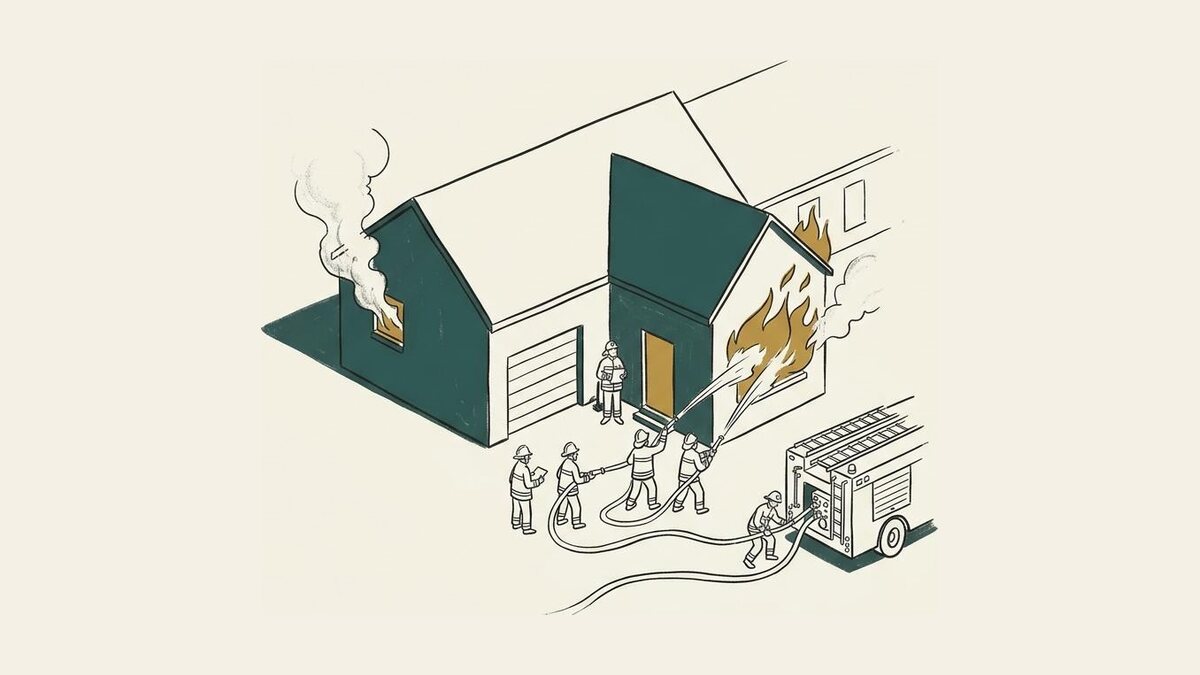
Your house is on fire.
You notice this because the curtains are ablaze, the smoke alarm is screaming and your lounge room is rapidly becoming an outdoor entertaining area.
Naturally, you call the fire brigade.
The fire brigade arrives.
They unroll hoses, spray several thousand litres of water through your house, smash a window, drag a burning sofa onto the lawn and, after considerable effort, extinguish the fire.
You survey the damage.
Then you turn to the firefighter and say:
“Well, I never had a house fire until you people turned up.”
Technically, this is true.
There was indeed a period of your life before the fire brigade arrived during which you had never previously met these particular firefighters.
Unfortunately, there was also the small matter of the house already being on fire.
This distinction occasionally becomes surprisingly difficult in healthcare.
A patient presents with a painful problem.
We assess the painful problem.
We treat the painful problem.
At some later point, the patient reports:
“Ever since you treated that, it's been painful.”
Which presents an interesting historical problem, because the medical record says:
Reason for presentation: pain.
Sometimes the chronology is even better.
Patient presents with painful corn.
Corn is treated.
Patient reports that the pain has resolved.
Time passes.
The story eventually becomes:
“That corn was really painful after you treated it.”
At which point the clinical notes sit quietly in the corner wondering whether they have somehow travelled here from a parallel universe.
The problem isn't that treatment can never cause pain. Of course it can. Treatments have adverse effects. Shoes can irritate things. Exercises can aggravate things. Clinicians occasionally get things wrong.
The interesting phenomenon is something much more specific.
It is when the thing that caused the patient to seek treatment subsequently becomes attributed to the treatment itself.
The indication becomes the complication.
A patient develops a musculoskeletal problem and is prescribed exercises.
Later:
“I didn't have this problem until I started those exercises.”
Except, inconveniently, some version of the problem was why the exercises were prescribed.
This is where chronology becomes quite important.
If I walk into my kitchen because the smoke alarm is going off and discover a flaming toaster, my arrival in the kitchen did not cause the toaster to catch fire.
If a plumber arrives because water is pouring through my ceiling, the plumber has not caused the leak.
If an ambulance arrives after I fall off a ladder, the ambulance has not pushed me off the ladder.
And if I present to a podiatrist saying:
“This corn hurts.”
then subsequently experience pain from the corn, we should at least entertain the radical possibility that:
the corn hurts.
There is another version involving footwear.
A painful lesion develops.
The patient seeks treatment.
Footwear advice is provided partly because of the painful lesion.
The patient subsequently notices the painful lesion while wearing the recommended shoes.
Therefore:
“Those shoes caused my corn to hurt.”
Perhaps.
But there is another suspect in this investigation.
The corn.
It was last seen at the scene of the crime and has an extensive history of causing precisely this symptom.
Again, none of this means clinicians should dismiss reports of adverse effects. Quite the opposite. If something genuinely deteriorates following an intervention, we should investigate whether the intervention contributed.
But “after” and “because of” remain different words for a reason.
And “the problem existed before the treatment because the problem was why we treated you” remains a surprisingly useful piece of clinical information.
Human memory is reconstructive. Once an intervention becomes a salient event, it provides a convenient landmark around which the history can reorganise itself:
I had the treatment, and then I remember having the problem.
The less memorable period in which the problem gradually developed, became troublesome and eventually caused the person to seek treatment can disappear from the reconstructed story.
Fortunately, healthcare has developed an ingenious technology for dealing with this.
We write things down.
This is why contemporaneous clinical notes matter.
If today's recollection is:
“The pain started after you treated the corn,”
and the original consultation begins:
“Presents with painful corn…”
we have encountered something more interesting than a disagreement about treatment.
We have encountered a disagreement with time itself.
And time, despite its many shortcomings, has generally proved stubborn about running in one direction.
So perhaps the next time the fire brigade leaves your smoking house, resist the temptation to shake your fist after them.
They may have flooded the carpet.
They may have broken the window.
They may even have backed the truck over your hydrangeas.
Those are perfectly legitimate complaints.
But they probably didn't start the fire.
Footnote: If your clinical notes say the house was already on fire when you arrived, keep the notes.