For the past two years, I've been writing about feet.
Well, ostensibly.
Somewhere between plantar fasciopathy, chemotherapy-induced neuropathy, diabetic foot disease, the peculiar economics of podiatry, and the extraordinary ability of healthcare institutions to manufacture problems they then congratulate themselves for managing, the subject matter expanded somewhat.
What started as a collection of clinical observations became something else.
An examination of how we practise healthcare, how we teach it, how we regulate it, and why so much of what we confidently repeat deserves considerably more scrutiny than it receives.
I've questioned clinical conventions, challenged professional institutions, criticised education, and occasionally suggested that the emperor might benefit from a second opinion.
Some people have agreed. Others haven't.
Excellent.
That's rather the point.
The Footnote now has its own home.
And it's considerably more ambitious than a website for storing articles about bunions.
The problem with knowing everything
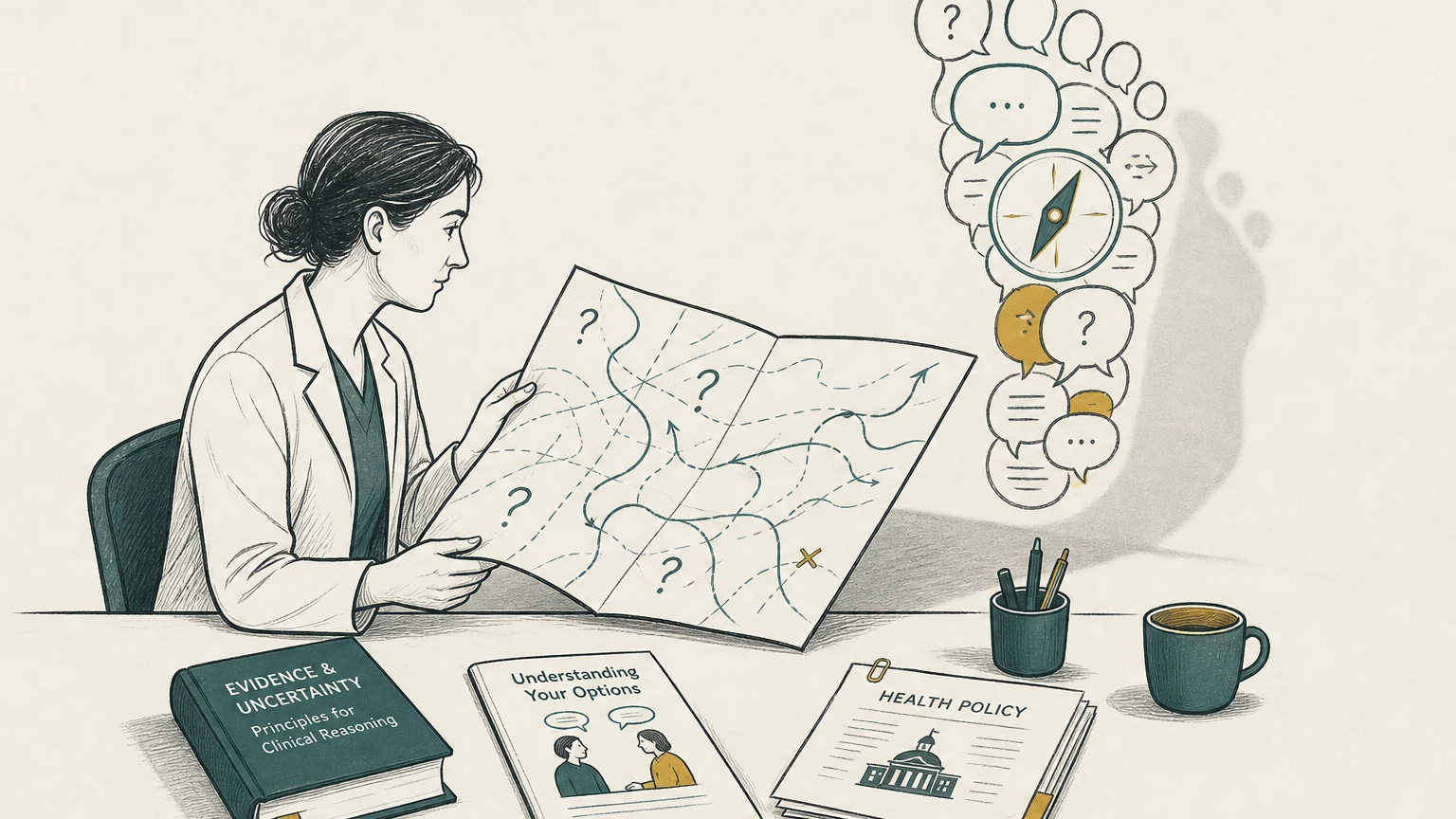
Healthcare has an uncomfortable relationship with uncertainty.
We spend years being educated to provide answers. We sit examinations that reward certainty, memorise classifications, learn treatment algorithms, and emerge with impressive qualifications that supposedly demonstrate our capacity to think.
Then a patient walks into the consulting room and inconveniently refuses to resemble the textbook.
The symptoms don't match the imaging. The treatment that should work doesn't. The diagnosis explains the pathology but not the pain.
And suddenly the most useful thing a clinician can possess isn't another memorised answer.
It's the capacity to question one.
Yet much of our professional education continues to reward the appearance of certainty over the process of reasoning. We teach conclusions, assess recall, and too often confuse familiarity with understanding.
The problem isn't that clinicians don't know enough.
It's that we aren't always encouraged to examine how we know what we think we know.
The Footnote was built around that distinction.
Not to replace established knowledge with my own collection of supposedly superior opinions. That would simply be another authority demanding obedience, albeit one with a better collection of foot illustrations.
The objective is to make the reasoning visible.
To challenge assumptions, examine evidence, expose contradictions, and make it entirely acceptable to say, "Actually, I'm not convinced."
Particularly when the person saying it is a student.
Education should teach you how to think, not what to repeat
This is where The Footnote has taken its biggest step.
I've built The Footnote Academy, an independent clinical education platform designed around the way problems actually present.
Not around how conveniently they fit into a lecture.
The flagship course, The Foot & Ankle Pain Map, starts with something beautifully uncomplicated.
A patient points to their foot.
It hurts here.
Now what?
Rather than beginning with a diagnosis and working backwards to justify it, the course starts with the patient's presentation. You navigate an anatomical map, explore competing explanations, work through examination findings, clinical reasoning, and management decisions.
There are 31 lessons, hundreds of questions, clinical cases, and downloadable resources.
But the number of lessons isn't the important part.
The important part is what happens between the question and the answer.
Why does one finding matter? What would make you reconsider? Which diagnosis are you overlooking because the first explanation felt comfortable?
What evidence would change your mind?
That's the education I'm interested in building.
And it's not confined to one course.
The Academy also includes education in treatment and rehabilitation, ingrown toenail management, and acute ankle injuries.
If you want to see what I'm trying to achieve before spending a cent, The Rolled Ankle is completely free.
Work through it. Challenge it. Tell me where the reasoning fails.
I'd much rather receive a well-argued disagreement than another certificate of attendance.
The profession needs to grow a backbone
There's another reason The Footnote exists.
I love podiatry.
I don't always love what we've allowed it to become.
We are a profession with extraordinary clinical knowledge, considerable responsibility, and a remarkable capacity to underestimate our own contribution.
We complain about recognition while too often accepting the structures that diminish it.
We argue about scope while allowing other people to define it.
We talk about professional advancement while sometimes treating anyone who questions established arrangements as though they've committed an act of treason against the foot.
And we've developed a peculiar habit of confusing professional unity with the absence of disagreement.
They aren't the same thing.
A profession that cannot tolerate criticism cannot meaningfully improve.
I want The Footnote to give podiatry a kick up the arse when it needs one, and help it stand its ground when it should.
That means challenging our own practices as readily as we challenge the institutions regulating them.
It means discussing professional remuneration, prescribing rights, Medicare, education, clinical autonomy, and the uncomfortable economics of delivering healthcare.
It means asking whether a policy actually benefits patients rather than accepting that it must be sensible because somebody important signed it.
To support that, the website includes an Australian Policy Library, bringing together the actual documents behind many of these debates.
Because if we're going to argue about policy, we might as well read the bloody thing first.
Healthcare doesn't belong to professional silos
Although The Footnote began in podiatry, I have no intention of keeping it there.
A patient with diabetic foot disease doesn't arrive as a purely podiatric problem.
Neither does someone with persistent pain, inflammatory disease, neuropathy, a complex injury, or a condition complicated by the medication they're taking for something entirely different.
The body hasn't read our professional scope documents.
It remains stubbornly interdisciplinary.
A physiotherapist might see a movement problem where I see a mechanical one. A nurse might recognise a clinical deterioration before either of us. A pharmacist might identify the medication responsible for the symptoms. A GP might recognise the systemic disease connecting everything.
None of us possesses the entire picture.
That's why The Footnote is being built for clinicians across disciplines, not simply for podiatrists.
And although I'm building it from Bunbury, Western Australia, its ambitions are international.
The underlying questions about clinical reasoning, education, evidence and professional authority aren't uniquely Australian.
I want clinicians in Manchester, Toronto, Perth, Singapore and anywhere else to be able to explore the same clinical problems, compare perspectives, and challenge the assumptions they encounter in their own systems.
Not because everyone should practise identically.
Precisely because they don't.
And what about the patients?
They haven't been forgotten.
The website also has a growing collection of free patient resources, written to explain clinical problems without requiring six years of university education and a working knowledge of Latin.
Patients deserve to understand what's happening to them.
They deserve explanations that acknowledge uncertainty, distinguish evidence from speculation, and don't turn every ache into a catastrophe requiring an expensive intervention.
They also deserve something better than the increasingly sophisticated industry devoted to selling them miracle cures.
If I can help someone understand their condition before they spend $89.95 on a magnetic compression sock endorsed by a man wearing a white coat in a stock photograph, I'll consider that a useful contribution.
A word about independence
The Footnote is independently built, independently edited, and independently funded.
That's deliberate.
I don't want to have to seek permission from a professional organisation before questioning its decisions.
I don't want educational content shaped around the interests of a sponsor.
And I don't want the commercial success of an article to determine whether its argument is worth making.
Independence doesn't guarantee accuracy. It certainly doesn't make me immune to bias.
It does mean the arguments can stand or fall on their merits.
The journal and patient resources are free. They will remain free.
The Academy is how I intend to make the wider project sustainable, with a combination of free and paid clinical education.
That distinction matters.
The ideas are not behind a paywall. The work of building structured education is what supports the platform.
And for those who've followed The Footnote on LinkedIn, nothing is disappearing.
I'll continue publishing full, clinician-focused articles here. You won't need to leave LinkedIn to finish reading an argument, and you won't find the interesting half hidden behind a subscription.
The website simply allows the project to become something that LinkedIn was never designed to accommodate.
A permanent, searchable body of writing. A clinical education platform. A patient resource. A policy reference. And, hopefully, a place where intelligent professional disagreement is treated as an asset rather than a disciplinary problem.
So, where does this go?
I don't know exactly.
Which, given everything I've just written about uncertainty, seems an appropriate admission.
I know what I want it to become.
A genuinely independent voice in healthcare.
A place where clinical reasoning matters more than professional theatre.
Where students are encouraged to question their teachers.
Where clinicians from different disciplines learn from each other.
Where professional organisations are expected to justify their decisions.
Where patients are treated as people capable of understanding their own health.
And where an argument can be challenged without everyone immediately retreating into their respective professional bunkers.
I want The Footnote to contribute something meaningful to healthcare in Australia and, eventually, well beyond it.
Not by claiming to possess the answers.
By insisting that we ask better questions.
For everyone who's read an article, shared one with a colleague, disagreed with me, or wondered why a podiatrist in Bunbury keeps writing about things that have absolutely nothing to do with toenails — thank you.
You've helped turn a writing project into something much bigger.
Now I'd like you to come and see what I've built.
Read the journal. Explore the Academy. Try the free Rolled Ankle course. Send a patient a resource. Read a policy document. Find something you disagree with.
And if you think I've got something wrong, tell me why.
The Footnote is open.
Clinical thinking without the professional theatre.
— Steve Gillingham
Doctor of Podiatric Medicine
Founder & Editor, The Footnote
Bunbury, Western Australia