Take a stethoscope—65 centimetres of soft PVC tubing, stainless steel, and a dash of nostalgia. Yet every time you sling it around your necks you tacitly accept a radical proposition: I hold in my hands a tool that can lessen another human’s suffering—and in so doing, polish my own rough edges. That tiny acoustic gadget is both a diagnostic instrument and a moral compass pointing true north toward the patient. Nearly a century ago Francis Peabody whispered the same wisdom: “The secret of the…
Author attribution not recorded
Prelude: the stethoscope as compass
Take a stethoscope—65 centimetres of soft PVC tubing, stainless steel, and a dash of nostalgia. Yet every time you sling it around your necks you tacitly accept a radical proposition: I hold in my hands a tool that can lessen another human’s suffering—and in so doing, polish my own rough edges. That tiny acoustic gadget is both a diagnostic instrument and a moral compass pointing true north toward the patient. Nearly a century ago Francis Peabody whispered the same wisdom: “The secret of the care of the patient is in caring for the patient.” ¹
Today, regardless of specialty—podiatry, cardiothoracic surgery, dermatology or dentistry—the consultation room remains a crucible where science, ethics, and plain-old human decency liquefy and re-solidify into something stronger. Clinical practice is a gift wrapped in nitrile gloves—a gift to patients, yes, but equally to clinicians brave enough to open it.
The Gift Nobody Asked for (Yet Everybody Needs)
A brief manifesto
Modern healthcare is an industrial maelstrom of electronic forms, throughput targets, and reimbursement gymnastics. Against that backdrop it is easy—almost logical—to treat patients as widgets on a conveyor. But each encounter is an unrepeatable experiment performed on two co-participants: practitioner and patient. The gift lies in that reciprocal transformation.
To the patient, the value is obvious: less pain, longer life, restored mobility, or merely the reassurance that nothing sinister lurks beneath a dull ache.
To the clinician, the return on investment is subtler yet deeper: enhanced empathy circuits, sharpened diagnostic reasoning, quicker pattern recognition, and—when we get it right—a fleeting, narcotic hit of existential purpose.
Why “helping humanity” is not a Hallmark-card cliché
Empathy isn’t just warm-and-fuzzy optics. It measurably improves clinical outcomes. In a landmark study of 891 diabetes patients, higher physician-empathy scores correlated with better HbA1c and LDL levels.² Systematic reviews in general practice echo these findings, linking empathic care with lower anxiety scores and improved enablement.³ Randomised trials even show that a clinician’s empathic style can shorten the common cold by nearly a day.⁴
More empathy → better biochemistry → fewer hospital beds occupied → healthier economies. That’s an ROI any health minister—or venture capitalist—can appreciate.
Practice as Moral and Intellectual Gymnasium
The character workout
Every session challenges one of the great moral triathlons: patience, humility, and curiosity.
Patience when your fifth “Dr Google” disciple insists their mole is malignant because an influencer said so.
Humility when today’s slam-dunk diagnosis reveals itself tomorrow as a red herring.
Curiosity when a child’s foot pain isn’t Sever’s disease but an obscure osteoid osteoma daring you to remember page 143 of that dusty orthopaedics text.
Repetition yields neuroplastic gains. Just as squats build quads, genuine listening builds character.
The cognitive upgrade
Clinical reasoning is jazz—structured improvisation atop foundational scales. Iterative exposure to uncertainty trains Bayesian thinking, cultivates tolerance for ambiguity, and inoculates against cognitive biases such as premature closure or anchoring. In an era where AI already outperforms dermatologists at melanoma detection, our edge is not database retrieval but metacognition: knowing how we know and flagging when we don’t.
Connection: The Non-Negotiable Currency
Evidence that connection converts
A meta-analysis covering 127 studies links effective physician communication with a 19 % improvement in patient adherence.⁵ Meanwhile, empathic communication demonstrably elevates satisfaction scores⁶ and trims malpractice risk.⁷
Translation for busy clinics: Better talk → Better adherence → Better outcomes → Fewer angry Google reviews → Fatter bottom line.
Connection under siege
Administrative creep, 12-minute consults, and inbox tsunamis threaten to amputate relational medicine. Burnout doubles the odds of unsafe care and unprofessional behaviour.⁸ The antidote? Ritualise connection:
60-second mindset reset before opening the door—breath, posture, intent.
Name + Concern + Goal in the first minute (“Ms Li, I see you’re worried about that plantar wart; my aim is to stop it sabotaging Parkrun”).
Micro-reflection after the consult: What surprised me? What moved me? This seeds continuous learning.
Money, Status, and the Ethical Ledger
There’s nothing impure about profit
Clinicians inhabit real economies. We mortgage houses, pay staff, and—heaven forbid—enjoy espresso machines. Charging fairly for expertise is neither greedy nor unhip; it is the scaffolding that keeps the clinic’s doors open for society’s most vulnerable.
When status becomes rust
Status, like iron, is useful until it oxidises into hubris. The moment prestige outranks patient welfare, we slide toward scandals that fuel royal commissions and social-media pile-ons. The internal audit is simple: Would I manage my mother this way if Medicare paid zero dollars more? If the answer is “perhaps not,” recalibrate.
5 Practical Habits to Honour the Gift
Radical presence: Put the phone face-down, close the EMR for 90 seconds, and make eye contact.
Narrative rounding: Borrow from Schwartz Rounds—share a 2-minute story of a patient who changed you in today’s team huddle.
Deliberate gratitude: End the day listing three patient encounters that taught you anything—clinical, ethical, or comedic (“Yes, Mr Jones, foot deodorant is tax-deductible if you’re a shoe model”).
Mentor sideways: Swap a tricky case with a peer outside your silo; cross-pollination spawns creative solutions.
Invest in communication CPD: Courses in motivational interviewing or non-violent communication yield higher returns than the latest gadget.
The Bigger Picture: Health Systems as Moral Amplifiers
Healthcare systems magnify clinician intent. When policy incentivises throughput over thought, empathy is collateral damage. Conversely, models that reimburse dialogue prove that paying for brains and hearts beats paying for hands alone. Clinicians must lobby for structures that let them practise the gift at scale—less clicking, more connecting.
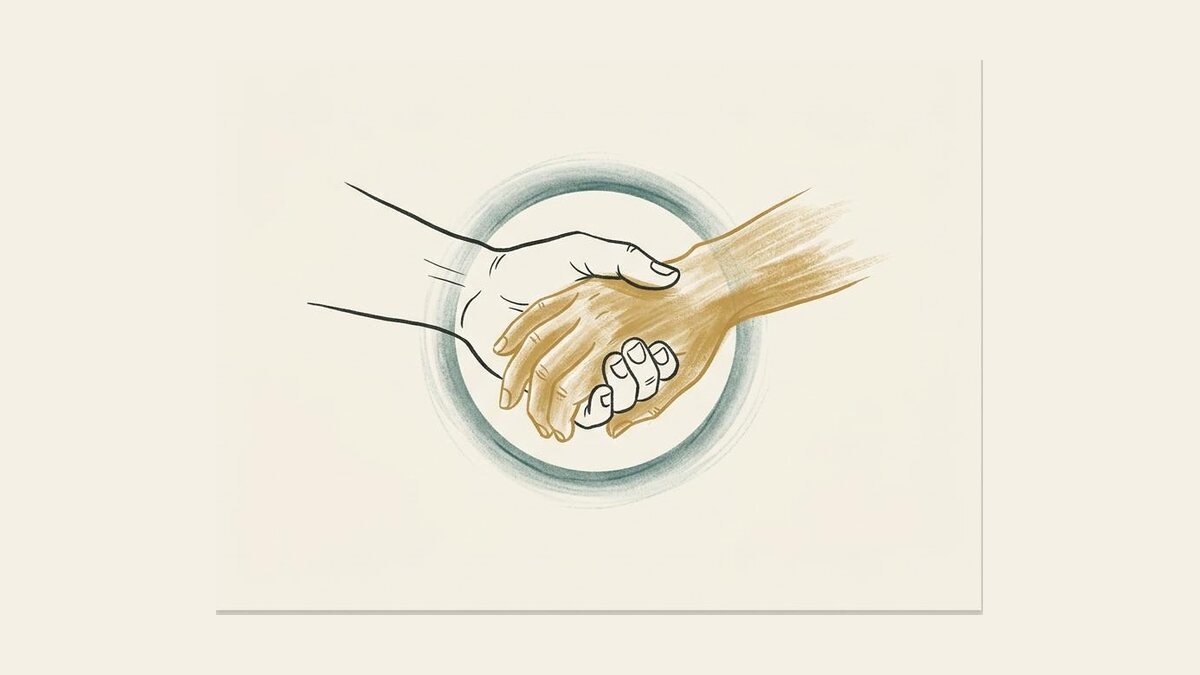
Conclusion: The Handshake that Changes Two Lives
Every time a clinician sanitises and extends a hand, two biographies intersect and neither emerges identical. The patient gains relief, guidance, or solace; the clinician gains perspective, pattern-recognition n + 1, and—if awake to it—a notch higher on the moral growth chart.
Money earned and accolades accrued are perfectly acceptable souvenirs. But history remembers those who helped, not those who merely billed. The gift of clinical practice is therefore less a profession than a passport—stamped daily in that liminal space between two chairs—authorising us to travel deeper into shared humanity.
Use it generously. Spend it lavishly. Then tell us about the journey in the comments below—because The Footnote thrives on stories that remind us why we picked up that humble stethoscope in the first place.
References
Peabody FW. The care of the patient. JAMA. 1927;88(12):877-882.
Hojat M, Louis DZ, Markham FW, Wender RC, Rabinowitz C, Gonnella JS. Physicians’ empathy and clinical outcomes for diabetic patients. Acad Med. 2011;86(3):359-364.
Derksen F, Bensing J, Lagro-Janssen A. Effectiveness of empathy in general practice: a systematic review. Br J Gen Pract. 2013;63(606):e76-e84.
Rakel DP, Hoeft TJ, Barrett BP, Chewning BA, Craig BM, Niu M. Practitioner empathy and the duration of the common cold. Fam Med. 2009;41(7):494-501.
Haskard Zolnierek KB, DiMatteo MR. Physician communication and patient adherence to treatment: a meta-analysis. Med Care. 2009;47(8):826-834.
Kim SS, Kaplowitz S, Johnston MV. The effects of physician empathy on patient satisfaction and compliance. Eval Health Prof. 2004;27(3):237-251.
Levinson W, Roter DL, Mullooly JP, Dull VT, Frankel RM. Physician–patient communication: the relationship with malpractice claims among primary care physicians and surgeons. JAMA. 1997;277(7):553-559.
Panagioti M, Panagopoulou E, Bower P, et al. Association between physician burnout and patient safety, professionalism, and patient satisfaction: a systematic review and meta-analysis. JAMA Intern Med. 2018;178(10):1317-1330.