The rocker-bottom shoe changed the way we manage foot pain. Then someone apparently decided that what it really needed was more foam.
A genuinely good idea
I'll give HOKA credit where it's due.
When HOKA popularised the modern maximalist rocker-bottom shoe, it was a genuine game changer. Not because it looked different. Not because it had an enormous slab of foam underneath it. But because the rocker actually did something useful.
It changed how the foot moved through the gait cycle.
For patients with forefoot pathology, particularly conditions affecting the metatarsophalangeal joints, that was a big deal.
Instead of requiring the forefoot to bend excessively during propulsion, the curved sole allowed the body to roll forward over the shoe.
Less demand for joint dorsiflexion. Less mechanical stress through painful structures. A relatively simple mechanical intervention with potentially enormous clinical benefit.
For patients with hallux rigidus, forefoot arthritis and other conditions aggravated by propulsion, a well-designed rocker can be transformative.
HOKA didn't invent the rocker sole. But it helped bring the concept into mainstream athletic footwear.
And for that, it deserves recognition.
Unfortunately, somewhere along the way, the plot seems to have been lost.
When cushioning becomes the problem
There's an obsession in modern footwear with softness.
More foam. More cushioning. More bounce. More promises about walking on clouds.
Apparently, we've decided that the ultimate shoe is a mattress with laces.
But here's the problem.
Softness and mechanical stability are not the same thing.
And in some patients, they're practically opposites.
Over the years, I've become increasingly frustrated with the direction of many HOKA models.
The rocker geometry is still there. The cushioning is certainly there. But the structural integrity of the shoe, particularly around the periphery of the midsole, can be another story.
For someone with a relatively neutral foot posture and well-controlled gait, this might not be particularly problematic.
But that's not the population I'm generally treating.
I'm treating people with deformity, asymmetrical loading, restricted joint movement and established pathology.
And putting these patients on top of an enormous stack of compressible foam can create an entirely new problem.
The disappearing edge
Here's what I repeatedly see clinically.
A patient with a varus or valgus alignment stands in a high-stack, soft-soled shoe.
Their loading isn't perfectly centred.
It rarely is.
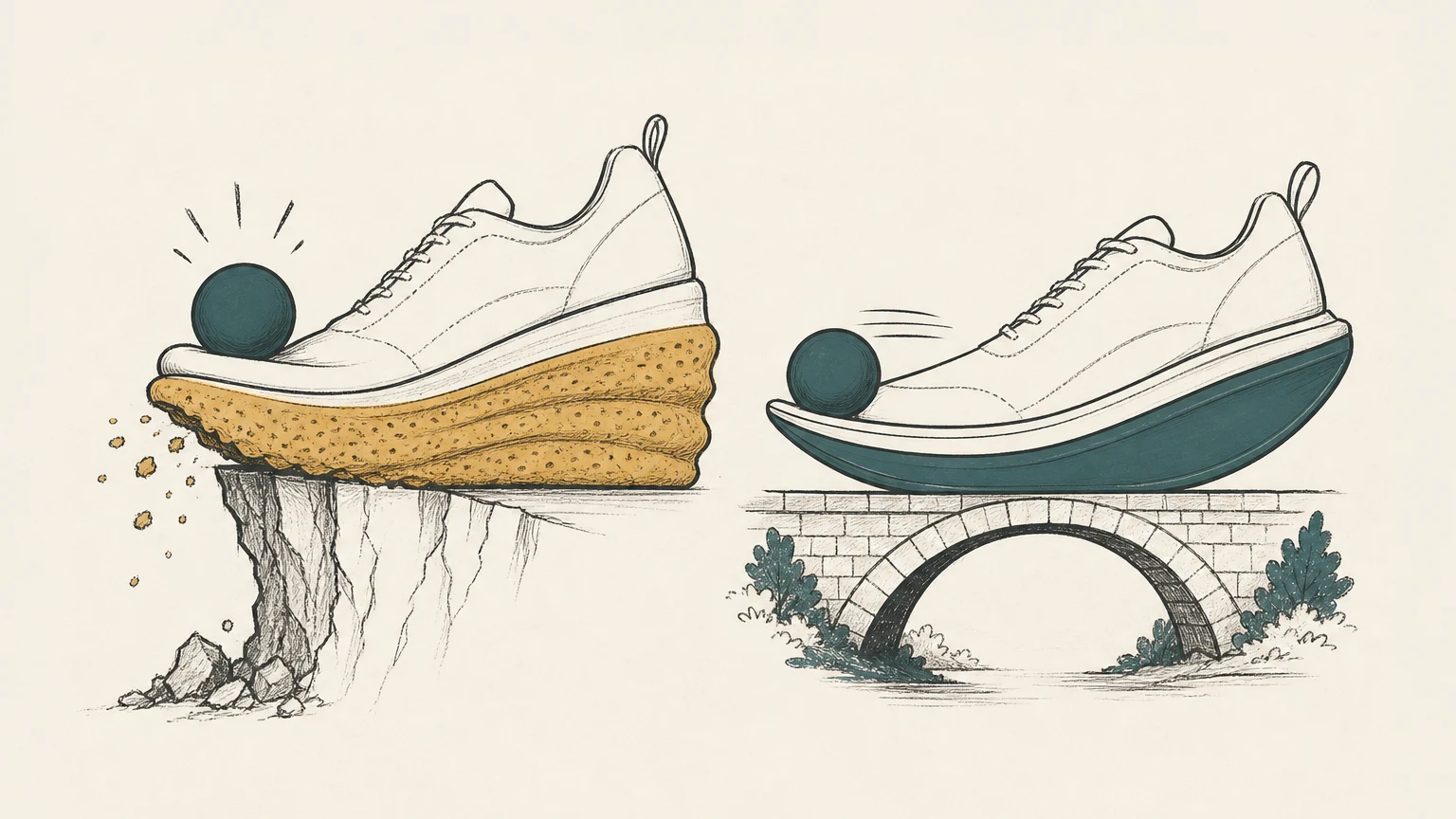
As they load the shoe, the foam compresses asymmetrically. The side receiving greater load deforms, and the foot begins to tilt further in that direction.
Rather than providing a stable platform beneath the foot, the shoe can effectively accommodate and exaggerate the existing deformity.
The patient starts falling towards the edge of the sole.
And because the stack height is substantial, the consequences of that instability can be magnified.
The shoe is no longer simply cushioning the foot. It's allowing the supporting platform to deform beneath it.
This is particularly concerning in patients with significant rearfoot varus or valgus, poor balance, lateral ankle instability or other mechanical abnormalities.
A rocker is supposed to help the foot progress forward.
It shouldn't also be sending it sideways.
To be clear, this isn't a claim that every HOKA model behaves this way, or that soft cushioning inevitably causes instability. Different models have different geometries and support characteristics.
But it's a recurring clinical observation, and one that deserves far more attention than the marketing obsession with cushioning.
The Speedgoat exception
Not every HOKA deserves to be thrown into the same basket.
I've found the Speedgoat models more acceptable in this respect.
They're trail-running shoes, rather than conventional road shoes, and their construction generally provides a more contained platform than some of the softer models I've encountered.
That can make them a reasonable option for selected patients.
But the fact that I'm looking towards a trail shoe to find adequate peripheral support says something about the direction of modern footwear.
And increasingly, I've found a better alternative.
Enter the Saucony Echelon
The Saucony Echelon has become one of my preferred footwear recommendations in recent clinical practice.
Not because it has the most exciting marketing campaign.
Not because it promises to revolutionise human locomotion.
And certainly not because it feels like walking on marshmallows.
Because it does something remarkably sensible: it combines a useful rocker profile with a more stable supporting platform.
The distinction is in the construction.
Rather than relying on a large volume of highly compressible foam without sufficient peripheral support, the Echelon provides a broader, more structured platform that better contains the foot.
The peripheral geometry helps resist the sensation of the foot collapsing over the edge.
The foot feels seated within the shoe rather than precariously balanced on top of it.
Think of it as a cradle.
The shoe provides room for the foot while maintaining a more consistent supporting platform beneath it.
That's particularly useful when you're managing patients whose foot mechanics are already compromised.
A patient with a cavus foot, forefoot overload and digital deformity doesn't necessarily need more cushioning.
They need a shoe that reduces the mechanical demands on painful structures without introducing unnecessary instability.
And in my recent experience, the Echelon has been doing that very well.
What I've actually seen in clinic
I've been recommending the Echelon increasingly over recent months, particularly for patients presenting with forefoot pain, hallux rigidus, arthritic changes and mechanically challenging foot types.
The clinical response has been encouraging.
Patients who have struggled with the instability of softer maximalist shoes have often found the Echelon more secure and comfortable.
Importantly, the rocker still performs its primary function: assisting forward progression while reducing the demand for movement through painful forefoot joints.
It's a combination that makes mechanical sense.
This is clinical experience, not a controlled comparative trial. I'm not suggesting that the Echelon is universally superior to every HOKA model, or that every patient will respond in the same way.
But when a particular design repeatedly works in the patients you're treating, it's worth paying attention.
And when another design repeatedly creates the same mechanical problem, it's worth saying so.
Stop confusing cushioning with treatment
This is the broader issue.
Footwear recommendations have become increasingly dominated by the language of comfort.
Soft. Plush. Cushioned. Responsive.
All perfectly reasonable qualities.
But none of them automatically translates into appropriate mechanical management.
For a patient with forefoot pathology, the question isn't simply how soft the shoe feels.
It's whether the rocker reduces the demand on the painful structures.
Whether the platform remains stable under load.
Whether the shoe accommodates the foot without exaggerating its deformity.
And whether the patient can actually walk in it without feeling as though they're about to roll off the edge.
A shoe can feel spectacular for the first thirty seconds in a shop and be entirely inappropriate for the mechanics of the person wearing it.
Comfort matters. But comfort without control is not necessarily good footwear.
The Footnote verdict
HOKA deserves enormous credit for helping popularise rocker-bottom footwear.
It changed the market, and in many respects, changed clinical footwear recommendations for the better.
But innovation doesn't grant permanent immunity from criticism.
In my view, the pursuit of ever-softer, higher-stack cushioning has compromised the usefulness of some of its shoes for patients with significant mechanical pathology.
The Saucony Echelon, meanwhile, has been quietly getting on with the job.
A useful rocker. A broad, supportive platform. Better peripheral containment. And, in my clinical experience, some very good patient outcomes.
It's not the answer for everyone. No shoe is.
But for patients who need forefoot offloading without feeling as though they're balancing on a couple of unstable foam towers, it's currently one of my preferred options.
The best shoe isn't necessarily the softest one.
It's the one that actually does the job.
The Footnote reviews footwear from a clinical and biomechanical perspective. These are independent professional opinions informed by clinical experience, not paid endorsements. Footwear performance varies between models, individual foot mechanics and clinical presentations.