Imagine going to see a healthcare professional because your feet hurt when you walk, only to be told that the solution is to walk less.
You've recently retired. You've spent forty years working, you've finally got some time to yourself, you've joined a walking group, you've got grandchildren who think you're a piece of playground equipment, and you've booked a holiday that doesn't involve sitting beside a swimming pool for fourteen consecutive days.
And now you're being told to take it easy.
Take it easy for what, exactly? What are we conserving you for? Is there some more important period of your life coming up that we need to keep your feet in good condition for?
This is one of my great frustrations as a podiatrist. Somewhere along the way, healthcare developed a tendency to prioritise the wellbeing of individual anatomical structures over the wellbeing of the person to whom they belong.
We become so preoccupied with protecting a joint, a tendon or a ligament that we forget why the person needs it in the first place.
I see patients with chronic foot pain who have been advised to reduce their walking, give up their recreational activities and spend more time resting. Often, this advice has come from their GP. It is generally well-intentioned, but as a long-term management strategy, it represents a rather extraordinary misunderstanding of what constitutes a successful treatment outcome.
Being physically active is not some frivolous recreational pursuit that we can simply dispense with when it becomes inconvenient to a particular anatomical structure. It is one of the most important determinants of our physical and psychological health.
Walking maintains cardiovascular fitness, muscle strength, bone density, balance and independence. It facilitates social interaction. It gets us out of the house. It allows us to participate in the lives of the people we love.
And there is something rather absurd about a healthcare system that spends an enormous amount of money encouraging people to exercise, only to tell them to stop when they develop the very musculoskeletal problems that healthcare professionals are supposed to help them manage.
When a patient tells me they enjoy walking five kilometres every morning, I don't regard those five kilometres as a problem that needs eliminating. I regard them as a treatment objective.
The same applies to golf, tennis, gardening, dancing, travelling or whatever peculiar activity you've decided makes your existence more enjoyable.
Your life is not something that needs to be modified to accommodate my treatment. My treatment needs to be designed to accommodate your life.
That distinction is enormously important.
Many of the conditions I treat are not necessarily curable. Osteoarthritis is a particularly good example. I cannot restore forty years' worth of cartilage through sheer enthusiasm, and no amount of motivational language is going to persuade a large osteophyte to reconsider its existence.
But I can often change the mechanical environment in which that joint operates. I can reduce the forces acting upon it, restrict painful movement, redistribute pressure and improve the comfort with which you walk.
We might achieve that through footwear, orthotics, padding, strengthening exercises or changes to the way you undertake certain activities. Some patients benefit from image-guided cortisone injections, occasionally repeated where clinically appropriate. Others require ongoing management or surgical intervention.
The point is that none of these interventions is an outcome in itself. They are simply tools we use to achieve something considerably more important.
Function.
I would much rather have a patient walking around Europe with arthritic feet and a manageable level of discomfort than sitting at home in Australia with perfectly comfortable arthritic feet.
Pain is important, of course. Nobody wants to spend their life in agony, and pain can sometimes indicate an injury that requires protection. There are legitimate circumstances in which temporary rest, immobilisation or reduced weight-bearing are essential. Nor should we simply suppress pain and ignore the potential for further tissue damage.
But temporary protection with the intention of restoring function is fundamentally different from surrendering function as a permanent solution to pain.
For many chronic conditions, the objective is to find a sustainable level of activity. Sometimes that means doing things differently. Sometimes it means taking shorter walks more frequently, changing the surfaces you walk on or wearing shoes that look slightly less fashionable than you might have hoped.
Although, frankly, there comes a point in life when the ability to walk into a restaurant becomes considerably more important than the aesthetic qualities of the shoes in which you arrive.
What I don't want is for you to progressively withdraw from the things you enjoy because your feet have become problematic.
The trouble with inactivity is that it creates problems of its own. You become weaker. Your balance deteriorates. Your exercise tolerance diminishes. Your confidence declines. The activities you temporarily abandoned become increasingly difficult to resume.
Eventually, the original foot problem may be the least of your concerns.
We've burnt down the house in order to save it.
When I assess the success of a treatment, I'm interested in whether you're walking further, participating more, enjoying your activities and maintaining your independence. I'm interested in whether your pain has become sufficiently manageable that it no longer dictates the terms of your existence.
A completely pain-free life is not always achievable. A meaningful, physically active and enjoyable life very often is.
And that is what we should be treating towards.
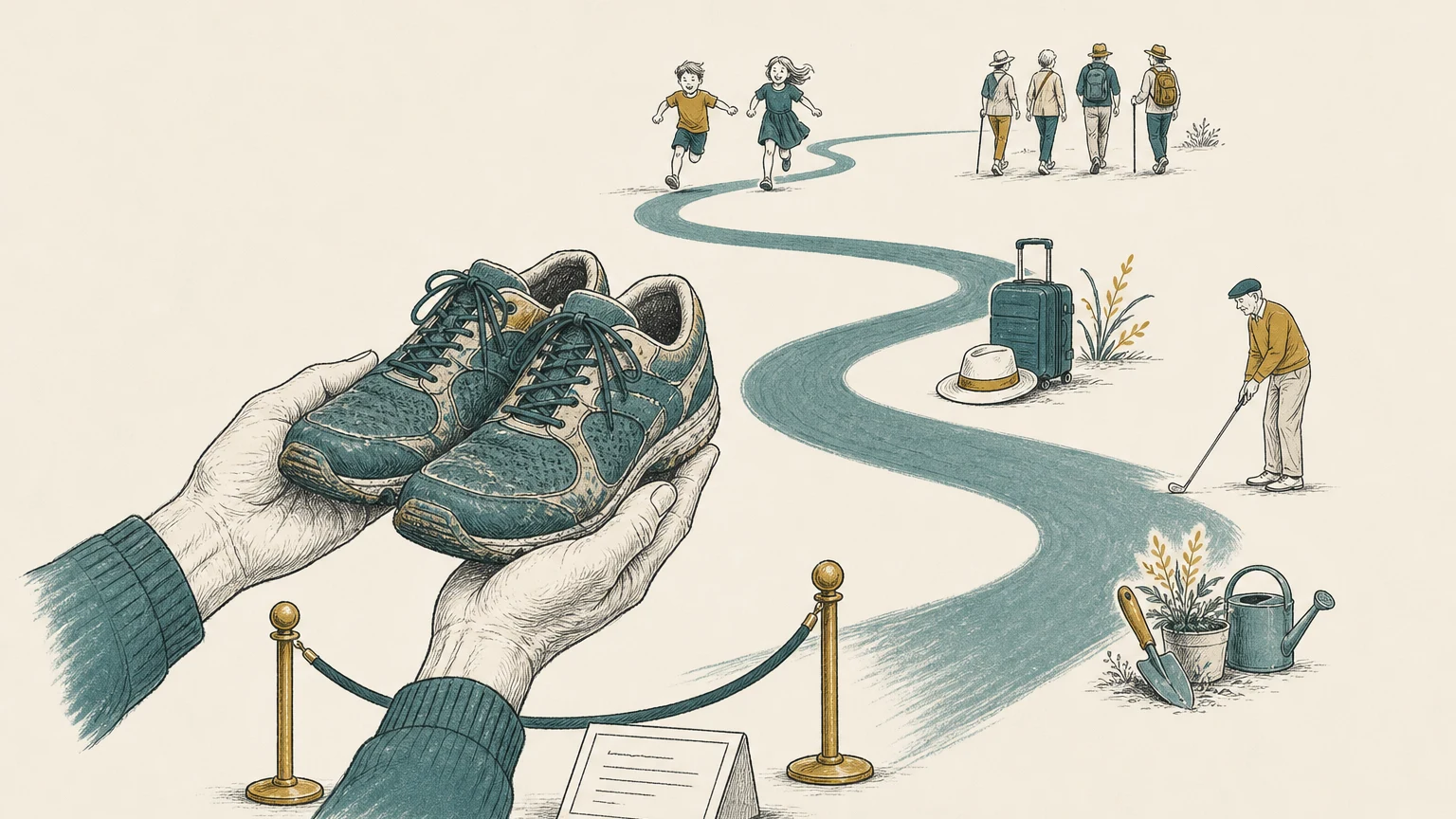
Your feet are not museum pieces. They are not something to be carefully preserved, protected from excessive use and maintained in immaculate condition for future generations.
They are the means by which you experience an enormous portion of your life.
My ambition as a podiatrist is not to have you arrive at the end of that life with a beautifully preserved pair of feet.
It's to have you arrive with a thoroughly worn-out pair and some bloody good stories about how they got that way.