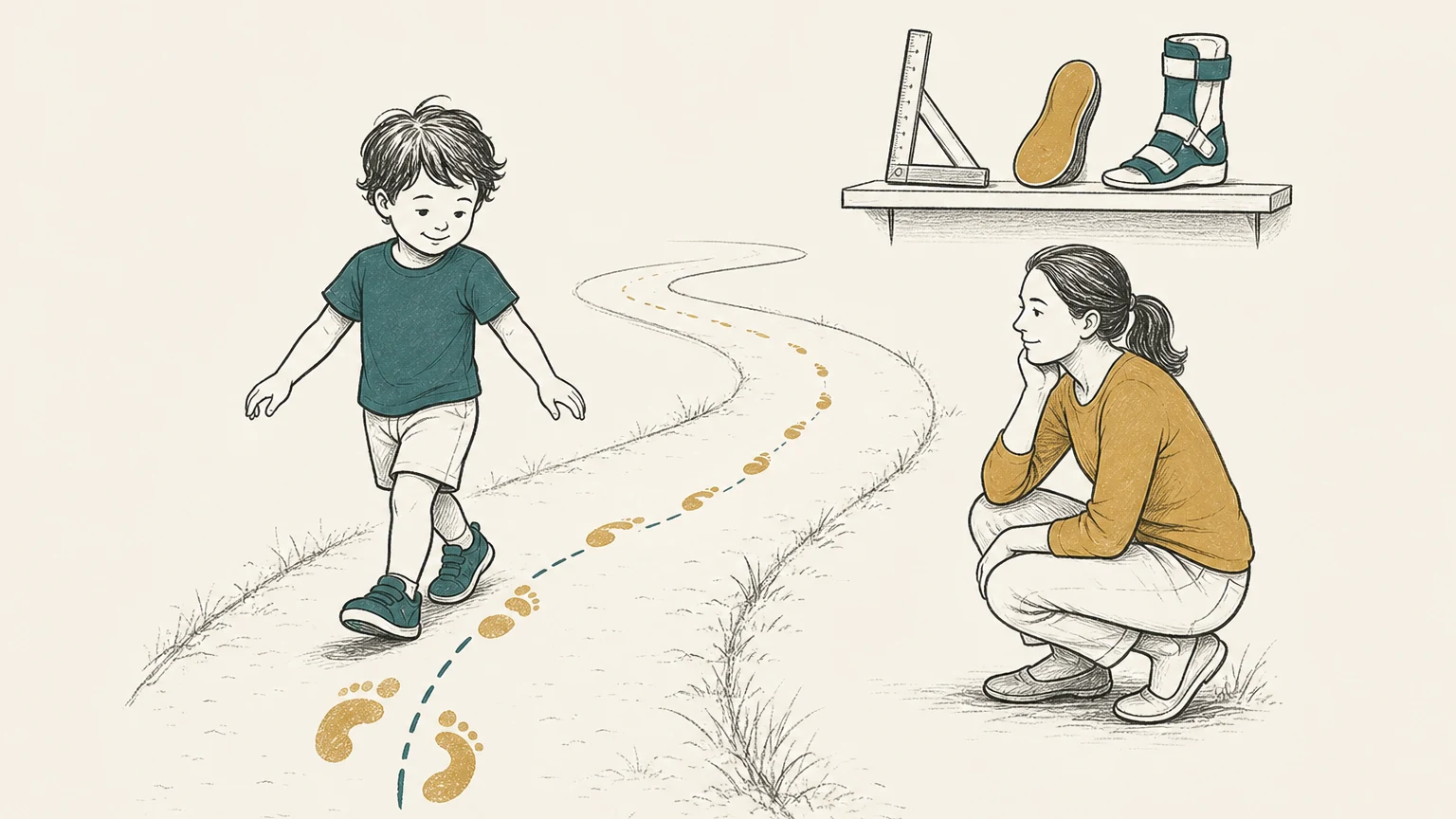
There is a particular moment in parenthood when you discover something about your child that you had never noticed before.
Perhaps it's the way they walk. Their feet seem to turn inwards. One foot more than the other. Maybe they trip over themselves occasionally, or run with a slightly unusual gait.
And suddenly, you're watching their feet everywhere.
At the playground. Walking down the hallway. Running across the kitchen.
Before long, someone has suggested special shoes, orthotics, exercises, or a visit to a specialist.
But here's something that might surprise you.
Most children whose feet point inwards don't need treatment at all.
And understanding why is considerably more useful than buying something to straighten them.
Children aren't miniature adults
A child's skeleton is a work in progress.
Their bones are growing, their muscles are developing, their balance is improving, and the rotational alignment of their legs changes naturally throughout childhood.
Expecting a three-year-old to walk like a thirty-year-old is a bit like expecting a puppy to run like a greyhound.
The machinery is still being assembled.
When a child's feet point inwards during walking, we call it intoeing. It's common, and there are three main reasons it happens.
Three reasons children's feet turn inwards
1. Metatarsus adductus — the foot itself curves inwards
This is usually noticed in babies.
The front half of the foot curves inwards, giving it a kidney-bean appearance.
Many flexible cases improve spontaneously. More rigid or pronounced deformities deserve early assessment because some benefit from casting or other treatment.
2. Internal tibial torsion — the shinbone turns inwards
Common in toddlers, this occurs when the tibia has an inward rotational alignment.
As children grow, this rotation usually reduces naturally.
Special shoes, braces and orthotics have not been shown to accelerate that correction.
3. Increased femoral anteversion — the thighbone rotates inwards
Often most noticeable between three and six years of age.
These children may walk with their knees and feet pointing inwards and frequently prefer sitting in a W position.
Most improve as they grow, although some rotational difference may persist into adulthood without causing significant problems.
But my child keeps tripping
This is one of the most common concerns parents raise.
And it's understandable. Watching your child repeatedly stumble can make you feel that something must be wrong with their feet.
But children fall for all sorts of reasons.
They're developing balance, coordination, spatial awareness and motor control. They're also frequently attempting to travel faster than their nervous system can manage.
Intoeing can contribute to tripping in some children, particularly when the feet turn substantially inwards. But tripping alone doesn't establish that a child needs orthotics or another intervention.
The important questions are whether the problem is improving, whether the child can participate comfortably in normal activities, and whether there are other concerning findings.
Do orthotics straighten children's legs?
Usually, no.
This is where we need to distinguish between changing how a foot functions and changing the rotational development of a bone.
Orthotics can be useful for particular foot conditions, but they do not reliably correct internal tibial torsion or increased femoral anteversion.
The same applies to corrective shoes, wedges and many of the devices historically marketed to parents.
If the rotation originates in the thighbone, placing something beneath the foot isn't going to remodel the thighbone.
That's not how growing bones work.
And it's worth remembering that a child who receives orthotics and subsequently improves may simply have followed the natural developmental course that would have occurred without treatment.
Improvement after treatment isn't automatically evidence that the treatment caused it.
What about W-sitting?
W-sitting attracts a remarkable amount of concern.
Children with increased femoral anteversion often find this position comfortable because their hip rotation makes it easy to adopt.
But the available evidence does not establish that W-sitting causes femoral anteversion or hip deformity in otherwise healthy children.
In many cases, the child's anatomy explains the sitting position, rather than the sitting position causing the anatomy.
There's no need to turn every moment on the living-room floor into a posture correction exercise.
Encouraging a variety of comfortable sitting and play positions is reasonable. Repeatedly policing a harmless preference generally isn't necessary.
When should parents be concerned?
Although most intoeing is a normal developmental variation, not every presentation should be dismissed.
Arrange an assessment if your child has:
Pain, swelling or a persistent limp.
A pronounced difference between the two legs.
Progressive worsening rather than gradual improvement.
A rigid or unusually shaped foot.
Frequent falls that significantly interfere with normal activities.
Delayed motor milestones, weakness or other neurological concerns.
A new change in walking after previously walking normally.
A child who suddenly refuses to bear weight, particularly with fever or significant pain, needs urgent medical assessment.
These findings don't necessarily mean something serious is wrong. They mean the child deserves a proper examination rather than reassurance based solely on age.
What does a proper assessment involve?
A good paediatric foot assessment shouldn't begin with a catalogue of products.
It begins with understanding the child.
We observe how they walk and run, examine their feet, measure the rotational alignment of the legs, assess hip movement and look at their neurological and developmental function when indicated.
We also ask about pain, fatigue, tripping, participation in sport and whether the presentation is changing.
The aim is to establish where the rotation originates, whether it falls within an expected developmental pattern and whether intervention would actually improve the child's life.
Sometimes the most appropriate management is observation and review.
That isn't doing nothing.
It's recognising that treatment should have a purpose, and that growing children don't always need us to interfere with their development.
The most important thing parents can do
Let children move.
Running, climbing, jumping, balancing and playing are valuable opportunities for children to develop strength, coordination and confidence.
Comfortable, appropriately fitting shoes are sensible when footwear is needed. Barefoot play on safe surfaces can also be part of normal activity.
But there's no special shoe that every child with intoeing needs, and no universal exercise programme that straightens growing bones.
If your child is comfortable, active, developing normally and gradually improving, reassurance may be the most useful thing a clinician can provide.
And reassurance is far more valuable when someone has actually examined your child and explained why they're not concerned.
The Footnote's final word
Children are not defective adults waiting to be corrected.
They're developing human beings, and their bodies don't always follow the tidy diagrams in anatomy textbooks.
Some feet point inwards. Some point outwards. Some children have flat feet, some have high arches, and some seem determined to run into every piece of furniture in the house.
The question isn't whether your child looks exactly like everyone else.
It's whether they're healthy, comfortable, developing appropriately and able to enjoy being a child.
Sometimes the best treatment is knowing when not to treat.
And sometimes the most useful thing a podiatrist can prescribe is a good explanation.
Medical disclaimer: This article provides general educational information for parents and caregivers. It does not replace an individual clinical assessment. Children experiencing pain, functional limitations, progressive deformity or concerning developmental findings should be examined by an appropriately qualified healthcare professional.