Why AI medical scribes should be regulated as medical devices
I have spent a considerable amount of time evaluating artificial intelligence consultation transcription software in my clinical practice. As someone who is genuinely enthusiastic about the application of artificial intelligence in healthcare, I was rather looking forward to relinquishing one of the more tedious aspects of my professional existence. I have no particular affection for typing clinical notes. Anything that allows me to spend more time engaging with my patients and less time staring at a computer screen is something I would ordinarily embrace with considerable enthusiasm.
Unfortunately, I appear to have acquired another job.
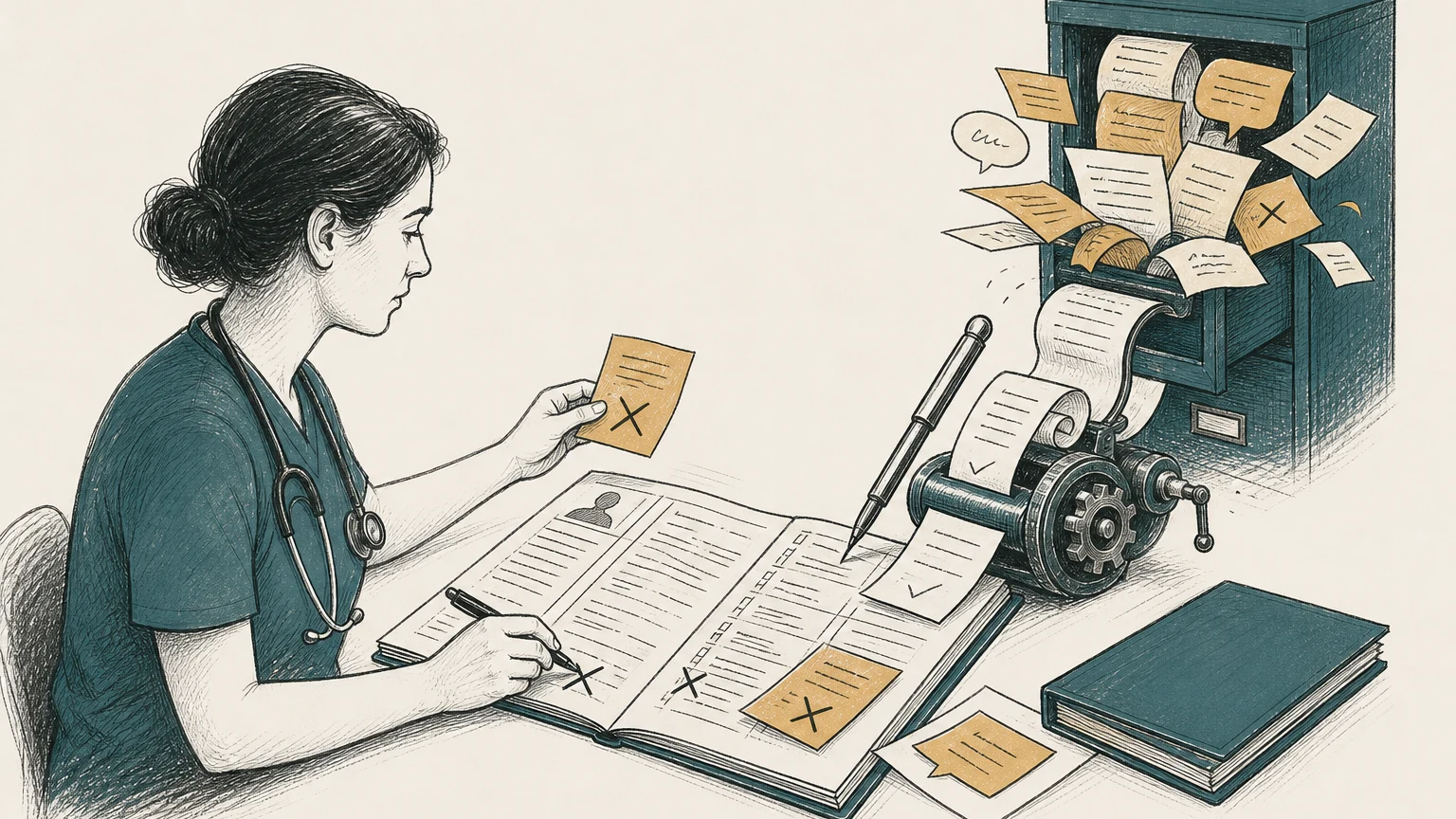
I am now an editor, fact-checker and forensic investigator for a remarkably imaginative administrative assistant who seems to possess an almost pathological aversion to leaving anything undocumented, irrespective of whether it actually happened.
What I found most concerning was not the software's inability to accurately transcribe complex medical terminology, although there was certainly plenty of that. It was its apparent inability to resist making shit up.
In podiatry, for instance, the mere mention of heel pain seemed sufficient on occasions for plantar fasciopathy to materialise in the clinical record. It did not particularly matter why the patient's heel was painful. The patient could have presented with painful cracked heels, plantar fasciopathy could have been entirely absent from the conversation, and no examination could have been undertaken to establish it. Nevertheless, there it was, nestled comfortably in the assessment section of an otherwise beautifully presented clinical note.
Apparently, the software had decided that it knew what was wrong with my patient.
I encountered clinical findings that I had never established, diagnoses I had never made, medical histories I had never elicited and documentation of examinations I had never performed. Information that had not been discussed would mysteriously populate the clinical record. Discussions about possible pathological mechanisms would become definitive diagnostic conclusions. The absence of information would become information about the absence of something.
That last distinction is particularly important. Not asking a patient about a particular symptom is not equivalent to establishing that the patient does not experience it. Yet generative AI can quite comfortably transform the former into the latter, producing a reassuringly comprehensive medical record that bears only a passing resemblance to the consultation from which it was supposedly derived.
What appears to be occurring is that the software is constructing a statistically plausible account of what a consultation of this nature might ordinarily look like. Heel pain is commonly associated with plantar fasciopathy. Certain musculoskeletal presentations are commonly associated with particular examination findings. Certain diagnoses are commonly associated with particular management strategies. The software appears capable of drawing upon these associations to populate the gaps in its information.
This is precisely the sort of behaviour I spend considerable time trying to discourage in healthcare professionals.
The entire purpose of clinical reasoning is to establish what is occurring in the individual patient sitting in front of us, rather than simply imposing upon them what commonly occurs in people with superficially similar presentations. We gather evidence, interrogate assumptions, consider competing hypotheses and attempt to arrive at a defensible conclusion. We are supposed to recognise the limitations of our knowledge and preserve uncertainty where uncertainty exists.
My administrative assistant, apparently, has no such reservations.
There is a fundamental epistemological distinction between documenting what happened and generating a plausible account of what happened. The former is the purpose of clinical documentation. The latter is an exercise in creative writing. I am reasonably comfortable with artificial intelligence engaging in creative writing. I am considerably less comfortable with it doing so in somebody's medical record.
Another remarkably persistent problem was the software's inability to distinguish between the people participating in a consultation. I might engage in ordinary conversation with a patient, mentioning where I live or sharing something about my own circumstances, only to discover that this information had subsequently become part of the patient's social history.
Apparently, I have been documenting my own medical record by proxy.
This becomes considerably more concerning when a patient attends with a spouse, a parent, a support worker or a carer. Statements made by accompanying individuals would be attributed to the patient. The software could not reliably distinguish between someone describing their own experiences and someone describing the experiences of another person. Nor could it reliably distinguish between information volunteered by a patient and observations made by their clinician.
Consider the implications of this in paediatrics, aged care, disability care or consultations involving patients with cognitive impairment. The provenance of clinical information is an important component of clinical reasoning. There is a considerable difference between a patient reporting that they are experiencing pain and a carer reporting that the patient appears to be experiencing pain. There is a difference between a patient denying a symptom and a family member being unaware of it. There is a difference between a clinician describing a possible diagnosis and a patient reporting an established diagnosis.
These distinctions matter enormously, and the software repeatedly failed to preserve them.
What I was left with at the conclusion of many consultations was an extraordinary mountain of inaccuracies. Fabricated information, misattributed statements, erroneous clinical terminology, omitted information and unsupported diagnostic conclusions, all beautifully formatted under the appropriate clinical headings.
I then had to sit there and dismantle the bloody thing.
And this is where the entire commercial proposition begins to unravel. The purpose of this technology is ostensibly to reduce the administrative burden on healthcare professionals. Yet I found myself spending considerable amounts of time interrogating clinical notes, identifying information that had been invented, removing diagnoses I had never made, correcting the attribution of statements and reinstating clinically relevant information that had been omitted.
In many instances, it would have been considerably quicker to write the notes myself.
There is also a fundamental difference in the cognitive workload involved. When I write my own clinical notes, I am documenting information that I already possess. When I review an AI-generated clinical note, I am undertaking an additional epistemological exercise. I must establish whether each individual statement corresponds to something that actually occurred, whether it has been attributed to the correct person, whether its meaning has been preserved and whether the software has introduced information of its own.
I am no longer simply documenting a consultation. I am auditing somebody else's account of it.
Generating a thousand words in three seconds is not a particularly impressive achievement if I subsequently have to spend ten minutes establishing which of those words are true.
And unlike an ordinary administrative inconvenience, the consequences of failing to identify an error may ultimately be borne by the patient.
The medical record is a longitudinal document. Information introduced into it today may be relied upon by another healthcare professional in six months, five years or twenty years. An erroneous diagnosis may be reproduced in a referral letter, incorporated into a specialist's assessment, carried forward into subsequent consultations and used to inform investigations or treatment decisions. An invented examination finding may create the impression that a particular pathology has already been investigated and excluded. An incorrectly attributed statement may fundamentally alter another clinician's understanding of a patient's circumstances.
The original error may never be identified. It simply becomes part of the patient's history.
We are potentially introducing false information into the very infrastructure upon which subsequent clinical decisions are made.
This brings me to the Therapeutic Goods Administration.
Under Australia's regulatory framework, digital scribes intended solely to transcribe or summarise clinical consultations can fall outside the definition of a medical device. Software intended to provide diagnostic conclusions, recommend investigations or inform treatment decisions may fall within it. Much depends upon the intended purpose of the software and the functionality it provides.
I understand the logic of this distinction. I simply do not think it adequately accommodates the nature of generative artificial intelligence.
A piece of software does not need to be designed to provide diagnostic advice to introduce an erroneous diagnosis into a medical record. It does not need to be marketed as a clinical decision-support system to fabricate an examination finding. It does not need to possess an intended therapeutic function to misrepresent a therapeutic intervention.
Indeed, the very behaviour that might bring a product within the scope of medical device regulation can occur as an unintended consequence of a product ostensibly designed to perform an administrative function.
The patient is unlikely to derive much consolation from discovering that the software responsible for a clinically consequential error was technically classified as an administrative tool.
If a blood pressure monitor routinely generated plausible but inaccurate readings, we would consider that a performance failure. If a diagnostic imaging system reversed laterality, we would consider that a significant patient safety concern. If a piece of laboratory software started populating missing investigation results with statistically plausible alternatives, I suspect there would be a rather substantial commotion.
Yet we are introducing technology into healthcare that is capable of performing the documentation equivalent of precisely these things.
If I were to deliberately document an examination I had never performed, a diagnosis I had never made or a medical history I had never obtained, I would rightly expose myself to serious professional and potentially medico-legal consequences. We are now deploying software capable of generating such information at extraordinary speed and scale.
And we are calling it an administrative tool.
The obvious response is that healthcare professionals remain responsible for reviewing and approving the documentation. Of course we do. I am entirely responsible for the accuracy of my clinical records, irrespective of how they are produced. I have no desire to relinquish that responsibility.
But professional responsibility does not absolve manufacturers of product responsibility.
We do not dispense with the requirement for medical devices to meet appropriate standards of safety and performance simply because a healthcare professional is ultimately responsible for their use. The existence of professional oversight is not a substitute for establishing that a product is fit for its intended purpose.
Moreover, the entire commercial appeal of these products rests upon the proposition that healthcare professionals can reduce the time and cognitive effort they devote to documentation. The more successful the industry becomes in persuading clinicians that these products are reliable, the greater the risk that clinicians may become less vigilant in scrutinising their output. Familiarity breeds confidence, and confidence in a system that produces extraordinarily convincing inaccuracies is not necessarily a desirable outcome.
What I would like to see is AI consultation transcription and clinical documentation software brought explicitly within the medical device regulatory framework in Australia, with appropriate classification and inclusion in the Australian Register of Therapeutic Goods.
I would like the TGA to establish mandatory, independently verifiable minimum standards of clinical accuracy that manufacturers must demonstrate before these products are supplied for use in clinical practice.
And I am not talking about some conveniently impressive percentage derived from the accurate transcription of ordinary conversational English.
A system could accurately transcribe 99 per cent of the words spoken during a consultation and still fundamentally misrepresent what occurred. Indeed, it could accurately transcribe every single word and subsequently generate a clinical note containing entirely fabricated information. It could correctly transcribe a conversation between three people and attribute everything to the wrong person.
Conventional transcription accuracy tells us remarkably little about the reliability of the document ultimately being generated.
What we need to establish is a standard of clinical fidelity.
Can the software faithfully reproduce the clinical information contained within a consultation without introducing information that was never present? Can it distinguish between the clinician, the patient and accompanying individuals? Can it establish whom a particular statement concerns? Can it preserve diagnostic uncertainty? Can it distinguish between something that has been discussed, something that has been considered and something that has actually been established? Can it reliably distinguish between an examination that has been performed and one that has merely been mentioned?
And, perhaps most importantly, can it refrain from making things up when it does not know something?
There should be independently validated performance testing across healthcare disciplines, clinical environments, accents, medical terminology and consultations involving multiple participants. The testing should deliberately expose these systems to ambiguous information, incomplete histories, competing diagnostic hypotheses and ordinary social conversation. It should establish whether the software can accommodate the messiness of an actual clinical consultation without attempting to resolve that messiness through invention.
Errors should be assessed according to their clinical significance. Misspelling a patient's occupation is not equivalent to fabricating a negative finding that might influence whether a patient receives further investigation. Omitting a discussion about the weather is not equivalent to omitting a known drug allergy. An aggregate accuracy score that treats these errors as equivalent would be of remarkably little value.
Manufacturers should be required to disclose clinically significant error rates, demonstrate the effectiveness of their safeguards against fabricated information and establish appropriate mechanisms for reporting and investigating documentation failures. Significant changes to the underlying artificial intelligence models should require appropriate revalidation. There should be ongoing post-market surveillance and a mechanism through which clinicians can report potentially dangerous failures to the regulator.
I would also like to see manufacturers substantiate their claims about reducing administrative workload. Not by demonstrating how quickly their software can generate a clinical note, but by establishing how long it takes a healthcare professional to produce an accurate, complete and clinically defensible medical record using the software compared with producing one without it.
The relevant endpoint is not the generation of a document. It is the completion of an accurate medical record.
My observations are drawn from practical clinical use rather than a controlled comparative study. I cannot establish from them the prevalence of these errors across the industry, and I have deliberately chosen not to identify the particular software I have been evaluating. My concern is not with an individual manufacturer. My concern is that we have an emerging industry supplying technology specifically designed to generate medical records without a universally mandated, clinically meaningful standard of accuracy appropriate to that function.
I should not have to conduct my own informal safety and performance evaluation of a medical documentation product during actual patient consultations to establish whether it is capable of reliably documenting them.
Surely that is something we ought to have established before selling it to me.
None of this is an argument against artificial intelligence in healthcare. I remain enormously enthusiastic about its potential. I would very much like to have a piece of software that reliably documents my consultations, reduces my administrative workload and allows me to devote more of my attention to my patients. I suspect most healthcare professionals would.
But I want the industry to actually deliver that product, rather than something that superficially resembles it.
We have spent decades developing regulatory frameworks to ensure that the technologies used in healthcare meet appropriate standards of safety, reliability and performance. The fact that a particular technology produces sentences rather than measurements should not exempt it from those expectations.
The medical record is not an administrative by-product of healthcare. It is an integral component of healthcare itself. The integrity of the information contained within it is fundamental to the safety of the people whose lives it documents.
The technology responsible for generating that information should be regulated accordingly.
And I would have thought that not making shit up was a fairly reasonable minimum performance standard.