Author attribution not recorded
A 15-Minute Rant-With-References About Money, Medicine, and the Curious Case of the El Cheapo Patient
THE GREAT IDEOLOGICAL PIVOT: FROM FREE-MARKET FANBOY TO MEDICAL MARXIST
Watch any Aussie barbecue debate swirl from house prices to health costs and you’ll witness an outrageous metamorphosis. Ordinary, pay-your-own-way citizens who will gleefully quote Milton Friedman on tax policy turn—without a blush—into hard-core communists the nanosecond a medical bill appears.
Suddenly everything in the consultation room should be “covered,” “bulk-billed,” or “rebated.” They believe in an invisible hand—provided that hand also swipes Medicare, massages private insurance, and slips the gap onto someone else’s MasterCard.
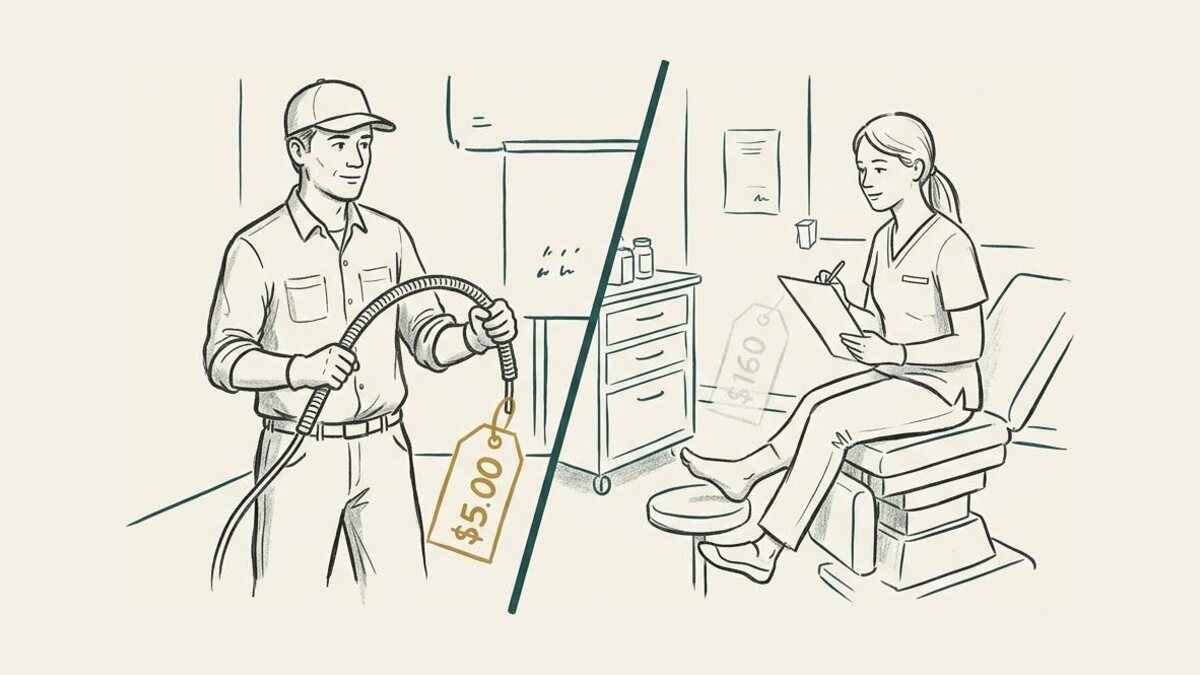
Yet five hours earlier those same people happily handed a plumber $300 to liberate a rogue wet wipe from the S-bend. No government rebate. No outrage. Just a shrug and “cheers, mate.” In other words: laissez-faire for leaks, Lenin for ligaments.
STICKER-SHOCK AMNESIA: WHY HEALTH PRICES FEEL WRONG
Health-care sticker shock isn’t caused by prices spiralling out of control—it’s fuelled by price invisibility. Most Aussies grow up on a Medicare drip-feed that hides the real cost of scalpels and stethoscopes. We know the price of a latte to the cent, but if you ask the average punter what a colonoscopy costs, their guess will range between “about fifty bucks?” and “shouldn’t that be free?”
Because the gap only appears when something isn’t subsidised, the brain files any out-of-pocket fee under “rip-off.” Cue the reflexive socialism:
“Health shouldn’t be about profit!” (Translation: please bill anyone but me.)
Ironically, plumbers, sparkies, and mechanics have no subsidy buffer, so their invoices land like gravity—inescapable and unquestioned.
NUMBERS YOUR PLUMBER KNOWS (AND YOUR PODIATRIST WISHES YOU DID)
Job – Typical Call-Out or Hourly Cost
Plumber (blocked drain, capital city, business hours): $80–$150 call-out + $80–$200/hour
Emergency plumber (after-hours): $150–$350/hour
Podiatry consult (ingrown-nail surgery incl. local anaesthetic): ~$180–$300
Custom orthotics (3-D scan, CAD-CAM design, manufacture, fitting, review): ~$600–$1000
Now compare incomes:
Average plumber earns about $32/hour on payroll—more once you add call-outs, weekend surcharges, and the cash-in-hand “mate’s rates” you’ll never see on PayScale.
Average Aussie podiatrist hauls in $72 k–$100 k a year—roughly $35–$46/hour on a 38-hour week.
Yes, the person who can rebuild your collapsing arch after seven years of university, a $50 k HECS debt, and ongoing AHPRA fees often earns less per hour than the bloke with a Hilti drain-snake (no offence to Hilti drain-snakes, fabulous bits of kit).
“BUT MY TRADIE HAS OVERHEADS!”
So does your podiatrist:
MedPro indemnity—because if Aunt Marge ignores post-op instructions and decides heel-popping tango is “light exercise,” guess who gets sued?
Sterile instrumentation—autoclaves aren’t cheap, and yes, burrs wear out.
Clinical software & audit compliance—every click tracked for the day Medicare decides to audit that one bulk-bill.
CPD—a plumber’s licence renewal takes a weekend seminar; a podiatrist’s involves multi-day wound-care intensives and biomechanical research updates.
Radiation licence fees, custom software, microwave therapy units, shock-wave machines … the list would make a dentist sweat.
Yet somehow we accept $180 call-out for a busted tap, but baulk at $150 to cure the toe that stops us walking the dog. The plumber’s invoice is a badge of homeowner competence; the podiatrist’s is “daylight robbery.”
THE BALI PARADOX: CHAMPAGNE HOLIDAYS, CASK-WINE HEALTH
Another crowd pleaser:
“Orthotics are so expensive. I’ll think about it after my Bali trip.”
Aussies will drop $3 k on a seven-day “Eat • Pray • Pooja” package faster than you can say “Bintang singlet.” Yet the same travellers balk at $900 for biomechanically-matched footbeds that remove their need for Voltarens, podiatry reviews, and future surgeries.
Perspective check:
Your holiday: sunburn, stray gin-bucket, suspicious nasi goreng.
Your orthotics: 250,000 steps per pair, pain-free Parkruns, no lawsuits from you limping into an Uber.
Guess which one still delivers value when the tan fades?
THE ECONOMICS OF “SHOULD-BE-FREE”
Whenever a bill is deemed “too high,” the conversation drifts to comparative fairness:
“But it’s healthcare, not luxury!”
“Doctors earn heaps anyway!”
“It only took ten minutes—why $100?”
Let’s debunk each in turn:
1. Vital ≠ Valueless Food is essential. Will Coles give you bread because carbs are a human right? Nope; you pay and you thank them for aisle four. Health is vital and priced, exactly because it’s valuable.
2. “Doctors earn heaps” (some do, podiatrists don’t) Income tallies above show many allied health pros hover near national median wages while carrying more lawsuit risk and regulatory eyes than any tradie. Meanwhile earth-moving contractors driving $400 k excavators clear six-figures tax-paid and get applause. Podiatrists treat diabetic ulcers that save the taxpayer $26 k per amputation avoided—and struggle to charge what the local spray painter does for a half-day gig.
3. The Ten-Minute Fallacy If it takes you ten minutes to fry an egg, does that devalue the 20 years it took the chook to evolve? Your consultation fee pays for the decades of study and the fact the clinician can pick osteomyelitis from a two-second glance. Nobody asks Usain Bolt for a refund because his 100 m took less than ten seconds.
BULK-BILLING: A LOVE STORY WITH A TRAGIC ENDING
Bulk-billing was the Cupid that made Australians fall for universal care. But like any romance, over-familiarity breeds contempt. Patients raised on $0 GP visits can’t compute why an orthopaedic review costs $320. They don’t see the Medicare rebate stagnating while overheads rise. They don’t witness the exodus of bulk-billing clinics turning “closed books” because the books show red ink.
Every time a practice absorbs the gap to avoid losing patients, that shortfall nibbles at wages, staff training, new tech, longer consults, and finally—the clinic itself. When the clinic dies, the same patients wail: “Why is there no doctor in my town?”
Answer: because the plumber wouldn’t unblock your sewer for gap-only rates either.
THE TRADIE PAY PARADOX: WHY IT MAKES SENSE (AND STILL HURTS)
Plumbers, electricians, and carpenters occupy an economic sweet-spot:
Scarcity—Trades shortages mean demand > supply.
Visibility—You see the broken pipe, you pay. No pipe = flood.
Price Anchoring—No centralised rebate sets an expectation.
Health professionals face the reverse:
Artificial price ceilings (Medicare),
Third-party payers (private insurers),
Ethical guilt (you can’t bargain-hunt for chemotherapy).
So the person drilling toenails competes with a national insurance schedule, while the person drilling drywall lets the market bid up his day rate. It’s capitalism’s weirdest inversion.
“BUT HEALTHCARE SHOULDN’T BE ABOUT PROFIT!”
Absolutely—you’d hate a surgeon choosing an op purely for dollars. Yet sustainability isn’t the same as profiteering. A clinic operating at cost can improve, hire staff, and expand hours. A clinic running at a loss will eventually shut, and then your free consult is 200 km away in Perth, three months from now.
Profit is the oxygen mask that lets practitioners keep serving while breathing themselves.
ONE FOOT IN THE FUTURE: WHAT IT COSTS TO STAY STANDING
Quick quiz: Which costs society more—early podiatry intervention or late-stage lower-limb amputation?
Early podiatry: $900 orthotics + $600 in annual reviews = $1,500
Amputation pathway: wound care, vac dressings, theatre, rehab, prosthesis, lost work hours = $46,000–$65,000 (conservative)
And that’s before measuring pain, carer burden, and mobility loss. Value for money, thy name is podiatry.
THE COMEDY OF VALUE: LAUGH SO YOU DON’T LIMP
Acrylic nails: $70 every three weeks = $1,200/year. Your own nails half your walking life? “Hmm, $100 seems steep.”
Streaming subscriptions: Three services at $19 each/month = $684/year. Telehealth podiatry follow-up? “Isn’t that covered?”
Daily barista coffees: $6 flat whites × 250 workdays = $1,500. Custom AFO brace to off-load Charcot deformity? “I’ll see if private health will cover it.”
Humans are gloriously irrational. We’ll adopt micro-payments (“less than the cost of a coffee a day!”) but panic at lump-sum health fees—even when the long-term tally is the same.
A (SEMI-SERIOUS) MANIFESTO FOR LESS COMMUNISM, MORE COMMONSENSE
Ask for transparency, not charity. Clinicians should itemise fees and explain why that ingrown-nail procedure costs what it does. If you understand the value—sterile packs, local anaesthetic, follow-up review—you’re less likely to feel robbed.
Budget health first, Bali second. A holiday doesn’t carry you to the fridge at 3 a.m. Your plantar fascia does.
Insurance ≠ free pass. Remember your extras cover is a risk-pool, not an infinite buffet. Use it wisely; top up when needed.
Lobby for realistic rebates. If Medicare’s podiatry cap hasn’t risen since the Rudd era, write to your MP. Price signals matter; so does political pressure.
Respect expertise. A licenced gasfitter spends four years in an apprenticeship. Your podiatrist spends double that, plus a research project on forefoot biomechanics. Both belong at the adult pay table.
CLOSING WITH A TOE-CURLING THOUGHT EXPERIMENT
Imagine if Medicare covered plumbing. You’d watch homeowners clog their disposal with pork crackling, ring the bulk-biller, and complain about the wait list. The system would buckle, the government would introduce “Drain Care Plans” (limit: five blocked pipes per year), and call-out fees would stay artificially low—until there were no plumbers left within a 30-kilometre radius.
Sound familiar? That’s the fate of any sector where real costs are hidden, expectations inflated, and practitioners shamed for staying solvent.
Your choice:
Pay a fair price for preventive care now,
or march bravely into the People’s Republic of Fifteen-Month Wait Lists later.
Either way, remember: your feet carry you every single day. Treat them at least as well as you treat your plumbing. Because a drain can be replaced—a human metatarsal, not so much.
Now go forth, spread the gospel of commonsense capitalism, and maybe—just maybe—book that orthotics appointment before the next flash sale to Bali.