An entirely reasonable question about a surprisingly unreasonable profession.
There is a question I get asked almost every day.
Not “Will this hurt?”
Not “Is that supposed to look like that?”
Not even “Can you just cut them a bit shorter?”
No.
“Why did you become a podiatrist?”
Usually followed by a slightly bewildered expression and the inevitable supplementary question:
“Why feet?”
It's a fascinating question because nobody seems particularly troubled by the existence of cardiologists.
Nobody asks an ophthalmologist, “But why eyeballs?”
Nobody looks at a dentist and says, “Surely you could have done something else with your life?”
Yet tell someone you're a podiatrist and they react as though you've confessed to a deeply troubling personal interest.
Feet? Really? Of all the bits?
And I understand.
Feet have a public relations problem.
They spend most of their lives hidden inside shoes, occasionally emerge looking like they've survived a hostage situation, and are generally discussed only when something has gone horribly wrong.
Nobody writes poetry about a particularly impressive second metatarsal.
Nobody gazes lovingly across a candlelit dinner and whispers, “Your subtalar joint is exquisite.”
Although, to be fair, that would work on me.
The truth is, I didn't grow up dreaming about toenails.
Like most children, I had ambitions.
Astronaut. Scientist. Possibly something involving dinosaurs.
At no point did I announce to my parents that I wanted to spend my adult life investigating the structural integrity of other people's heels.
My journey into podiatry wasn't particularly conventional.
Before becoming a podiatrist, I studied molecular genetics and worked for years in radiation therapy, treating people with cancer. I had already spent a considerable portion of my adult life in healthcare.
Then, for reasons that probably deserve their own psychological assessment, I went back to university and studied medicine again.
Only this time, I concentrated on the bit below the ankles.
Which sounds like a spectacular narrowing of ambition.
Until you discover what's actually down there.
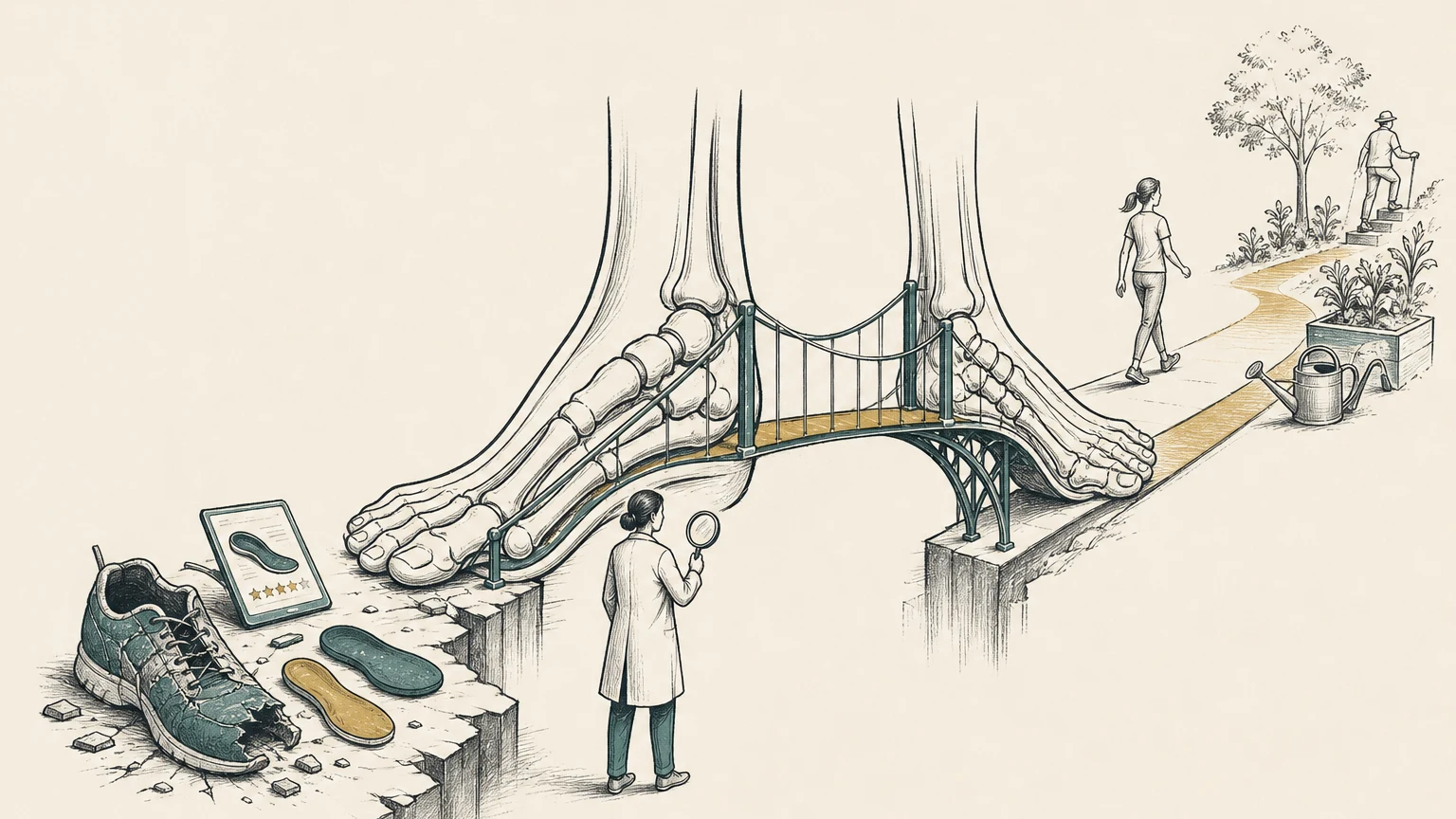
The foot is an engineering masterpiece. With terrible management.
Consider this.
Each foot contains 26 bones, 33 joints and more than a hundred muscles, tendons and ligaments.
That's 52 bones between your two feet.
Roughly a quarter of all the bones in your body.
All packed into two relatively small structures that spend their days supporting your entire body weight, absorbing impact, adapting to uneven surfaces and propelling you forward.
And what do we do to reward this extraordinary feat of biological engineering?
We shove them into shoes designed by someone whose primary understanding of anatomy appears to have come from looking at a triangle.
Then we stand on them for twelve hours.
Then we complain when they hurt.
The foot is essentially a highly sophisticated suspension system being operated by an owner who has never read the manual.
And unlike your car, you can't trade it in when the mileage gets too high.
But podiatry isn't really about feet.
This is the part people don't expect.
Podiatry is about people.
More specifically, it's about keeping people moving.
And movement is one of those things you don't fully appreciate until you lose it.
Think about how much of your life depends on your feet.
Walking to the shops.
Playing with your children.
Working.
Exercising.
Gardening.
Travelling.
Getting up in the middle of the night because somebody has decided that 3 am is an excellent time to discuss the location of their favourite stuffed animal.
Your feet are involved in almost everything you do.
And when they stop working properly, your world can become remarkably small.
That lovely morning walk disappears.
The weekly round of golf becomes unbearable.
The trip you've been planning for years suddenly looks impossible.
Even walking from the bedroom to the kitchen becomes an ordeal.
People often arrive in my consulting room thinking they've got a foot problem.
Frequently, what they've actually got is a life problem caused by a foot.
And that's where podiatry becomes genuinely interesting.
We're detectives. Just with worse crime scenes.
A patient walks in and points to their heel.
“It hurts here.”
Excellent.
We've established the location of the crime.
Now comes the investigation.
Is it the plantar fascia? A nerve? A stress fracture? A problem with the fat pad? Something inflammatory? Referred pain?
Is the pain worse first thing in the morning? After activity? During activity? At night?
What does the foot look like? How does it move? What happens when we load it? What happens when we change the forces acting on it?
Sometimes the answer is obvious.
Sometimes it requires imaging, further investigations and a great deal of clinical reasoning.
And sometimes the diagnosis somebody has been carrying around for six months turns out to be completely wrong.
Which is awkward.
Particularly when they've already bought seventeen different insoles from the internet.
But that's medicine.
The body doesn't always read the textbook.
And feet, in particular, appear to regard textbooks as a collection of loosely worded suggestions.
The things your feet can tell us about the rest of you.
Here's another surprise.
Podiatrists don't just treat foot problems.
We regularly encounter the consequences of diseases affecting the entire body.
Diabetes can damage nerves and blood vessels, turning an apparently minor foot injury into something potentially limb-threatening.
Inflammatory arthritis can first reveal itself through painful, swollen joints in the feet.
Circulatory disease can show up as changes in skin colour, temperature, wound healing or walking tolerance.
Neurological conditions can alter gait, balance and muscle function.
Even medications and cancer treatments can produce significant changes in the feet.
Which means that the person examining your apparently unremarkable big toe may actually be looking for evidence of something much more important.
We're not simply looking at feet.
We're using feet to understand what's happening to the person attached to them.
And occasionally we're the first clinicians to recognise that something is seriously wrong.
Not bad for a profession some people think consists entirely of clipping toenails.
And yes, we do cut toenails.
Let's address the elephant in the room.
Or rather, the toenail in the room.
Because whenever I tell someone I'm a podiatrist, there is a reasonable chance they'll immediately look down at their feet and apologise.
“Sorry, I haven't done anything with them.”
That's fine.
I wasn't expecting you to bring them in gift-wrapped.
And yes, nail care is part of podiatry.
For someone with arthritis, reduced mobility, poor eyesight or significant medical problems, something as simple as maintaining their toenails can be essential to their comfort, independence and safety.
There is dignity in that work.
There's also tremendous satisfaction in relieving a painful ingrown toenail.
A person can walk into the clinic looking as though they've been interrogated by the Spanish Inquisition and leave twenty minutes later wondering why they put up with it for six months.
That is a pretty good return on a consultation.
But podiatry also includes biomechanics, sports injuries, wound management, paediatrics, dermatology, vascular and neurological assessment, orthotic therapy, rehabilitation, and surgical management of foot and ankle conditions.
It's an extraordinary range of clinical practice.
All contained within a part of the body most people would prefer not to discuss over dinner.
The best part of the job?
It's not the feet.
It's the moment someone realises they can do something again.
A patient who hasn't been able to walk comfortably for months gets back to their morning routine.
An older person who has become frightened of falling starts moving with confidence.
A runner returns to training.
Someone with painful arthritis finds a way to keep gardening without spending the following three days regretting every decision they've ever made.
A person with diabetes avoids a serious complication because a problem was recognised and treated early.
These aren't necessarily dramatic medical miracles.
Nobody is going to make a Netflix documentary about a successful modification to someone's footwear.
The Man Who Added a Rocker Sole.
Six episodes. Narrated by David Attenborough.
But to the person whose life has improved, these things matter enormously.
And that's the point.
Healthcare doesn't always need to produce a spectacular cure to make a profound difference.
Sometimes the most valuable thing you can do is help somebody keep doing the things that make their life worth living.
So why did I become a podiatrist?
Because it's intellectually challenging.
Because it combines medicine, anatomy, engineering, problem-solving and practical treatment.
Because you can make a meaningful difference to someone's life, sometimes in a single appointment.
Because the profession offers an extraordinary opportunity to work across almost every stage of human life, from children learning to walk to older people determined to keep walking.
Because it allows you to investigate complex medical problems while still