Your calves are probably not something you spend much time thinking about. Unless you're a runner, a cyclist, or someone who has recently attempted to walk up a steep hill and discovered that your legs have lodged a formal complaint.
But those two large muscles at the back of your lower legs have an enormous influence on how your feet work. And when they become particularly tight, the consequences can extend well beyond your calves.
Heel pain. Achilles tendon problems. Forefoot pain. Sometimes even discomfort through the midfoot.
Different problems, different structures, but potentially one common contributing factor: your ankle isn't moving as freely as it needs to.
The good news? Improving calf flexibility doesn't require expensive equipment, a gym membership, or someone charging you $150 to explain how to lean against a wall.
You might just need a stack of magazines and three minutes.
Walking is, fundamentally, the process of carrying your body forward over your foot.
Think about it. Your foot lands on the ground, your body travels over it, and eventually you push off and take another step. It sounds simple enough. But to make that happen smoothly, your foot and ankle rely on three movements known as the three rockers of walking.
The first is the heel rocker. Your heel contacts the ground and your foot lowers towards the floor.
The second is the ankle rocker. Your foot is now planted, and your shin needs to move forward over it as your body travels ahead.
The third is the forefoot rocker. Your heel rises, your weight moves towards the front of your foot, and you roll over your toes into the next step.
Of these three, the ankle rocker is particularly important when we're talking about tight calves.
Why?
Because for your body to move forward over a planted foot, your ankle needs to bend upwards. We call that dorsiflexion.
And your calf muscles need to allow that movement to happen.
Your calf is actually made up of several muscles, but the two we're particularly interested in are the gastrocnemius and soleus. Both connect into the Achilles tendon, which attaches to the back of your heel.
The gastrocnemius is the larger, more visible muscle. It crosses both your knee and ankle. The soleus sits underneath it and is particularly important during standing and walking.
Together, they help control how your shin moves over your foot.
Now imagine what happens when they're too tight.
Your body still needs to move forward. You can't simply stop halfway through every step because your calves have decided they've had enough.
So you find another way.
One option is to lift your heel earlier than you should. Instead of smoothly rolling forward over your ankle, you move onto the ball of your foot prematurely. That can increase the duration or magnitude of loading through parts of your forefoot.
Another option is to turn your foot outwards. By walking with your foot abducted, you can reduce some of the demand for straight-ahead ankle dorsiflexion.
You might also allow your foot to roll inwards more, increasing pronation and using movement through other joints to compensate for movement you aren't getting at the ankle.
Or you might simply roll off the side of your foot rather than travelling smoothly over it.
These are all ways your body can work around restricted ankle movement.
And here's the important part: your body doesn't necessarily care whether you're walking efficiently. It cares that you keep moving.
If one joint doesn't provide the movement you need, other joints and tissues may be asked to do more.
Sometimes those compensations are perfectly well tolerated. But sometimes they change the loading of structures that are already struggling.
Your plantar fascia. Your Achilles tendon. The joints through your midfoot. The tissues beneath the ball of your foot.
This is why, when someone comes into my clinic complaining about pain underneath their heel or across their forefoot, I don't just look at where it hurts.
I look at how their ankle moves.
Because the painful structure isn't always where the mechanical problem begins.
Consider plantar heel pain, often called plantar fasciitis.
The plantar fascia is a thick band of connective tissue running underneath your foot. It helps support your arch and contributes to the mechanical behaviour of your foot during walking.
I often explain it to patients using an elastic band.
Imagine we're standing opposite each other, each holding one end of a long elastic band. If I suddenly pull my end, you won't necessarily be dragged forward. The elastic stretches, absorbing some of that movement.
Now replace the elastic band with a rigid piece of rope.
If I suddenly pull, you're going to be lurched forward because there's very little stretch available to absorb that movement.
Your plantar fascia isn't literally a rubber band, of course. It's a tough, collagen-rich structure designed to tolerate considerable forces. But the analogy helps explain why the ability of tissues to deform and manage load matters.
Over time, particularly when the fascia is repeatedly exposed to more load than it can comfortably tolerate, its structure and mechanical properties can change. In some people, the tissue becomes less effective at tolerating and distributing those forces.
The attachment at the heel, near a bony prominence called the medial calcaneal tubercle, can become particularly painful.
Now add restricted ankle movement into the picture.
If your calf won't allow your shin to move forward normally, the way forces pass through your foot may change. The plantar fascia may be asked to tolerate loading patterns that contribute to an already irritated attachment.
That doesn't mean tight calves cause every case of plantar fasciitis. They don't. But limited ankle dorsiflexion is a recognised factor worth assessing in people with plantar heel pain.
The Achilles tendon is another obvious candidate. It connects your calf muscles to your heel and plays a major role in walking, running and jumping. Restricted ankle movement can influence how the calf–Achilles complex is loaded, although Achilles problems are not simply caused by tightness.
Further forward, an early heel rise may alter pressure beneath the metatarsal heads, contributing to discomfort around the ball of the foot in some people.
The important distinction is that tight calves are not the cause of every foot problem. Foot and ankle pain is rarely that simple.
But calf flexibility is one of the things worth assessing when someone presents with persistent pain.
And unlike your age, genetics, or the fact that humans inexplicably decided concrete was a suitable surface to spend their lives walking on, calf flexibility is something you may be able to change.
So how do you stretch them?
There are dozens of ways to stretch your calves. Some involve walls, some involve stairs, and some involve elaborate equipment that looks suspiciously like it belongs in a medieval interrogation chamber.
My preferred approach is considerably simpler.
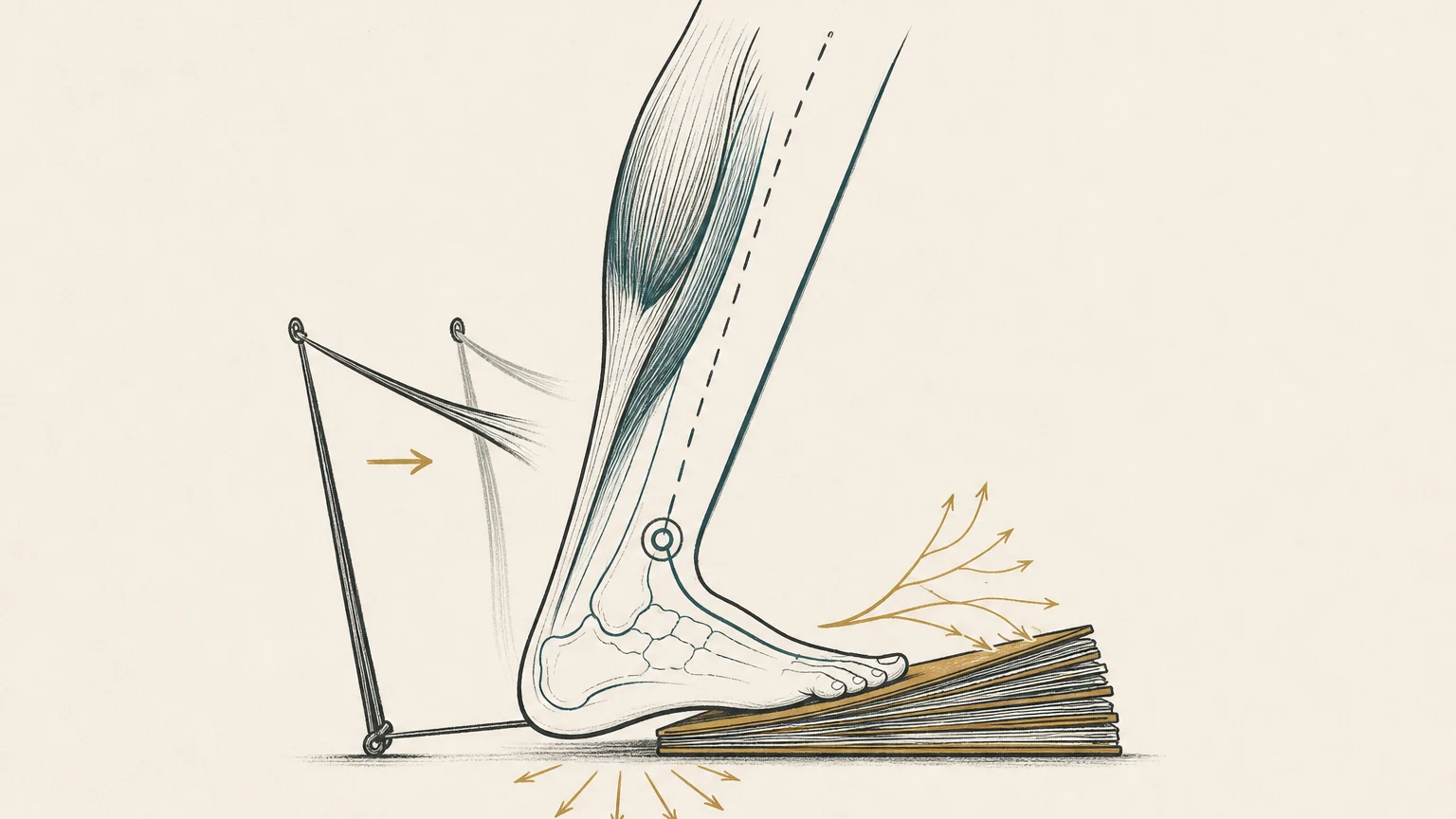
Find something firm and stable that you can place underneath the front of your foot. A purpose-made slant board works well, but so can a securely supported stack of magazines, a firm wedge, or another suitable raised surface.
The advantage is that you can adjust the height to suit your flexibility.
Stand facing a wall or sturdy bench so you have something to hold for balance. Place the ball of one foot on your raised support, keeping your heel firmly on the ground.
Keep your knee relatively straight and slowly move your body forward until you feel a comfortable stretch through the back of your calf.
Then hold it.
Three minutes.
Not three seconds. Not a quick bounce before you run out the door. Three minutes of comfortable, sustained stretching.
You don't need to force the movement. You should feel a definite stretch through the calf, but not sharp pain, tingling, or a sensation that something is about to tear.
If the stretch is too strong, lower the height of your support. If it's too easy, increase it slightly.
The beauty of this approach is that you control the angle. You can start gently and gradually increase the stretch as your flexibility improves.
And please make sure your improvised support isn't going to slide across the floor. Improving your ankle mobility by falling through the coffee table would rather defeat the purpose.
There's another important detail.
Remember those two calf muscles, the gastrocnemius and soleus?
They don't stretch in quite the same way.
Because the gastrocnemius crosses the knee, keeping your knee straight places greater emphasis on stretching it.
But the soleus doesn't cross the knee. To place greater emphasis on that deeper muscle, you need to bend your knee slightly while keeping your heel on the ground.
So once you've completed your straight-knee stretch, repeat the same movement with your knee bent.
You'll often feel the stretch lower and deeper in your calf.
Both muscles matter. Stretching only with a straight knee can leave an important part of the picture unaddressed.
Here's the program I suggest as a practical starting point.
The Footnote Calf Stretching Program
Straight-knee calf stretch
Place your forefoot on a stable raised support.
Keep your heel on the floor and your knee straight.
Gently move your body forward until you feel a comfortable calf stretch.
Hold for three minutes.
Repeat on the other leg.
Bent-knee calf stretch
Use the same raised support.
Keep your heel firmly on the floor.
Bend your knee slightly and move it forward.
Hold for two to three minutes.
Repeat on the other leg.
Aim to complete the routine five or six days per week.
That works out to around 10–12 minutes per session.
If you're not accustomed to stretching, start with shorter holds and gradually work towards the full duration. Three minutes is a practical target I like to use, not a scientifically established magic number.
You can do the stretches while watching television, listening to a podcast, or contemplating why your electricity bill has somehow doubled despite your appliances remaining exactly the same.
Give the program four to six weeks before judging whether your ankle mobility has improved.
Some people notice changes sooner. Others take longer. And some people have structural limitations that stretching alone won't resolve.
There's also an important distinction between flexibility and strength. Stretching may improve your available movement, but it doesn't replace the need for your calf muscles and Achilles tendon to be strong enough to manage the loads you place on them.
If you're recovering from Achilles tendinopathy, for example, progressive strengthening is often central to treatment. Stretching alone isn't going to solve that problem, and aggressive stretching can aggravate some painful Achilles conditions, particularly near the tendon attachment at the heel.
So what does the research actually tell us?
There's good evidence that regular stretching can improve ankle dorsiflexion. A systematic review of controlled studies found that static stretching produced measurable improvements in ankle range of motion.
The amount varies, but improvements of several degrees are possible.
That might not sound particularly exciting. But when your ankle needs to repeatedly move through a relatively small range during walking, a few additional degrees can be meaningful.
The 2023 clinical practice guidelines for plantar heel pain also recommend gastrocnemius–soleus stretching and plantar fascia-specific stretching as part of treatment to improve pain and function.
However, we need to be careful not to overstate the evidence.
Research doesn't establish that holding a stretch for three minutes is necessarily better than shorter holds. Nor does it prove that improving calf flexibility will prevent every foot or ankle injury.
And although restricted dorsiflexion is associated with certain foot problems, an association doesn't automatically establish cause and effect.
The sensible goal is to improve a potentially restricted movement, rather than promise that stretching cures everything.
If you're experiencing persistent heel pain, Achilles discomfort or recurring foot problems, it's worth having your ankle movement assessed.
But don't assume that every painful foot is simply attached to a tight calf. Persistent symptoms deserve a proper diagnosis. And if you have an acute calf injury, significant Achilles pain, numbness, or circulation problems, seek individual advice before attempting prolonged stretches.
For everyone else, a few minutes of regular stretching may be a worthwhile investment in keeping your ankles moving comfortably.
Because walking is really just the process of moving your body over your foot.
And that process works a whole lot better when your ankle can actually do its job.
Your calves do a remarkable amount of work without receiving much attention.
Perhaps it's time to give them three minutes.
Research and further reading
Martin RL et al. (2023). Heel Pain – Plantar Fasciitis: Revision 2023. Journal of Orthopaedic & Sports Physical Therapy. https://doi.org/10.2519/jospt.2023.0303
Radford JA et al. (2006). Does stretching increase ankle dorsiflexion range of motion? A systematic review. British Journal of Sports Medicine. https://pmc.ncbi.nlm.nih.gov/articles/PMC2465055/
Stretching demonstration
For a visual demonstration of calf stretching, including a bent-knee variation, see the NHS patient exercise resources:
https://www.southtees.nhs.uk/resources/lower-calf-stretch/
The demonstration uses a conventional stretching position rather than the adjustable forefoot support described above, but the underlying movement is similar.
The Footnote — Making foot health a little less complicated.